
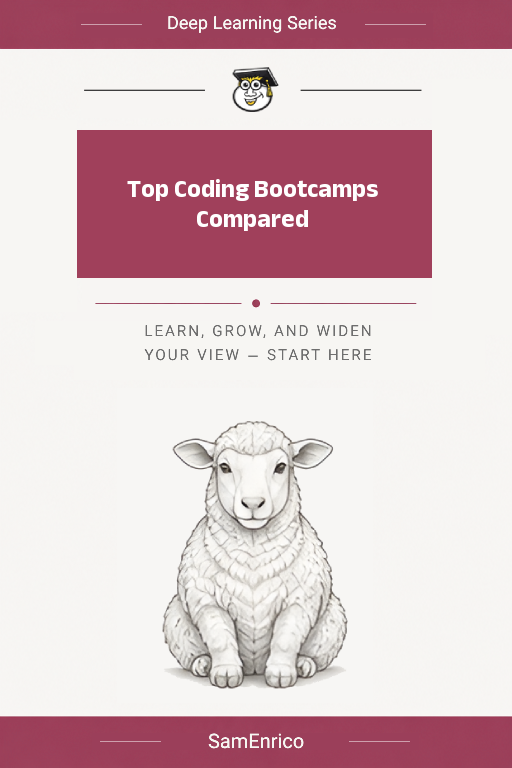
Top Coding Bootcamps Compared eBook
Compare Le Wagon General Assembly and App Academy
by Wilde Pa
Compare Le Wagon General Assembly and App Academy across curriculum price and job guarantees for global students.
Formats
Free sample
Chapter 1: The Million-Dollar Lie--–- Maria was crying on Zoom, and I didn’t know how to help her. Thirty-four years old, a former high school biology teacher from São Paulo, she had done everything right. She had researched coding bootcamps for six months. She had read every Switch Up review, watched every “day in the life” You Tube video, and taken four different free coding tutorials to confirm she liked the work. She had scraped together 16,000fromsavingsandasmallloan.Shehadbeenacceptedintoareputablebootcamp—oneofthetoptenrankednationally.Shehadgraduatedatthetopofherclass,withaperfectattendancerecordandaportfoliothatincludedthreefull−stackapplications.Andnow,elevenmonthslater,shewasworkingtheopeningshiftatacoffeeshopin Dublin,Ireland,sharingathree−bedroomapartmentwithsevenotherpeople,andcryingonavideocallbecauseherstudentloanpaymentwasdueinthreedaysandshehad16,000 from savings and a small loan.
She had been accepted into a reputable bootcamp—one of the top ten ranked nationally. She had graduated at the top of her class, with a perfect attendance record and a portfolio that included three full-stack applications. And now, eleven months later, she was working the opening shift at a coffee shop in Dublin, Ireland, sharing a three-bedroom apartment with seven other people, and crying on a video call because her student loan payment was due in three days and she had 16,000fromsavingsandasmallloan.Shehadbeenacceptedintoareputablebootcamp—oneofthetoptenrankednationally.Shehadgraduatedatthetopofherclass,withaperfectattendancerecordandaportfoliothatincludedthreefull−stackapplications.Andnow,elevenmonthslater,shewasworkingtheopeningshiftatacoffeeshopin Dublin,Ireland,sharingathree−bedroomapartmentwithsevenotherpeople,andcryingonavideocallbecauseherstudentloanpaymentwasdueinthreedaysandshehad140 in her checking account."Tell me what happened," I said.She wiped her eyes with the back of her hand. "I did everything they told me to do. I updated my Linked In.
I went to all the career coaching sessions. I applied to six hundred jobs. Six hundred. I got twelve first-round interviews. Four technical screens.
Zero offers. And now I'm making coffee for people who have the jobs I was supposed to get."I had heard this story before. In fact, I had heard variations of it more than two hundred times over the previous eighteen months. But Maria’s story was different in one crucial way: she had chosen her bootcamp specifically because of its advertised job placement rate. The number had been prominently displayed on the school’s website: 93% of graduates employed within six months.
It was bold, italicized, and placed inside a green bubble that screamed "JOBS." She had believed it. Why wouldn't she? The school had been featured in Forbes. It had thousands of five-star reviews. Its alumni worked at Google and Microsoft and Amazon.
And yet here she was, crying into her laptop, wondering if she had made the worst financial decision of her life.I asked her the question I have now asked hundreds of times: "Did you check the fine print on that 93%?"She looked confused. "What fine print? It was on their homepage."The Great Disconnect: What Bootcamps Promise vs. What They Deliver Let me pause Maria’s story for a moment—we will return to her—because before we can compare any bootcamp, before we can talk about curriculum or price or job guarantees, we need to address the fundamental question that every single prospective student gets wrong: Is a coding bootcamp even the right move for you?The coding bootcamp industry generated approximately $400 million in revenue in 2024, serving more than 35,000 students worldwide. That number has grown every year since 2015, with the single exception of the COVID-19 pandemic.
Tens of thousands of people—career changers, recent college graduates, underemployed workers, stay-at-home parents, and burnt-out teachers like Maria—have poured their savings, their time, and their hope into the promise that twelve to sixteen weeks of intense training can transform them into software engineers earning six-figure salaries.And for some people, that promise comes true. Absolutely, unequivocally, true.But for many others—and the industry does not want you to know this number—the promise does not come true. The most reliable independent data, drawn from sources like Course Report and the US Department of Education’s gainful employment statistics, suggests that between 40% and 60% of coding bootcamp graduates do not land a full-time, in-field job within twelve months of graduation. That is not a typo. Depending on which study you trust, somewhere between two out of five and three out of five graduates end up like Maria: underemployed, over-indebted, and wondering where they went wrong.The problem is not that coding bootcamps are scams.
Most of them are not. The problem is that coding bootcamps and prospective students operate under completely different definitions of success.Here is what the bootcamp defines as success: collecting your tuition, delivering the curriculum, and helping you update your Linked In profile. If you then happen to find a job, that is counted in their placement statistics. If you do not find a job, or if you find a job as a barista, the bootcamp has already spent your money on rent and instructor salaries and Facebook ads. Their incentive structure ends on graduation day.Here is what you define as success: a stable career in technology with a salary that justifies the time and money you invested.These two definitions are not aligned.
And until you understand that disconnect, you are not ready to choose between Le Wagon, General Assembly, and App Academy—or any other bootcamp, for that matter.The Four-Year Degree Fantasy Before we go further, let me address the elephant in the room. Some of you reading this are considering a coding bootcamp because you believe the traditional four-year computer science degree is a broken, outdated, overpriced relic of a bygone era. You have read the stories about college graduates with 100,000indebtandnojobprospects.Youhaveheardthattechcompaniescaremoreaboutportfoliosthanpedigrees.Youhaveseenthetweetsfromdeveloperswhoneverfinishedcollegeandnowmake100,000 in debt and no job prospects. You have heard that tech companies care more about portfolios than pedigrees. You have seen the tweets from developers who never finished college and now make 100,000indebtandnojobprospects.Youhaveheardthattechcompaniescaremoreaboutportfoliosthanpedigrees.Youhaveseenthetweetsfromdeveloperswhoneverfinishedcollegeandnowmake300,000 at Stripe.You are not entirely wrong.
But you are not entirely right, either.The traditional computer science degree has real problems. The curriculum is often years behind industry practice. Many professors have never worked outside academia. Students spend semesters learning theoretical concepts—big O notation, discrete mathematics, compiler design—that have limited application in most entry-level web development jobs. Meanwhile, they graduate without ever using Git, deploying to AWS, or writing a single line of code in React, the library that powers half the modern web.This gap between academic computer science and practical software engineering is what created the market for coding bootcamps in the first place.
Employers wanted graduates who could contribute on day one. Universities were producing graduates who needed six months of on-the-job training. The bootcamp industry stepped into that gap, promising to teach exactly what employers wanted, exactly when they wanted it, in exactly the amount of time a motivated adult could afford.But here is what the anti-degree crowd does not tell you: computer science graduates still have better long-term outcomes than bootcamp graduates, on almost every measurable metric. According to data from the US Bureau of Labor Statistics and the National Association of Colleges and Employers, the median starting salary for computer science graduates is approximately 75,000,slightlylowerthanthemedianstartingsalaryforbootcampgraduateswhofindjobs.However,theunemploymentrateforcomputersciencegraduatesissignificantlylower(around375,000, slightly lower than the median starting salary for bootcamp graduates who find jobs. However, the unemployment rate for computer science graduates is significantly lower (around 3% vs.
10-15% for bootcamp graduates), and the salary growth trajectory is steeper. Five years into their careers, CS degree holders out-earn bootcamp graduates by an…
This is the end of the free sample. Get the eBook to keep going. Buy now
About this book
Details
- Author
- Wilde Pa
- Publisher
- SamEnrico
- Language
- English
- Genre
- Non-Fiction, Student's Shortcut, Bootcamp Comparison, Program Guide
- Released
- 2026-05-28
- Pages (approx.)
- 144
- Available as
- eBook, Audiobook

Read better in the ZLOADR app
Your eBooks on your phone or tablet. Sign in with your SamEnrico account and start reading.
More by Wilde Pa
 The Levush TailorWilde Pa$11.99
 Exercise Selection for HGH BoostWilde Pa$11.99
 Hostage Art TherapyWilde Pa$11.99
 The Stay At Home Parent ResilienceWilde Pa$11.99
 Sex Addicts Anonymous Step GuideWilde Pa$11.99
 Chromatic Uprising: The Day the World Turned PinkWilde Pa$11.99
 The Forgotten Eruption: The Medieval Explorers Who Unlocked the Secrets of CotopaxiWilde Pa$11.99
 Engineering TechnicianWilde Pa$11.99
 Understanding Brachydactyly Type A2Wilde Pa$17.99
 10 Ways to Use Cocktail (Recipe Book)Wilde Pa$11.99
 Voice Commerce 2026-2030 ForecastWilde Pa$12.99