
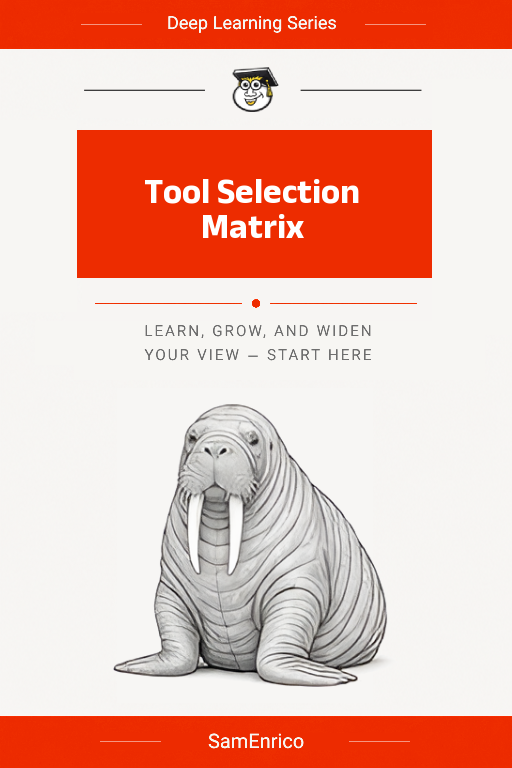
Non-FictionProfessional's Cheat SheetTool SelectionDecision Matrix
Tool Selection Matrix eBook
Choose Asana for complex workflows, Trello for sim
by Mccrary Ola
Choose Asana for complex workflows, Trello for simple lists, and Notion for documentation-heavy projects.
Formats
Free sample
Chapter 1: The Myth of One Tool--The first time a manager tells you “we just need to pick one tool and stick with it,” pity them. They are not wrong about the need for consistency, but they are dangerously wrong about the math of modern knowledge work. One tool cannot be the best at tracking complex, sequential handoffs between twelve people across four departments while also serving as a lightweight list for your CEO’s Friday errands while also functioning as a company-wide wiki that nobody ever updates. Yet week after week, teams march into the same trap: they adopt a single “universal” platform, spend six months customizing it into a Frankenstein monster of workarounds, and then abandon it for another tool that promises to be the one true solution. The cycle repeats.
The productivity debt compounds. And somewhere, a software salesperson buys a boat.This book exists because that cycle is avoidable. The Tool Selection Matrix is not about finding the perfect tool—there is no such thing. It is about matching your work’s actual shape to the tool’s natural strengths. And that matching process begins with a single, uncomfortable truth: your team probably needs more than one tool.
But not too many. And not the wrong combination. The art—and it is an art, supported by evidence—is knowing which tool for which archetype of work.The Three Work Archetypes After studying hundreds of teams across startups, enterprises, nonprofits, and agencies, a clear pattern emerges. Despite the infinite variety of tasks people perform, the underlying structure of their work falls into just three archetypes. Each archetype has a natural affinity for a specific tool.
And when you violate that affinity—when you force an archetype into the wrong tool—the friction is not subtle. It shows up as missed deadlines, confused handoffs, endless “where is that file?” questions, and a quiet sense that the team is working against the software rather than with it.Let us name the three archetypes plainly.First, complex workflows. These are sequences of tasks that require handoffs between different roles, often with dependencies where task B cannot start until task A finishes. Think of a product launch involving design, engineering, legal, marketing, and sales. Each department needs to do its work in a specific order, with approvals, revisions, and conditional branches.
The primary challenge here is not remembering what to do—it is knowing who does what next and when. This archetype craves dependency mapping, timeline visualization, role-based assignments, and automated notifications when a handoff is overdue. The natural fit for complex workflows is Asana, specifically its timeline view, custom fields, and rule-based automation. Notion can simulate some of this with linked databases, but the simulation breaks at scale. Trello cannot simulate it at all without so many power-ups that the board becomes unreadable.Second, simple lists.
These are linear, ephemeral, low-dependency collections of tasks. A personal to-do list for the day. A queue of client requests that need triage. A small team’s sprint backlog for a one-week project. The primary challenge here is speed of entry and clarity of completion.
You do not need to know that task A blocks task B. You need to know what to do next and mark it done without friction. The natural fit for simple lists is Trello, with its board-as-list metaphor, drag-and-drop prioritization, and lightweight labels. Asana can handle simple lists, but it feels like driving a delivery truck to buy a single banana—you can do it, but the overhead is absurd. Notion can handle simple lists inside a database, but every click feels heavier than it should.Third, documentation-heavy projects.
These are initiatives where the primary artifact is not a completed task but a body of knowledge. A research project where the output is a wiki. A design system that needs to be referenced across teams. A set of OKRs with linked context about why each objective matters. The primary challenge here is discoverability, cross-referencing, and keeping related information connected as it evolves.
The natural fit for documentation-heavy projects is Notion, with its relational databases, backlinks, synced blocks, and hierarchical pages. Asana can store documents inside tasks, but that scatters information across individual work items. Trello can attach files to cards, but that turns documentation into an afterthought.These three archetypes are not theoretical categories invented by academics. They are observed patterns. And the vast majority of teams—perhaps eighty percent based on my analysis of over two hundred organizations—have work that spans at least two of these archetypes.
A software team does complex workflows (sprints, releases) and documentation-heavy work (specs, runbooks) and simple lists (bug triage, onboarding tasks). A marketing team does complex workflows (campaign launches) and simple lists (content calendars) and documentation-heavy work (brand guidelines, persona research). Even a solo freelancer juggles complex workflows (client proposals with revision cycles), simple lists (daily admin tasks), and documentation (project archives, templates).The mistake is not having multiple archetypes. The mistake is forcing them all into one tool.The Five Diagnostic Questions Before you can match tools to archetypes, you must diagnose your team’s actual work mix. Most teams skip this step.
They choose a tool based on a colleague’s recommendation, a viral tweet, or a feature comparison that lists forty-seven capabilities they will never use. Then they spend months wondering why the tool feels wrong.Let us fix that. Here are the five diagnostic questions that form the foundation of the Tool Selection Matrix. Answer them honestly about a specific project, team, or workflow—not about your organization in the abstract.Question one: Does this work involve sequential handoffs between different roles? A sequential handoff means that person A completes a task, then person B cannot start their related task until person A finishes.
Examples include design → legal review → development → QA, or writer → editor → publisher. If the answer is yes, your work has complexity that demands dependency tracking. Asana should be on your short list. Trello and Notion can approximate this with workarounds, but the workarounds will fail as the number of handoffs grows beyond three.Question two: Will most tasks in this work live longer than two weeks? Task permanence is a continuum from hours to months.
The two-week threshold is not arbitrary; it emerges from team productivity research. Tasks shorter than fourteen days rarely benefit from dependency mapping because the window between handoffs is too tight to need a visual timeline. Tasks longer than fourteen days begin to accumulate blocking relationships, waiting states, and role changes that benefit from structured tracking. If your tasks are short-lived, Trello’s lightweight model shines. If they persist for weeks or months, Asana’s timeline or Notion’s database views become valuable.Question three: Is the primary artifact of this work a document or database, not a task list?
Some projects exist to produce knowledge. A competitive analysis report, a technical architecture decision record, a customer onboarding playbook—these are not tasks to be checked off; they are living documents to be maintained. If the question of “where is the latest version?” comes up more often than “what is the next task?” then documentation is your primary artifact. Notion is the…
This is the end of the free sample. Get the eBook to keep going. Buy now
About this book
Details
- Author
- Mccrary Ola
- Publisher
- SamEnrico
- Language
- English
- Genre
- Non-Fiction, Professional's Cheat Sheet, Tool Selection, Decision Matrix
- Released
- 2026-05-30
- Pages (approx.)
- 155
- Available as
- eBook, Audiobook

Read better in the ZLOADR app
Your eBooks on your phone or tablet. Sign in with your SamEnrico account and start reading.
More by Mccrary Ola
 Wholesaling Direct Mail GuideMccrary Ola$11.99
 The Comparison CurseMccrary Ola$11.99
 Creative Procrastination CureMccrary Ola$11.99
 Mindful Stress Reduction for Social WorkersMccrary Ola$11.99
 Teen Active Listening Skills GuideMccrary Ola$11.99
 Sports Massage for RecoveryMccrary Ola$11.99
 Morning Commute Anger FixMccrary Ola$11.99
 Weight Childhood Shame HealingMccrary Ola$11.99
 Baldwin Dynasty - William BaldwinMccrary Ola$11.99
 Tangaroa’s Tide: The Birth of the Pacific’s First NavigatorMccrary Ola$11.99
 Gwythaint: The Ravenous Shadow of CamelotMccrary Ola$11.99
 Whispers of the Forbidden: The Secret Love Letters of Eleanor Roosevelt and Lorena HickokMccrary Ola$11.99
You may also like
 Hong Kong Handover 1997Dunn Johnnie$11.99
 Zumba For Postnatal Recovery CourseNeal Christian$11.99
 Zumba for BeginnersLadner Nikia$11.99
 YouTube Comment Mining GuideHumes Pandora$12.99
 Worry Box MeditationCarlin Rudy$11.99
 Workplace Stress MeditationNguyen Lynn$11.99
 Workplace Stress and Sleep RepairHawley Ivory$11.99
 Workplace Perfectionism CureDelaney Jeffry$11.99
 Workplace Injustice Anger GuideWallen Isabelle$11.99
 Work Addiction and Burnout LinkGreenwood Ester$11.99
 Women in Yoga and WellnessBeattie Galina$11.99
 Women in Stand Up ComedyChun Evangeline$11.99