
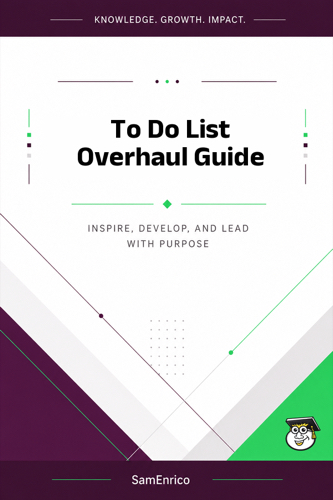
To Do List Overhaul Guide eBook
Transform endless lists into prioritized action us
Transform endless lists into prioritized action using both methods together.
Formats
Free sample
Chapter 1: The 117-Item Confession--–- I once had a to-do list with one hundred and seventeen items on it.I know the exact number because I printed it out. It took four pages. I carried it in a leather notebook like a holy text, believing that the sheer weight of the paper proved I was a serious person. Every morning, I added five to seven new tasks. Every night, I crossed off two or three.
After six months of this ritual, the list had grown to two hundred and three items. I hadn't finished a single important project. I had simply perfected the art of being busy while standing perfectly still.This is not a confession of laziness. I was exhausted. I worked ten-hour days, answered emails before breakfast, and rarely took a lunch break.
My calendar was a mosaic of colored blocks. Yet at the end of each week, when I asked myself, "What did I actually accomplish that matters?" the answer was often a hollow silence. I had done many things. I had finished almost nothing of consequence.The problem was not my work ethic. The problem was my list.If you are reading this book, I suspect you know exactly what I am talking about.
You have a list somewhere—maybe in an app, maybe on a yellow legal pad, maybe scattered across sticky notes on your monitor. That list has become a source of low-grade dread rather than a tool for action. You add to it faster than you subtract from it. You feel a small spike of anxiety every time you look at it. And deep down, you have begun to suspect that the list is not helping you at all.
It is lying to you. It is telling you that you are behind, that you are failing, that you will never catch up.This chapter exists to give you permission to stop believing that lie.The Infinite Scroll of Obligation Let me name the enemy, because a best-selling book needs a villain, and your villain has a name: The Infinite Scroll of Obligation.Here is how it works. Every time you say "yes" to a task, every time you write down a reminder, every time someone asks you for "just a minute" of your time, you add a line to an invisible scroll. That scroll has no bottom. It has no end.
It grows whether you work or sleep. And because the scroll is infinite, you will never, ever reach the bottom of it. The very act of trying creates anxiety, because your brain knows—even if you won't admit it—that you are fighting an unwinnable war.Most productivity advice pretends this isn't true. It tells you to "work smarter," "prioritize better," or "optimize your workflow." These are not solutions. These are coping mechanisms.
They are rearranging deck chairs on a ship that is structurally incapable of reaching shore. You cannot optimize your way out of infinity.I want you to sit with that for a moment. Really feel it. You will never finish your to-do list. Not because you are lazy, not because you are disorganized, not because you haven't found the right app.
You will never finish your to-do list because the list is designed to be unfinishable. Every time you cross something off, two more appear. That is not a bug. That is the feature of a system that has no natural limits.The only way to win is to stop playing the game entirely. Not by abandoning your responsibilities, but by radically changing the rules of how you engage with them.Finite vs.
Infinite: The Philosophical Shift Oliver Burkeman, in his remarkable book Four Thousand Weeks, introduces a distinction that will serve as the foundation for everything that follows. He distinguishes between finite games and infinite games.A finite game has clear rules, defined players, and a specific endpoint. Chess is a finite game. So is a football match. So is baking a cake.
You know when you have won, and you know when you are done.An infinite game has no finish line. The goal is not to win, because winning is impossible. The goal is to continue playing. Raising a child is an infinite game. So is maintaining a marriage.
So is staying healthy. So is your career. You never "finish" these things. You simply show up, do your best, and accept that you will die with them still in progress.Here is the disaster that most people walk into: they treat infinite games as if they were finite. They put "get fit" on their to-do list as if it were a task that can be completed and crossed off.
They treat "build my career" as a project with a delivery date. They manage their relationships as if "quality time" were a checkbox. This is a category error, and it is the source of nearly every to-do list crisis.Your to-do list is currently a landfill of infinite games masquerading as finite tasks. You have written down things that cannot be finished, and then you feel like a failure when they remain unfinished. That is not a personal failing.
That is a logical impossibility dressed up as productivity advice.The overhaul mindset begins with a single, brutal recognition: You will never do it all. Not because you are inadequate, but because "it all" does not exist. "It all" is a fantasy. The universe will continue generating tasks faster than you can complete them until the day you die. This is not pessimism.
This is the basic arithmetic of existence.Strategic Underachievement: The Permission Slip You Have Been Waiting For If you cannot do it all, then the only rational response is to deliberately choose what you will NOT do. I call this Strategic Underachievement.Let me be very clear about what this is not. Strategic Underachievement is not laziness. It is not procrastination. It is not "quiet quitting" or giving up.
Strategic Underachievement is the active, intentional, ruthless selection of a small number of things that matter most, combined with the conscious abandonment of everything else. It is the opposite of passive failure. It is aggressive prioritization dressed in uncomfortable clothing.Most people fail because they try to do everything. They spread their attention across twenty tasks, complete none of them well, and end each day feeling vaguely disappointed. Strategic Underachievement says: do three things excellently and let seventeen things slide.
The seventeen things might be important. They might even be urgent. But they are not as important as the three, and you have decided—consciously, bravely—to accept the consequences of leaving them undone.This requires courage. It requires saying "no" to people who are used to hearing "yes." It requires looking at a task that is perfectly reasonable and saying, "I am choosing not to do that today, and I am at peace with that choice."I want to give you a permission slip right now, at the beginning of this book, before we get into any methods or systems. Here it is:Permission Slip #1: *I am allowed to leave things undone.
I am allowed to disappoint people who expect too much of me. I am allowed to close my to-do list…
This is the end of the free sample. Get the eBook to keep going. Buy now
About this book
Details
- Author
- German Bernetta
- Publisher
- SamEnrico
- Language
- English
- Genre
- Non-Fiction, Self-Help, Task Management
- Released
- 2026-06-12
- Pages (approx.)
- 143
- Available as
- eBook, Audiobook

Read better in the ZLOADR app
Your eBooks on your phone or tablet. Sign in with your SamEnrico account and start reading.
More by German Bernetta
 Self Hypnosis for Creativity HabitsGerman Bernetta$11.99
 Parental Anger And Child LyingGerman Bernetta$11.99
 Emotional Flooding Recovery WorkbookGerman Bernetta$11.99
 Mindfulness for Chronic Pain NewbiesGerman Bernetta$11.99
 The Frozen Relics of the Arctic: Unlocking the Secrets of the Saqqaq Burial GroundsGerman Bernetta$11.99
 Silicon Shadows: How a Russian Troll Farm Hijacked American DemocracyGerman Bernetta$11.99
 Hazelnut HarvestingGerman Bernetta$11.99
 Nonprofit Payroll Tax GuideGerman Bernetta$12.99
 Community Safety ProtocolsGerman Bernetta$12.99
 How to Become a Jewel StakerGerman Bernetta$11.99
 Understanding Deafness Peripheral Neuropathy Arterial DiseaseGerman Bernetta$17.99
You may also like
 Multitasking Myth Recovery GuideJasper Faustino$11.99
 Task List Daily ReviewChristy Wilda$11.99
 Task Batching Time Management GuideMarquis Karan$11.99
 Remote Task Batching GuideEscamilla Amada$11.99
 ABCDE Method Task RankingFelton Viki$11.99
 ABCDE Method Priority SystemKowalski Shena$11.99
 Burnout Prevention Task RotationBranch Josette$11.99
 Task Batching Strategies CourseYamamoto Leann$11.99
 Interruption Proof To-Do List GuideBennett Ginger$11.99
 ABC Prioritization RulesGuillen Stevie$11.99
 Loci Method For To Do ListsMasters Elvera$11.99
 Microsoft To Do GuideFaber Tarra$11.99