
Non-FictionSelf-HelpSleep Health
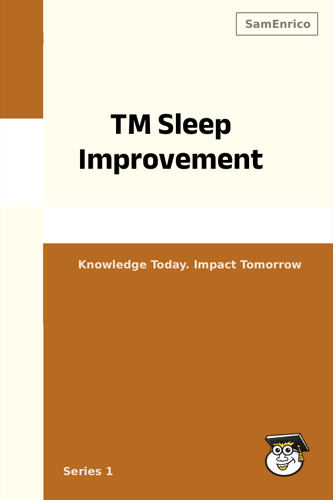
TM Sleep Improvement eBook
Practice TM before bed to quiet racing thoughts an
Practice TM before bed to quiet racing thoughts and improve sleep quality.
Formats
Free sample
Chapter 1: The 3 AM Prison...--It’s 3:14 AM. You’ve been lying here for forty-seven minutes—not that you’re counting, except that you are, obsessively. Your body is heavy, weighted down as if poured into the mattress. Your jaw is clenched so tightly that your teeth ache. And your brain?
Your brain is playing a highlight reel of every mistake you made in 2007, followed by a detailed financial projection of what will happen if you don’t fall asleep in the next twenty-two minutes, followed by the opening lyrics of a song you haven’t heard in a decade. You have no idea why that song is there. You only know that it will loop for the next hour.This is not tiredness. This is a hostage situation.Welcome to the 3 AM prison. The walls are made of racing thoughts.
The bars are forged from cortisol and adrenaline. The warden is your own exhausted, overworked, desperately trying-to-help brain. And the worst part? You’ve been told your whole life that the solution is simple: just relax. Just let go.
Just stop thinking.If you’ve ever wanted to scream at someone who told you to “just relax,” you are not alone. And more importantly, you are not broken.Meet Sarah: A Portrait of the War Inside Let me introduce you to Sarah. She is forty-two years old, a marketing director at a mid-sized firm, mother of two children under ten, and the primary caregiver for her aging mother who lives thirty minutes away. Sarah is competent, capable, and completely exhausted—but not in the way you might think.Sarah can run on four hours of sleep. She’s done it for years.
She can power through back-to-back meetings, drive carpool, negotiate with vendors, and still make it to her mother’s physical therapy appointment. Her body knows how to keep moving. But here’s what her body cannot do: shut up at night.Last week, Sarah lay awake from 1:30 AM until her alarm went off at 6:15 AM. During those four hours and forty-five minutes, she mentally rehearsed a presentation she’d already given (and received praise for), recalculated her mortgage payment three times, composed an email she will never send to her sister, and worried about a mole on her shoulder that she’s had for fifteen years. At 4:00 AM, she got up and ate a spoonful of peanut butter.
At 5:00 AM, she cried silently so she wouldn’t wake her husband. At 6:15 AM, she got up and did it all again.Sarah has tried everything. Melatonin worked for exactly two weeks, then stopped. CBD gummies cost her eighty dollars a month and didn’t touch the racing thoughts. Counting sheep felt insulting.
Sleep podcasts—the ones with the soothing British voices describing rain on a windowpane—worked until they didn’t, and now she can’t listen to rain sounds without feeling a flash of rage. She’s tried weighted blankets (too hot), white noise machines (too robotic), and the “military method” of falling asleep in two minutes (too humiliating when it failed for the thirtieth time).Sarah doesn’t have a sleep problem. Sarah has a mind that doesn’t have an off switch. And that, right there, is what this book is actually about.The Hidden Epidemic: Why Tiredness Isn't the Real Problem Here is a statistic you’ve probably heard: over thirty percent of adults suffer from chronic insomnia. The World Health Organization estimates that sleep deprivation costs the global economy hundreds of billions of dollars annually in lost productivity, healthcare costs, and workplace accidents.
In the United States alone, the CDC has declared insufficient sleep a public health epidemic.Here is a statistic you probably haven’t heard: among people who report chronic insomnia, the single most common complaint is not physical pain, not environmental noise, not even medical conditions. It is racing thoughts at bedtime. When researchers ask insomniacs what keeps them awake, the answer overwhelmingly is: “I can’t turn my brain off.”Let that land for a moment.You are not struggling with a mattress problem. You are not struggling with a caffeine problem (though that doesn’t help). You are not struggling with a willpower problem or a discipline problem or a “you just need to try harder” problem.
You are struggling with a brain that has forgotten how to settle. And that is a very different kind of problem—one that requires a very different kind of solution.The distinction at the heart of this book is simple but profound: physical tiredness is not the same as mental fatigue.Physical tiredness is what you feel after a long run, a day of moving furniture, or a shift on your feet. Your muscles are heavy. Your eyelids droop. Given half a chance, you will fall asleep on a park bench.
Physical tiredness is solved by physical rest—lying down, closing your eyes, letting your body recover.Mental fatigue is different. Mental fatigue is what you feel after a day of hard thinking, emotional labor, difficult conversations, financial worry, or social anxiety. Your body may be perfectly rested—you might have spent the entire day sitting at a desk—but your mind is churning. Mental fatigue is not solved by lying down. In fact, lying down often makes it worse, because you have removed all external stimulation and handed the microphone to your own thoughts.You can be exhausted in your body yet wide awake in your mind.
That is not a paradox. That is the signature symptom of our time.Why "Try Harder" Is the Worst Advice for Sleep Let me tell you about a study that changed how I think about insomnia. Researchers at the University of Glasgow divided poor sleepers into two groups. The first group was told to “try to fall asleep” using whatever techniques they knew. The second group was told to “stay awake as long as possible” while lying in bed with their eyes closed.You can probably guess what happened.
The group that tried to fall asleep took longer to fall asleep. The group that tried to stay awake fell asleep faster.This is what psychologists call the paradox of effortful control. When you try to fall asleep, you activate the same prefrontal brain networks that you use to solve math problems, write emails, and make decisions. You are literally thinking about thinking. And thinking about thinking is the opposite of sleep.
Sleep requires the quieting of those networks. Trying requires their activation. You cannot do both at the same time.Here is the cruel irony: the more you care about sleep, the worse your sleep gets. The more you track your hours, calculate your remaining time, and strategize about how to fall back asleep after a midnight waking, the more you activate the very systems that keep you awake. Insomnia is one of the only medical conditions where effort makes the problem worse.Try to relax, and you create tension.
Try to let go, and you grip tighter. Try to stop thinking, and you think about stopping thinking. The instruction “just relax” is not helpful. It is actually harmful, because it implies that you…
This is the end of the free sample. Get the eBook to keep going. Buy now
About this book
Details
- Author
- Slattery Shawnee
- Publisher
- SamEnrico
- Language
- English
- Genre
- Non-Fiction, Self-Help, Sleep Health
- Released
- 2026-06-09
- Pages (approx.)
- 140
- Available as
- eBook, Audiobook

Read better in the ZLOADR app
Your eBooks on your phone or tablet. Sign in with your SamEnrico account and start reading.
More by Slattery Shawnee
 Social Comparison and Self DoubtSlattery Shawnee$11.99
 Async PR and Media Relations GuideSlattery Shawnee$11.99
 Probuphine Implant MAT GuideSlattery Shawnee$11.99
 Cultural Emotional IntelligenceSlattery Shawnee$11.99
 The Dot-Com Bubble: When Billions Burst OvernightSlattery Shawnee$11.99
 The Dyatlov Pass: The Frozen WhisperSlattery Shawnee$11.99
 Understanding Cramp Fasciculation SyndromeSlattery Shawnee$17.99
 How to Start a Breakfast Cereal (cooked) Business (Beginners Guide)Slattery Shawnee$11.99
 WhatsApp Broadcast Free GuideSlattery Shawnee$12.99
 Right To Audit Operating CostsSlattery Shawnee$12.99
 Ebène Marbre HarvestingSlattery Shawnee$11.99
You may also like
 Hong Kong Handover 1997Dunn Johnnie$11.99
 Zumba For Postnatal Recovery CourseNeal Christian$11.99
 Zumba for BeginnersLadner Nikia$11.99
 YouTube Comment Mining GuideHumes Pandora$12.99
 Worry Box MeditationCarlin Rudy$11.99
 Workplace Stress MeditationNguyen Lynn$11.99
 Workplace Stress and Sleep RepairHawley Ivory$11.99
 Workplace Perfectionism CureDelaney Jeffry$11.99
 Workplace Injustice Anger GuideWallen Isabelle$11.99
 Work Addiction and Burnout LinkGreenwood Ester$11.99
 Women in Yoga and WellnessBeattie Galina$11.99
 Women in Stand Up ComedyChun Evangeline$11.99