
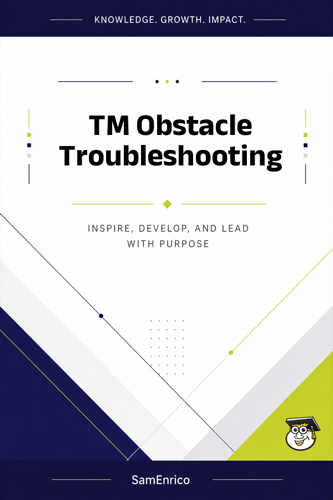
Non-FictionSelf-HelpProblem Solving
TM Obstacle Troubleshooting eBook
Address common obstacles like sleepiness, boredom,
by Rubio Carly
Address common obstacles like sleepiness, boredom, or doubt.
Formats
Free sample
Chapter 1: The Effortlessness Paradox–– You paid for effortlessness. You were told, explicitly, that Transcendental Meditation requires “no concentration, no control, and no effort.” The brochures promised a technique so natural that a ten-year-old could do it correctly on the first try. The teacher assured you that “thinking the mantra is effortless” and that “there is no such thing as a bad meditation.” So why, after two weeks of twice-daily practice, do you feel exhausted, irritable, and mentally chaotic? Why does your mind race faster than before you closed your eyes? Why does your body twitch, your back ache, and your eyelids droop with a fatigue that feels heavier than any sleep debt you have ever known?
And most painfully: why does this “effortless” practice feel like hard work?If you have asked yourself any of these questions, you have already taken the first step toward mastery. The fact that you are aware of a gap between the promise and your experience is not a sign of failure. It is a sign of honesty. And honesty is the only prerequisite for troubleshooting.This chapter exists to resolve the central paradox of TM: the Effortlessness Paradox. The paradox states: The technique is effortless, but the practice of the technique requires intelligent action.
These two statements appear contradictory only if we mistake “effortless” for “passive” or “automatic.” They are harmonious once we understand the difference between striving and adjusting, between fighting your experience and creating the conditions for ease.Let us be clear from the outset: you will never, in a lifetime of meditation, need to strain, clench, concentrate, or force your mind into silence. That is the genuine meaning of effortless. However, you may need to adjust your posture, change your meditation time, learn to distinguish healing from harm, and understand the physiology of your own nervous system. These are not violations of effortlessness. They are the intelligent scaffolding that allows effortlessness to emerge.Think of it this way: a river flows effortlessly downhill.
No one would say the river is “trying.” But if a beaver builds a dam, the river does not flow. Removing the dam is not a violation of the river’s nature—it is the restoration of the river’s conditions. In the same way, your nervous system has built dams: habits of tension, stored fatigue, suppressed trauma, and the deeply ingrained reflex of “checking” your own performance. Removing those dams is not effort. It is housekeeping.This chapter introduces three foundational concepts that will govern every troubleshooting tool in this book: unstressing, the checking reflex, and the critical distinction between healing crises and adverse effects.
By the end of this chapter, you will understand not only why effortless feels like work, but also how to use that very feeling as a diagnostic compass.The Unstressing Mechanism: Why the Mud Rises When You Stop Stirring The single most important scientific concept for the troubled meditator is unstressing. The term was popularized by Dr. Harold Bloomfield in his 1975 bestseller Discovering Inner Energy and Overcoming Stress, and it has been validated by decades of psychophysiological research. Unstressing refers to a specific neurological process: when the body enters a state of deep rest—what TM calls “transcending”—the autonomic nervous system begins to reverse the effects of chronic stress. Muscle groups that have been unconsciously clenched for years suddenly release.
Emotional memories that have been suppressed by cortical inhibition rise to the surface. Metabolic byproducts of fatigue that were never fully cleared during shallow sleep are now flushed into the bloodstream.In plain language: unstressing is the garbage truck arriving to take out the trash. And garbage trucks are loud, smelly, and disruptive.The pond metaphor is useful here, though we must refine it to avoid a common misunderstanding. Imagine a pond that has been stirred by a motor for twenty years. The water is cloudy with suspended mud, but you have forgotten there was ever a time when it was clear.
Now, you turn off the motor. What happens? The mud does not vanish instantly. It rises, swirls, and then slowly—very slowly—begins to settle. During the settling process, the water looks more muddy, not less.
A casual observer might think, “This is worse than before.” But the observer would be wrong. The mud is not increasing. It is simply becoming visible as the stirring stops.Your nervous system is that pond. The “stirring” is the endless churn of modern life: caffeine, deadlines, notifications, relationship conflicts, financial worry, and the low-grade hypervigilance that has become normal. When you sit to meditate, you turn off the motor for twenty minutes.
Immediately, the mud rises. You feel fatigue—not because meditation creates fatigue, but because your body finally has permission to feel the fatigue that was already there. You feel anxiety—not because meditation creates anxiety, but because the cortical brakes that suppressed the anxiety have been released. You feel physical twitches, itches, and heat—not because something is wrong, but because neuromuscular tension is exiting your body in measurable bursts.This is unstressing. And it is not only normal.
It is necessary.However—and this is a critical “however” that will save you years of confusion—not every unpleasant experience during meditation is unstressing. Some experiences are adverse effects. The difference is not in the content of the experience (anxiety, fatigue, and tears can be either) but in its trajectory and functionality. Unstressing is temporary, tolerable, and resolves within the meditation session or shortly thereafter. It leaves you feeling lighter, even if the session itself was difficult.
An adverse effect, by contrast, persists for hours or days, worsens over time, and impairs your ability to function at work or in relationships.Here is the rule you will use for the rest of this book: If a symptom appears during meditation and fades within thirty minutes after, it is likely unstressing. If it persists beyond one day, or if it includes suicidal ideation, self-harm urges, or psychosis, it is an adverse effect requiring immediate cessation of meditation and professional consultation. This distinction will be repeated, refined, and applied to specific obstacles in Chapters 6, 8, and 11. For now, simply hold it as a compass.The Checking Reflex: The Only True Mistake If unstressing is the mechanism of healing, the checking reflex is the mechanism of suffering. The checking reflex is the internal voice that asks, “Am I doing this right?” It is the mental gesture of leaning over your own shoulder to inspect your performance.
It is the impulse to measure, judge, categorize, and compare your current meditation against an idealized standard.Here is the devastating truth: the checking reflex is the only effort that can sabotage TM. Everything else—thoughts, emotions, physical sensations, even falling asleep—is either unstressing or neutral background noise. But the moment you ask, “Is this working?” you have introduced a subtle but powerful contraction. You have stepped out of the experience and into a commentary about the experience. You have stopped meditating and started administering a test.The checking reflex is insidious because it wears the mask of self-improvement.
“Surely,” you think, “I should know if I am making progress.” “Surely,” you think, “it is responsible to monitor my…
This is the end of the free sample. Get the eBook to keep going. Buy now
About this book
Details
- Author
- Rubio Carly
- Publisher
- SamEnrico
- Language
- English
- Genre
- Non-Fiction, Self-Help, Problem Solving
- Released
- 2026-06-08
- Pages (approx.)
- 147
- Available as
- eBook, Audiobook

Read better in the ZLOADR app
Your eBooks on your phone or tablet. Sign in with your SamEnrico account and start reading.
More by Rubio Carly
 Vegan Infant And Toddler Nutrition HandbookRubio Carly$11.99
 Resentment in Caregiving HandbookRubio Carly$11.99
 The Runner Stretch RoutineRubio Carly$11.99
 Imposter Syndrome and the Dunning Kruger EffectRubio Carly$11.99
 The Puppet Master: How a Child Prodigy Became a Notorious Con ArtistRubio Carly$11.99
 Lost Worlds of New Guinea: The Forgotten Expeditions of Richard ArchboldRubio Carly$11.99
 Plant Production ManagerRubio Carly$11.99
 How to Start a Cartridge Case Business (Beginners Guide)Rubio Carly$11.99
 Design Patent Fees GuideRubio Carly$12.99
 UN Language Competitive ExamRubio Carly$12.99
 Understanding Crest Syndrome (Calcinosis Raynaud's Esophagus Sclerodactyly Telangiectasia)Rubio Carly$17.99
You may also like
 Hong Kong Handover 1997Dunn Johnnie$11.99
 Zumba For Postnatal Recovery CourseNeal Christian$11.99
 Zumba for BeginnersLadner Nikia$11.99
 YouTube Comment Mining GuideHumes Pandora$12.99
 Worry Box MeditationCarlin Rudy$11.99
 Workplace Stress MeditationNguyen Lynn$11.99
 Workplace Stress and Sleep RepairHawley Ivory$11.99
 Workplace Perfectionism CureDelaney Jeffry$11.99
 Workplace Injustice Anger GuideWallen Isabelle$11.99
 Work Addiction and Burnout LinkGreenwood Ester$11.99
 Women in Yoga and WellnessBeattie Galina$11.99
 Women in Stand Up ComedyChun Evangeline$11.99