
Non-FictionSelf-HelpCorrections Rehabilitation
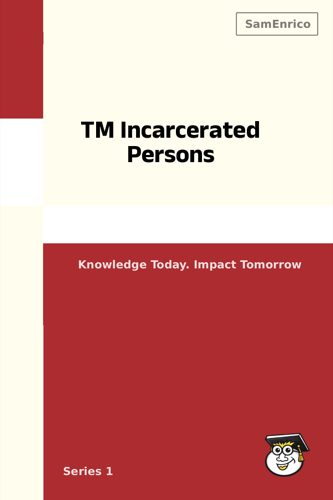
TM Incarcerated Persons eBook
Reduce recidivism and improve emotional regulation
Reduce recidivism and improve emotional regulation behind bars.
Formats
Free sample
Chapter 1: The Survivor’s Code...--–- You are not a monster. You are not a parasite. You are not a predator who woke up one morning and decided to destroy. You are, in almost every case that matters, a survivor—a person who learned a set of rules, reflexes, and responses in one world that became felonies in another. That is the central lie that the system wants you to believe: that your crimes reveal your essence.
They do not. They reveal your training. And what was trained can be retrained.This book is not here to make you feel good about what you did. It is not here to excuse, minimize, or romanticize harm. Harm is real.
Victims are real. The consequences of your actions are written in police reports, restraining orders, and the faces of people who no longer answer your letters. None of that disappears. But guilt without understanding is just self-destruction with better vocabulary. You cannot change what you refuse to examine.
And you cannot examine what you have been taught to call "evil nature" instead of "survival strategy."Let us begin with a question that most prisons never ask: What were you surviving?The Binary That Kills Change The criminal justice system, the media, and even many well-meaning reformers love a simple story. In that story, there are two kinds of people: victims and villains. Victims are innocent, helpless, and deserving of compassion. Villains are evil, calculating, and deserving of punishment. You have been placed firmly in the second category.
The system tells you that you are broken, that your choices came from a defective character, and that the only solution is to lock you away until you decide to be good.But this binary is a lie. And worse—it is a lie that guarantees recidivism.Because if you believe that you are inherently evil, you have two options. The first is to accept it and continue committing crimes because "that is who you are." The second is to live in permanent shame, white-knuckling your way through every day, waiting to fail because failure is what evil people do. Neither option produces lasting change. Neither option addresses the actual wiring beneath your actions.You are not a villain.
You are also not a victim in the way the system uses that word. You are something far more complex: a person who adapted to chaos.The Third Category: Survivor Let us define what we mean by "survivor" in this chapter. A survivor is someone who developed a set of behaviors, thought patterns, and emotional reflexes in response to chronic danger, deprivation, or trauma. Those behaviors worked in the environment where they were learned. They kept you alive.
They kept you fed. They kept you from being beaten, abandoned, or destroyed.Then you left that environment. Or that environment followed you into adulthood. And the behaviors that saved you became the behaviors that imprisoned you.Think of it this way: if you grow up in a house where the only way to get food is to take it before someone else does, stealing is not a moral failure. It is a solution to hunger.
If you grow up in a neighborhood where the only way to avoid being hurt is to strike first or project extreme violence, aggression is not a character flaw. It is a survival algorithm. If you grow up with adults who lie to you, betray you, or abandon you, lying and distrust are not pathologies. They are shields.The tragedy is not that you learned these things. The tragedy is that no one ever taught you a different set of skills for a different world.The Imprisoned Mind We call this collection of survival reflexes the "Imprisoned Mind." It is not a psychiatric diagnosis.
It is a description of a thinking pattern that many incarcerated people share, regardless of race, class, or the specific crime that brought them here.The Imprisoned Mind has five signature features:First, it over-perceives threat. Because you learned that danger could come from anywhere—a parent's mood, a peer's glance, a stranger on the corner—your brain now treats neutral events as potentially hostile. Someone looks at you wrong. A guard speaks to you with a tone you do not like. A loved one does not call when they said they would.
The Imprisoned Mind says: "This is an attack. Respond now."Second, it confuses hypervigilance with intelligence. You are proud of how well you read people. You can walk into a room and know who is dangerous, who is weak, and who is lying. This skill kept you alive.
But in a prison or on the outside, this same hypervigilance exhausts you, alienates you, and creates conflicts that did not need to exist. Not every glance is a threat. Not every silence is a betrayal.Third, it rejects vulnerability as death. In the environment where you learned to survive, showing weakness meant being eaten. Crying meant being mocked.
Asking for help meant being exploited. So you built walls. You armored yourself in anger, sarcasm, or silence. And those walls keep everyone out—including the help you actually need.Fourth, it collapses time. The Imprisoned Mind does not distinguish between past danger and present safety.
When a guard raises his voice, your brain does not think, "This is a frustrated employee." It thinks, "This is the uncle who beat you. This is the cop who arrested you. This is the pimp who owned you." You react to the past as if it is happening right now.Fifth, it confuses loyalty with lockstep. You learned that survival required a crew, a gang, a family that would ride or die. Anyone outside that circle is an enemy.
Anyone who questions the circle is a traitor. This binary thinking—us versus them, loyal versus disloyal—prevents you from forming the diverse, flexible relationships that actually support reentry.A Story of Two Worlds Let us make this concrete with a story. The details are anonymized, but the pattern is real. This is the story of someone we will call Marcus.Marcus grew up in a house where his father drank and his mother worked two jobs. By age seven, Marcus had learned that the safest place was outside, away from his father's unpredictable rages.
By age ten, he had learned that the older boys on the corner would protect him if he carried packages for them. By age fourteen, he had learned that showing fear meant getting jumped, that crying meant getting called a bitch, and that the police were not helpers but hunters.Marcus's survival code was simple: never back down, never snitch, never show weakness, always take what you need before someone takes it from you.That code kept him alive. It got him food when there was none. It gave him status when he had no other currency. It created a family when his biological family was broken.Then Marcus was arrested for armed robbery at nineteen.
He went to prison. And inside, the same code worked again—until it did not. He stabbed a man who disrespected him. He spent three years in solitary. He got out…
This is the end of the free sample. Get the eBook to keep going. Buy now
About this book
Details
- Author
- Sigler Lorean
- Publisher
- SamEnrico
- Language
- English
- Genre
- Non-Fiction, Self-Help, Corrections Rehabilitation
- Released
- 2026-06-09
- Pages (approx.)
- 138
- Available as
- eBook, Audiobook

Read better in the ZLOADR app
Your eBooks on your phone or tablet. Sign in with your SamEnrico account and start reading.
More by Sigler Lorean
 Imposter Syndrome and ProcrastinationSigler Lorean$11.99
 Async Usability Test Review CourseSigler Lorean$11.99
 EQ for Executive LeadershipSigler Lorean$11.99
 OUD and Pregnancy OutcomesSigler Lorean$11.99
 The Frozen Signal: How Ancient Arctic Tribes Mastered the Art of Long-Distance CommunicationSigler Lorean$11.99
 The Last Ride of the CycloneSigler Lorean$11.99
 Understanding Craniofacial Dysostosis Arthrogryposis Progeroid AppearanceSigler Lorean$17.99
 Emotional Distress Damages GuideSigler Lorean$12.99
 UN Young Professionals ProgramSigler Lorean$12.99
 How to Start a Preservation Society for Historic Houses Business (Beginners Guide)Sigler Lorean$11.99
 Forestry TechnicianSigler Lorean$11.99
You may also like
 Hong Kong Handover 1997Dunn Johnnie$11.99
 Zumba For Postnatal Recovery CourseNeal Christian$11.99
 Zumba for BeginnersLadner Nikia$11.99
 YouTube Comment Mining GuideHumes Pandora$12.99
 Worry Box MeditationCarlin Rudy$11.99
 Workplace Stress MeditationNguyen Lynn$11.99
 Workplace Stress and Sleep RepairHawley Ivory$11.99
 Workplace Perfectionism CureDelaney Jeffry$11.99
 Workplace Injustice Anger GuideWallen Isabelle$11.99
 Work Addiction and Burnout LinkGreenwood Ester$11.99
 Women in Yoga and WellnessBeattie Galina$11.99
 Women in Stand Up ComedyChun Evangeline$11.99