
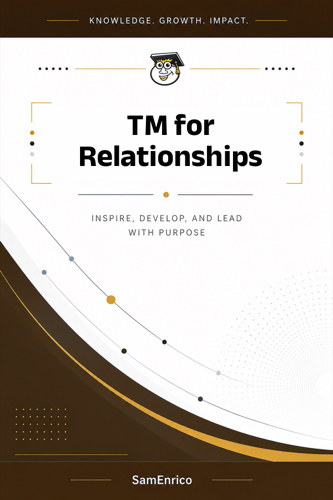
TM for Relationships eBook
Reduces reactivity and improves communication thro
Reduces reactivity and improves communication through inner calm.
Formats
Free sample
Chapter 1: The Body Keeps the Scoreboard--–- You are not having a communication problem. You are having a nervous system problem.Let that land for a moment. If you are reading this book, chances are you have been in at least one argument in the past month—perhaps the past week, perhaps the past hour—where you said something you immediately regretted. Or perhaps you said nothing at all, retreating into a cold silence that felt safer than the fire. Either way, after the fight, you asked yourself some version of the same question: Why did I say that?
Why couldn't I just listen? Why do we keep having the same fight over and over?The self-help industry has made a fortune answering that question with a seductively simple diagnosis: you need better communication skills. Learn to say "I feel" instead of "you always." Practice active listening. Use non-violent communication. Take a pause before responding.
All of this advice is technically correct and practically useless when you are in a triggered state. Because here is the truth that no communication workshop will tell you: when your nervous system believes you are under attack, your brain literally shuts down the neural circuits required for skillful communication.You cannot "I feel" your way out of a hijacked amygdala. You cannot active-listen your way out of a fight-or-flight response. And you cannot pause your way out of a physiological state that has evolved over millions of years to prioritize survival over social grace.This chapter is about why everything you have been taught about fixing your relationship has been aimed at the wrong target. The problem is not in your mouth.
It is in your body. And until you address the stress that lives in your nervous system, no communication technique in the world will save you from the next fight.The 90-Percent Problem Let us begin with a radical claim: approximately 90 percent of arguments between intimate partners have nothing to do with the content of the disagreement. They are not about the dishes, the money, the kids, the in-laws, or the forgotten anniversary. Those topics are merely the stage upon which a much older drama unfolds—the drama of a stressed nervous system mistaking a partner for a predator.Consider a typical argument. You come home from work already depleted.
Your nervous system is running on fumes. Your partner makes a seemingly innocuous comment: "Did you remember to call the plumber?" Your body interprets this not as a neutral question but as an accusation. Your heart rate increases. Your jaw tightens. Your breathing becomes shallow.
Before you have consciously registered what is happening, you hear yourself say something defensive: "I've had a long day, I don't need you criticizing me."Your partner, whose own nervous system is also depleted, hears this not as exhaustion but as attack. They respond in kind. Within ninety seconds, two people who love each other are engaged in a fight about absolutely nothing.Here is what neither of you realizes in that moment: you were not fighting each other. You were fighting the accumulated stress that had turned your partner's neutral question into a perceived threat.This is not a metaphor. This is neurology.The Amygdala: Your Brain's Overprotective Security Guard Deep within your brain, buried beneath the rational cortex, lies a small almond-shaped cluster of nuclei called the amygdala.
Its job is simple: detect threats and sound the alarm. When the amygdala perceives danger, it triggers the sympathetic nervous system—the fight-or-flight response. Your body releases cortisol and adrenaline. Your blood rushes to your large muscle groups. Your digestion slows.
Your peripheral vision narrows. Your prefrontal cortex, the seat of rational thought and impulse control, is partially suppressed.This response is exquisitely designed for one purpose: survival in the face of a physical predator. A tiger appears; your amygdala fires; you run or fight; you live to see another day.But here is the problem. The amygdala cannot tell the difference between a tiger and a tone of voice. It cannot distinguish between a physical threat and an emotional one.
A sigh from your partner, a raised eyebrow, a brief silence—all of these can trigger the exact same physiological response as a charging predator. Your body does not know that you are safe. It only knows that something in your environment has changed, and it is not taking any chances.This is why you have said things in arguments that you would never say in a calm moment. It is not because you are a bad person or a poor communicator. It is because your amygdala hijacked your brain and left your rational self watching helplessly from the sidelines.The Stress Riddle: Why Some Couples Fight and Others Don't Here is a puzzle that has confounded relationship researchers for decades.
Two couples experience the same provocation. One escalates into a screaming match. The other navigates the moment with relative grace. What is the difference?The standard answer has been attachment style, personality, or learned communication patterns. But these explanations miss a more fundamental variable: baseline physiological arousal.Every person has a resting level of sympathetic nervous system activation.
Some people walk through life with a relatively calm baseline; their heart rate is steady, their breathing is deep, their muscles are relaxed. Others walk through life with their foot already on the gas pedal; their baseline cortisol is elevated, their heart rate is faster, their muscles are perpetually braced for impact.The person with the calm baseline can absorb a partner's sigh without reaction. Their amygdala does not fire because the threshold for threat detection is higher. The person with the elevated baseline is already halfway to fight-or-flight before the sigh even occurs. That sigh is merely the final push over the edge.This is why the same couple can have the same argument on two different days with two completely different outcomes.
On a day when both partners are well-rested and low-stress, the argument is a mild disagreement that resolves quickly. On a day when both partners are exhausted and depleted, the same topic becomes World War III.The variable is not the topic. The variable is not the communication skill. The variable is the stress load in the nervous system.The Unspoken Contract of Modern Life If stress is the real enemy of relationship health, then modern life has declared war on your love. Consider the average adult's daily stress inventory:Chronic sleep deprivation (the average American adult sleeps 6.8 hours per night, a full hour less than a century ago)Continuous digital connectivity (the average person checks their phone 96 times per day, each notification a small cortisol spike)Financial precarity (even among the middle class, the sense of economic instability has become ambient background noise)Information overload (the average person consumes the equivalent of 174 newspapers worth of information per day)Social isolation (loneliness has been declared an epidemic by the US Surgeon General)Historical trauma (unresolved wounds from childhood that have never been processed)Add to this the specific stresses of partnership: the endless negotiations over chores, the financial decisions, the parenting disagreements, the sexual disappointments, the in-law tensions, the health scares, the career pressures.…
This is the end of the free sample. Get the eBook to keep going. Buy now
About this book
Details
- Author
- Fairbanks Dallas
- Publisher
- SamEnrico
- Language
- English
- Genre
- Non-Fiction, Self-Help
- Released
- 2026-06-09
- Pages (approx.)
- 118
- Available as
- eBook, Audiobook

Read better in the ZLOADR app
Your eBooks on your phone or tablet. Sign in with your SamEnrico account and start reading.
More by Fairbanks Dallas
 Noise Reduction Anger GuideFairbanks Dallas$11.99
 Senior Memory Care EsteemFairbanks Dallas$11.99
 Undercover Officer Identity StressFairbanks Dallas$11.99
 Pomodoro Study SystemFairbanks Dallas$11.99
 The Mother's Hidden ChildFairbanks Dallas$11.99
 Bystander CPR Legal GuideFairbanks Dallas$11.99
 Action Planning for FreelancersFairbanks Dallas$11.99
 The Forgotten Champions: The 1896 Olympics and the Exclusion of Asian AthletesFairbanks Dallas$11.99
 The Siege of Zhongdu: Kublai Khan's Final GambitFairbanks Dallas$11.99
 How to Produce Pretend Play and PreschoolFairbanks Dallas$11.99
 Maslin: Mixed Wheat & RyeFairbanks Dallas$11.99
 How to Produce E-book Reader Screens and Screen DigitizersFairbanks Dallas$11.99
You may also like
 Hong Kong Handover 1997Dunn Johnnie$11.99
 Zumba For Postnatal Recovery CourseNeal Christian$11.99
 Zumba for BeginnersLadner Nikia$11.99
 YouTube Comment Mining GuideHumes Pandora$12.99
 Worry Box MeditationCarlin Rudy$11.99
 Workplace Stress MeditationNguyen Lynn$11.99
 Workplace Stress and Sleep RepairHawley Ivory$11.99
 Workplace Perfectionism CureDelaney Jeffry$11.99
 Workplace Injustice Anger GuideWallen Isabelle$11.99
 Work Addiction and Burnout LinkGreenwood Ester$11.99
 Women in Yoga and WellnessBeattie Galina$11.99
 Women in Stand Up ComedyChun Evangeline$11.99