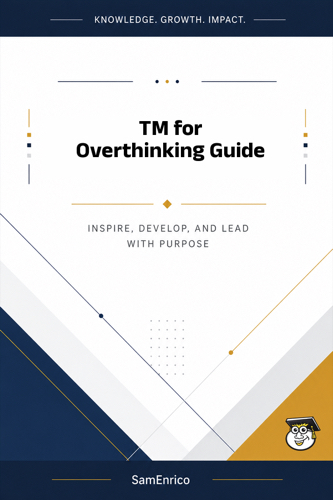
TM for Overthinking Guide eBook
Teaches Transcendental Meditation to quiet ruminat
Teaches Transcendental Meditation to quiet rumination and mental chatter.
Formats
Free sample
Chapter 1: The 3 AM Loop--–- The bedroom is dark. The clock reads 3:14 AM. You have been staring at the ceiling for forty-seven minutes. Your mind is not quiet. It is screaming.
A conversation from last Tuesday is playing on repeat—what you said, what you should have said, what they must think of you now. Another memory intrudes: an email you sent three years ago that you suddenly realize might have been misinterpreted. Then the future crashes in: the presentation tomorrow, the mortgage, the doctor's appointment, the thing you forgot to do last week that will certainly unravel everything.You try to stop. You tell yourself: "Just go back to sleep." But the command becomes another thought, piled on top of the others. You try to focus on your breathing.
In. Out. In. Out. But the thoughts shove their way back in, louder now, because you are trying so hard.
The harder you try, the worse it gets. This is the trap. This is the 3 AM loop. And if you are reading this book, you know it intimately.This chapter is about naming the enemy. Not to scare you, but to demystify it.
Because once you understand what is actually happening inside your brain during those midnight spirals, you will realize something crucial: it is not a character flaw. It is not a lack of willpower. It is not because you are broken. It is a neurological pattern—a specific, measurable, and remarkably common malfunction of a otherwise brilliant system. And most importantly, it is fixable.The Two Kinds of Thinking Before we can solve the problem of overthinking, we have to distinguish it from its productive cousin.
Not all repetitive thinking is bad. In fact, some of it is essential to survival and success. The human brain is a problem-solving machine. Give it a puzzle, and it will chew on it until it finds an answer. This is called productive problem-solving, and it has three distinct features.First, productive problem-solving is linear.
It moves from point A to point B to point C. You identify a problem, you consider solutions, you evaluate consequences, you choose a course of action. There is a narrative arc, a sense of progression. Second, productive problem-solving ends. When you reach a decision—even an imperfect one—the brain releases a reward signal, and the thinking quiets.
You have done your job. Third, productive problem-solving is goal-oriented. It serves a purpose. It helps you plan, create, navigate, and survive.Now consider its evil twin: destructive rumination. This is the 3 AM loop.
It has a different set of features. First, rumination is circular. It returns to the same starting point over and over. You replay the conversation, but you never reach a new conclusion. Second, rumination does not end.
There is no reward signal, no sense of closure. It can continue for hours, days, even years. Third, rumination is self-referential and negatively biased. It focuses on perceived threats, failures, and social slights. It says, "What is wrong with me?" not "What can I do next?"The critical insight is this: your brain does not know the difference.
The same neural machinery that solves problems also produces rumination. The difference is not in the machinery but in how it is being used—or rather, how it is being abused by stress, fatigue, and modern life. Understanding this distinction is the first step toward freedom, because you cannot solve a problem you cannot name.A Brief History of Your 3 AM Self Let us step back for a moment. Why do you overthink? What is the evolutionary purpose of this maddening loop?
The answer is both surprising and liberating: the capacity for rumination evolved as a survival mechanism. Millions of years ago, your ancestors lived in a world of predators, scarce resources, and tribal politics. The ones who survived were the ones who paid attention to threats. A rustle in the bushes might be the wind—or it might be a saber-toothed cat. The brain that assumed the rustle was a threat, even when it was not, lived longer than the brain that assumed it was the wind.This is called the negativity bias.
The brain is Velcro for bad experiences and Teflon for good ones. It takes one criticism to ruin your day, but it takes five compliments to recover. This was adaptive on the savanna. It is maladaptive in a world where the "predators" are email drafts, social media comments, and performance reviews.Modern research has quantified this bias. Psychologist Roy Baumeister and his colleagues found that bad events are approximately three times more powerful than good events in shaping behavior and emotion.
One study showed that a single negative interaction with a partner requires five positive interactions to compensate. Another study found that losing $50 hurts twice as much as gaining $50 feels good. Your 3 AM loop is not a bug. It is a feature—a feature that was installed in your brain over millions of years of evolution, and it is now running in an environment it was never designed for.The problem is not that you have a negativity bias. Everyone does.
The problem is that modern life has weaponized this bias. You are exposed to thousands of potential "threats" every day: a passive-aggressive email, a critical comment on social media, a colleague's disapproving glance, a news headline about economic collapse. Your ancient brain treats each of these as a genuine survival threat, flooding your system with stress hormones and initiating the rumination loop. The result is a brain that never rests, a body that never fully relaxes, and a mind that feels like it is being held hostage by its own thoughts.The Default Mode Network: Your Brain's Idle Engine In the early 2000s, neuroscientists made a discovery that would change our understanding of overthinking. Using functional magnetic resonance imaging (f MRI), they noticed something strange.
When research participants were asked to perform a task—solving a math problem, identifying colors, pressing a button—certain brain regions became active. That was expected. But when the task ended and the participants were told to simply rest, those task-related regions quieted down, and a different set of regions became active.This was a surprise. For decades, neuroscientists had assumed that the brain "turned off" during rest. Instead, they discovered that the brain has a default mode—a baseline state of activity that is metabolically expensive, consuming approximately 20% of the body's energy despite being "at rest." They called this network the Default Mode Network (DMN) , and its discovery has profound implications for understanding overthinking.So what does the DMN do?
In healthy brains, the DMN is active during self-referential thinking—when you are reflecting on your past, imagining your future, considering what others think of you, or constructing a narrative of your life. This is not inherently bad. A well-regulated DMN allows you to learn from experience, plan for the future, and maintain a coherent sense of self. It is the neural substrate of your autobiography.But here is the catch. In overthinkers, the DMN does not shut off when it should.
The task-related regions of the brain—the ones responsible for focused attention, decision-making, and problem-solving—are supposed to suppress the DMN when…
This is the end of the free sample. Get the eBook to keep going. Buy now
About this book
Details
- Author
- Salgado Karyl
- Publisher
- SamEnrico
- Language
- English
- Genre
- Non-Fiction, Self-Help, Overthinking
- Released
- 2026-06-08
- Pages (approx.)
- 147
- Available as
- eBook, Audiobook

Read better in the ZLOADR app
Your eBooks on your phone or tablet. Sign in with your SamEnrico account and start reading.
More by Salgado Karyl
 Self Hypnosis for Fear of BirdsSalgado Karyl$11.99
 The Substance and Emotion LinkSalgado Karyl$11.99
 JonBenét Cold Case UnitSalgado Karyl$11.99
 Yellow Fever Vaccine RegulationsSalgado Karyl$11.99
 Husband's Final PromiseSalgado Karyl$11.99
 Self Esteem Divorce RecoverySalgado Karyl$11.99
 Falls Prevention Dual LossSalgado Karyl$11.99
 The Silk and Steel Magnate: The Industrial Vision of Sir Samuel BakerSalgado Karyl$11.99
 Frozen Resolve: The 1969 USS Pueblo Crew's Arctic ExileSalgado Karyl$11.99
 How to Produce Semi-precious Stone CraftsSalgado Karyl$11.99
 How to Start a Combined Facilities Support Business (Beginners Guide)Salgado Karyl$11.99
 Creating a Tutoring Website or Landing PageSalgado Karyl$12.99