
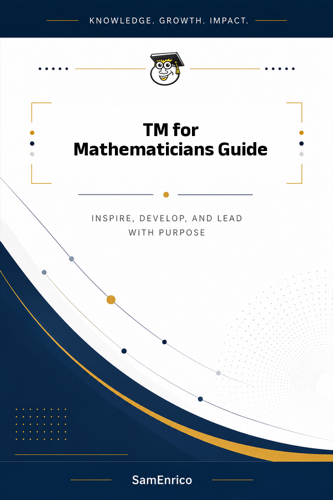
TM for Mathematicians Guide Audiobook
Accesses intuitive problem-solving states.
Accesses intuitive problem-solving states.
Formats
Free sample
Chapter 1: The Other Half...--–- Every mathematician knows the feeling. You have stared at a problem for hours. You have filled pages with definitions, lemmas, and dead ends. Your head aches. Your vision blurs.
And then you stand up, walk away, make coffee, step onto a bus, or lie down to sleep—and the answer arrives like a gift from nowhere. It is complete. It is elegant. It feels obviously true. And you did not think your way to it.This chapter dismantles the pervasive myth that mathematics is a purely linear, left-brain, rule-following discipline.
It introduces the central premise of this entire book: that intuition is not a mystical gift reserved for geniuses but a trainable cognitive skill. By the end of this chapter, you will understand why traditional mathematics education has trained you to distrust your deepest resource, and you will take the first step toward reclaiming it.The Great Deception of Mathematical Education From primary school through graduate programs, mathematics is taught as a monument to logic. Teachers present proofs as pristine chains of deduction. Textbooks display theorems in order, each resting securely on the last. Examinations reward the student who can reproduce these chains from memory.
The implicit message is clear: mathematics is what you can prove, and proving is what you can write down step by step.This is what David Bessis, in his groundbreaking book Mathematica: A Secret World of Intuition and Curiosity, calls expository mathematics. It is the cleaned-up, sanitized version of the discipline—the final draft, not the working notes. Expository mathematics is how mathematicians present their results to one another. It is orderly, logical, and linear because that is how you convince a skeptical colleague.But expository mathematics is not how mathematics is discovered.Discovery mathematics is the opposite. It is messy, recursive, and deeply intuitive.
It involves false starts, wild guesses, visual hunches, and feelings that cannot yet be articulated. The great mathematician Henri Poincaré described it this way: "It is by logic that we prove, but by intuition that we discover." Every working mathematician knows this. Few admit it openly. The culture of mathematics prizes rigor above all, so the messy process of discovery remains hidden—the dirty secret of every clean proof.The result is a tragic irony. Students who struggle with mathematics are told they lack "mathematical ability." But what they actually lack is permission to think the…
This is the end of the free sample. Get the Audiobook to keep going. Buy now
About this book
Details
- Author
- Breedlove Denyse
- Publisher
- SamEnrico
- Language
- English
- Genre
- Non-Fiction, Self-Help
- Released
- 2026-06-06
- Pages (approx.)
- 115
- Available as
- eBook, Audiobook

Listen in the VoxFlicks app
Audiobooks and audio dramas wherever you go. Sign in with your SamEnrico account and press play.
More by Breedlove Denyse
 Values And Mission Alignment Customer Experience HandbookBreedlove Denyse$11.99
 The SAD Cognitive Behavioral GuideBreedlove Denyse$11.99
 Mediterranean Brain HealthBreedlove Denyse$11.99
 Email Overload FixBreedlove Denyse$11.99
 The Algorithm Whisperer: How a Forgotten Genius Cracked the Code of Human BehaviorBreedlove Denyse$11.99
 Exit Driven Business PlanBreedlove Denyse$12.99
 Remote SWOT Analysis GuideBreedlove Denyse$12.99
 Understanding Tricho Onychic DysplasiaBreedlove Denyse$17.99
 Asset Management ConsultantBreedlove Denyse$11.99
 How to Become a Pleat PatternmakerBreedlove Denyse$11.99
You may also like
 Hong Kong Handover 1997Dunn Johnnie$11.99
 Zumba For Postnatal Recovery CourseNeal Christian$11.99
 Zumba for BeginnersLadner Nikia$11.99
 YouTube Comment Mining GuideHumes Pandora$12.99
 Worry Box MeditationCarlin Rudy$11.99
 Workplace Stress MeditationNguyen Lynn$11.99
 Workplace Stress and Sleep RepairHawley Ivory$11.99
 Workplace Perfectionism CureDelaney Jeffry$11.99
 Workplace Injustice Anger GuideWallen Isabelle$11.99
 Work Addiction and Burnout LinkGreenwood Ester$11.99
 Women in Yoga and WellnessBeattie Galina$11.99
 Women in Stand Up ComedyChun Evangeline$11.99