
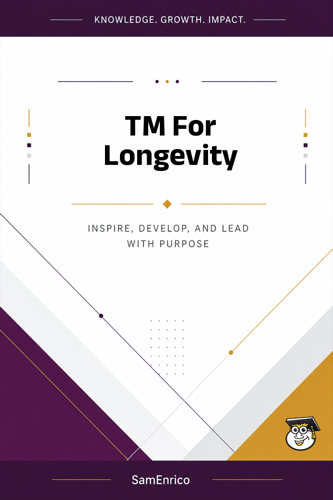
TM For Longevity eBook
Add healthy years by reducing all-cause mortality
Add healthy years by reducing all-cause mortality risk.
Formats
Free sample
Chapter 1: The 23% Solution--Every seven minutes, someone in the United States dies from a disease that a twenty-minute mental technique could have helped prevent. That is not a metaphor. That is a calculation.Take the 2.8 million Americans who die each year from all causes. Roughly 23 percent of those deaths—about 644,000 people annually—occur in populations where the primary risk factor is unmanaged chronic stress. Hypertension, insulin resistance, chronic inflammation, accelerated telomere shortening, vascular dementia, and even certain cancers all share a common biological pathway: the prolonged activation of the sympathetic nervous system.
And that activation is not inevitable. It is reversible.The data behind this claim comes from one of the most underreported studies in the history of preventive medicine. In 1996, the American Journal of Cardiology published the results of an 18.8-year randomized controlled trial funded by the National Institutes of Health. The study followed 202 participants—all with documented coronary artery disease—and assigned them to one of two groups. The first group received health education classes covering diet, exercise, and medication adherence.
The second group learned a specific meditation technique called Transcendental Meditation.The results were not subtle. After nearly two decades of follow-up, the TM group showed a 23 percent reduction in all-cause mortality. A 30 percent reduction in cardiovascular mortality. And a 49 percent reduction in cancer mortality. These numbers were statistically significant, clinically meaningful, and—for reasons we will explore in this chapter—largely ignored by mainstream medicine.This book exists because that silence is unacceptable.What "All-Cause Mortality" Actually Means Before we go any further, we need to define a term that will appear frequently in these pages: all-cause mortality.
In epidemiological research, this is the gold standard endpoint. It does not measure whether a drug lowers blood pressure or whether a diet reduces cholesterol. It measures whether you are alive or dead, from any cause whatsoever.Why does this matter? Because many interventions look good on surrogate endpoints—they lower one risk factor—but fail to extend actual life. Statins lower cholesterol but have a modest effect on all-cause mortality in primary prevention.
Many supplements lower inflammatory markers but do not keep you alive longer. All-cause mortality is the ultimate truth test.The TM study passed that test. A 23 percent reduction in all-cause mortality means that if you took one hundred people with heart disease and followed them for eighteen years, roughly twenty-three fewer of the TM practitioners would die compared to the control group. That is not a small effect. That is comparable to the impact of statins after a heart attack, or blood pressure medication in severe hypertension—without a single prescription.But here is where we must be precise.
A 23 percent risk reduction does not translate to a fixed number of added years for every person. If you are seventy-five years old with advanced heart disease, your remaining life expectancy might be ten years. A 23 percent reduction in mortality risk might add two to three years. If you are forty-five years old, healthy, and simply stressed, your remaining life expectancy might be forty years. The same 23 percent reduction could add eight to ten years.
The benefit scales with your baseline risk and your remaining life expectancy.In Chapter 12, you will learn how to calculate your personal estimated gain. For now, understand this: the 23 percent figure is an average across a population. Your individual gain could be larger or smaller depending on your age, your health status, and—critically—how consistently you practice. What is not in dispute is that the effect exists, it is large, and it is achievable by anyone who learns the technique correctly.The Study That Should Have Changed Everything Let us walk through the landmark trial in detail, because most summaries of it get the details wrong.The study was conducted by a research team led by Dr. Charles Alexander and Dr.
Robert Schneider at the Medical College of Wisconsin, in collaboration with Maharishi International University. It was funded by the National Institutes of Health's National Heart, Lung, and Blood Institute—the same agency that funded the famous Framingham Heart Study. The participants were 202 men and women, average age sixty-seven, all with documented coronary artery disease (previous heart attack, bypass surgery, or angiographic evidence of significant blockage).Participants were randomly assigned to one of two groups. The control group received health education classes covering standard recommendations: eat less saturated fat, exercise more, take your medications, stop smoking. The TM group received the same health education plus instruction in Transcendental Meditation, which they were asked to practice for twenty minutes twice daily.Here is what makes this study unusually rigorous: it was an intention-to-treat analysis.
That means even participants who did not meditate consistently—who learned TM and then practiced irregularly—were still counted in the TM group. In the real world, this matters because not everyone adheres perfectly. The fact that the study still found a significant mortality reduction despite inconsistent adherence suggests the true effect for consistent practitioners is even larger.The study also controlled for every major confounding variable: age, sex, blood pressure, cholesterol, smoking status, body mass index, and medication use. The two groups were statistically identical at baseline. The only difference was the meditation instruction.After 18.8 years of follow-up, the results were published in the American Journal of Cardiology.
The TM group had 23 percent fewer deaths from all causes. Specifically:Cardiovascular mortality was reduced by 30 percent. Fewer heart attacks, fewer strokes, fewer deaths from heart failure.Cancer mortality was reduced by 49 percent. This finding was so unexpected that the researchers re-analyzed the data multiple times to ensure it was not a statistical anomaly.Other-cause mortality (accidents, infections, etc.) showed a trend toward reduction but did not reach statistical significance.These numbers have been replicated in other populations. A 2005 study in the American Journal of Hypertension found that TM reduced blood pressure and mortality risk in older African Americans with hypertension.
A 2012 meta-analysis in Current Hypertension Reviews pooled data from multiple studies and confirmed the 23 percent all-cause mortality reduction. A 2018 meta-analysis in the Journal of Hypertension reviewed over one hundred studies and concluded that TM was unique among meditation techniques in producing consistent, clinically significant reductions in blood pressure and mortality risk.How TM Compares to Other Practices A natural question arises: is TM special, or would any meditation or relaxation technique produce the same mortality reduction?The data says TM is special. Not better in every way—mindfulness has its own benefits for depression and anxiety, and other relaxation techniques can reduce acute stress—but specifically for all-cause mortality and cardiovascular outcomes, the evidence consistently favors TM.Consider the comparison to mindfulness-based stress reduction (MBSR) . A 2017 systematic review in the Journal of the American Heart Association found that while MBSR improved psychological outcomes like anxiety and depression, it did not produce statistically significant reductions in blood pressure or mortality. A 2019 meta-analysis in Frontiers in Neuroscience concluded that mindfulness and TM operate through different neural pathways: mindfulness increases metacognitive awareness (thinking about thinking), while TM reduces sympathetic nervous system activity directly (calming the fight-or-flight response).
For longevity, the latter seems to matter more.Consider the comparison to progressive muscle relaxation (PMR) . In the 2005 Schneider study mentioned earlier…
This is the end of the free sample. Get the eBook to keep going. Buy now
About this book
Details
- Author
- Fitzsimmons Mirella
- Publisher
- SamEnrico
- Language
- English
- Genre
- Non-Fiction, Self-Help, Longevity
- Released
- 2026-06-05
- Pages (approx.)
- 146
- Available as
- eBook, Audiobook

Read better in the ZLOADR app
Your eBooks on your phone or tablet. Sign in with your SamEnrico account and start reading.
More by Fitzsimmons Mirella
 Radio Based Therapy For Remote AreasFitzsimmons Mirella$11.99
 CBD Sleep Memory GuideFitzsimmons Mirella$11.99
 The Gacy Property DemolitionFitzsimmons Mirella$11.99
 Chunking for StudentsFitzsimmons Mirella$11.99
 LTC Insurance For AccountantsFitzsimmons Mirella$11.99
 The Sobriety Values WorkbookFitzsimmons Mirella$11.99
 The Oath of SupremacyFitzsimmons Mirella$11.99
 Self Talk For AbortionFitzsimmons Mirella$11.99
 Lancelot and the Enchanted Mirror: A Knight’s Forbidden ReflectionFitzsimmons Mirella$11.99
 Golden Shadows: The Untold Saga of the Forgotten OlympianFitzsimmons Mirella$11.99
 The Dancer's Guide to GotipuaFitzsimmons Mirella$11.99
 China PIPL FinesFitzsimmons Mirella$12.99
You may also like
 TM Biological AgingFortenberry Stefany$11.99
 The Stress Aging ConnectionSmoot Soraya$11.99
 Stress Telomere ShorteningLaplante Eulalia$11.99
 When Stress Ages YouStratton Shela$11.99
 Stress Longevity GuideBoyd Neil$11.99
 Stress Accelerates Aging ProcessCrandall Tasia$11.99
 Transcendental Meditation and TelomeresOrtiz Juana$11.99
 Stress and Early Aging ConnectionFlowers Charlotte$11.99