
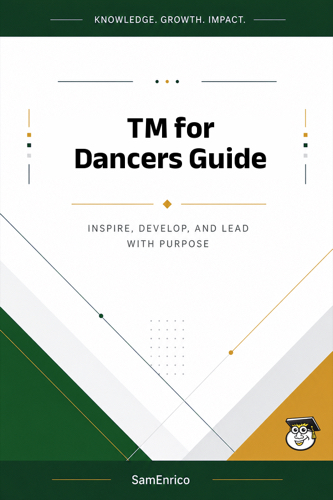
TM for Dancers Guide eBook
Deepens body-mind connection and recovery.
Deepens body-mind connection and recovery.
Formats
Free sample
Chapter 1: The Silent Split--–- You are standing at the barre. Your left hand rests lightly on the polished wood. The teacher calls out the combination: tendu, dégagé, rond de jambe. You execute each movement with precision. Your lines are clean.
Your turnout is correct. You feel the satisfying burn in your supporting leg. And yet, somewhere between your second tendu and your first dégagé, you stop feeling your body entirely.Not the burn. You feel that. Not the fatigue.
You feel that too. But the rest of your body—the soft interior landscape of your organs, your breath, your gut feelings, your emotional temperature—has gone quiet. It has been replaced by a running commentary: My hip is too high. My arm is two inches too low. The teacher is watching.
I'm the worst one in this row. My stomach looks terrible in this leotard.This is the Silent Split. And if you are a dancer, you have been living inside it for years.The Paradox at the Heart of Dance Dancers possess extraordinary physical intelligence. You can learn a sixty-second combination after seeing it twice. You can land a jump on a dime, turn your leg out from the hip with surgical precision, and remember choreography that would leave most people breathless.
Your brain has mapped your body in exquisite detail—where every joint is, how every muscle fires, how to arrange your limbs in space to create lines that audiences find beautiful.And yet, despite this mastery, most dancers report feeling profoundly disconnected from their own bodies.This is the Elite Dancer Paradox: the more technically proficient you become, the more likely you are to treat your body as a machine to be manipulated rather than a self to be inhabited. Your body becomes a tool. An instrument. A vehicle for your ambition. But it stops feeling like you.Think about the last time someone asked you how you were feeling—not about your performance, but about you.
Not "how did class go?" but "how is your body, really?" Not "did you get the part?" but "what are you carrying in your chest right now?"If you are like most dancers, you struggled to answer. Not because you don't care about your body. Because you have forgotten how to listen to it.The Mirror: Teacher or Tyrant?Let us trace this problem to its most obvious source: the mirror.The dance studio mirror is a tool. It is not evil. It is not the enemy.
It becomes problematic only when it replaces internal sensation rather than supplementing it. A healthy relationship with the mirror looks like this: 70 percent internal awareness (how does this movement feel?) and 30 percent external check (what does this movement look like?). But most dancers have the ratio reversed. You have learned to see yourself from the outside first, last, and always.Here is how it happens.You arrive at the studio as a young dancer. You are told to watch yourself in the mirror.
Check your alignment. Straighten your knees. Point your feet. Tuck your tailbone. Pull up.
All of this is good information. But over time, the external gaze takes over. You stop asking how does this feel? and start asking only how does this look?Your eyes learn to scan your reflection for errors. Your mind learns to compare your body to an ideal that recedes every time you get close.
Your internal sensation—the soft, subtle voice of your body telling you about hunger, fatigue, pain, emotion—gets overridden. Eventually, it goes silent altogether.This is somatic amnesia: a learned forgetting of what your body actually feels. Not just forgetting to notice. Forgetting how to notice. A dancer with somatic amnesia can execute a flawless triple pirouette while being entirely unaware that they haven't eaten in six hours, that their lower back is screaming for rest, or that their heart is racing with anxiety they cannot name.The Three Voices Living Inside You Before we go any further, I want to introduce you to a framework that will guide this entire book.
Inside your head, right now, there are three distinct voices. Learning to tell them apart is the single most important skill you will develop as a dancer who wants to heal the Silent Split.The Inner Critic The Inner Critic is loud. It is harsh. It speaks in absolutes: "always," "never," "disgusting," "pathetic," "everyone else," "not enough." It sounds like a teacher you once had—or like every teacher you ever had, compressed into one relentless voice. It might also sound like a parent, a competitor, or your own worst self.Examples of the Inner Critic at work:"That turn was disgusting.
You'll never get this combination.""Everyone else is working harder than you.""If you rest today, you're lazy and you'll fall behind.""Your body is the problem. Fix it."The Inner Critic believes that shame is an effective motivator. It says: If I make you feel bad enough, you will work harder. And in the short term, this works. A blast of shame can produce a temporary spike in effort.
But over time, the Inner Critic poisons everything. It leads to anxiety, depression, burnout, perfectionism, and the loss of intrinsic motivation—the pure joy of dancing for its own sake.The Inner Witness The Inner Witness is quiet. It does not judge. It does not praise. It simply observes.
It speaks in neutral, descriptive language: "I notice," "I feel," "there is," "this is happening."Examples of the Inner Witness at work:"I notice tension in my right hip flexor.""My breath is shallow. There is a flutter in my stomach.""I feel heat in my chest.""My left knee is tracking inward during this plié."The Inner Witness is not trying to change anything. It is not trying to improve or fix or optimize. It is simply gathering data. This is the voice that says here is what is happening right now without adding and that means I am a failure.Most dancers have never met their Inner Witness because the Inner Critic talks so loudly.
The Witness gets drowned out. But the Witness is the foundation of everything else in this book. You cannot heal what you cannot see. You cannot change what you cannot observe. The Inner Witness is the bridge between your automatic, habitual self and your intentional, growing self.The Inner Coach The Inner Coach is compassionate and constructive.
It speaks with honesty but without cruelty. It is specific, not global. It corrects the action, not the person. And it is always forward-looking.Examples of the Inner Coach at work:"Your standing leg straightened early on that turn. Let's try it again with a soft knee.""You lost your balance in the adagio.
What if you engaged your lower belly more?""That combination felt rushed. Tomorrow, try counting out loud.""You are tired. Resting now will make tomorrow's rehearsal stronger."The Inner Coach is not permissive or indulgent. It does not say "you're perfect just as you are" when you are clearly struggling with a technical correction. But it also does not say "you're pathetic." It tells the truth—the useful truth, the actionable…
This is the end of the free sample. Get the eBook to keep going. Buy now
About this book
Details
- Author
- Haag Dorothea
- Publisher
- SamEnrico
- Language
- English
- Genre
- Non-Fiction, Self-Help
- Released
- 2026-06-06
- Pages (approx.)
- 147
- Available as
- eBook, Audiobook

Read better in the ZLOADR app
Your eBooks on your phone or tablet. Sign in with your SamEnrico account and start reading.
More by Haag Dorothea
 Affirmations for ApologyHaag Dorothea$11.99
 Active Listening For JournalistsHaag Dorothea$11.99
 Imposter Syndrome for Military VeteransHaag Dorothea$11.99
 The GAD and Insomnia GuideHaag Dorothea$11.99
 The Green Gold Rush: How a Farmer Turned the World Upside DownHaag Dorothea$11.99
 TikTok Content Business SetupHaag Dorothea$11.99
 LibreCAD Replaces AutoCAD GuideHaag Dorothea$12.99
 Nonprofit One Page Business PlanHaag Dorothea$12.99
 How to Start a Canned Soup Containing Meat or Vegetables or Both Business (Beginners Guide)Haag Dorothea$11.99
 Understanding Toxoplasmosis, CongenitalHaag Dorothea$17.99Understanding Toxoplasmosis, CongenitalHaag Dorothea$17.99
You may also like
 Hong Kong Handover 1997Dunn Johnnie$11.99
 Zumba For Postnatal Recovery CourseNeal Christian$11.99
 Zumba for BeginnersLadner Nikia$11.99
 YouTube Comment Mining GuideHumes Pandora$12.99
 Worry Box MeditationCarlin Rudy$11.99
 Workplace Stress MeditationNguyen Lynn$11.99
 Workplace Stress and Sleep RepairHawley Ivory$11.99
 Workplace Perfectionism CureDelaney Jeffry$11.99
 Workplace Injustice Anger GuideWallen Isabelle$11.99
 Work Addiction and Burnout LinkGreenwood Ester$11.99
 Women in Yoga and WellnessBeattie Galina$11.99
 Women in Stand Up ComedyChun Evangeline$11.99