
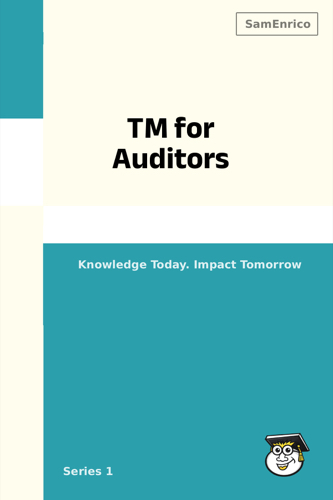
TM for Auditors eBook
Maintains focus during detailed reviews.
Maintains focus during detailed reviews.
Formats
Free sample
Chapter 1: The Fog Descends--It begins with a quiet tremor you almost don’t notice. You’ve been staring at the same spreadsheet for forty-seven minutes. The numbers haven’t changed, but something has. Your eyes are still moving across the screen, but your brain has stopped processing. You read the same invoice number three times.
You know it’s wrong—you felt that jolt of recognition on the first pass—but you cannot say why. The reason hovers just beyond reach, like a word on the tip of your tongue that refuses to be spoken. You take a sip of cold coffee. You blink hard. You tell yourself to focus.But focus has already left the building.This moment—this quiet, insidious collapse of attention—has a name.
In the pages ahead, we will call it The Fog. It is not laziness. It is not a character flaw. It is not a lack of discipline or a sign that you chose the wrong profession. The Fog is a predictable, measurable, and utterly normal cognitive state that every auditor enters when fatigue, distraction, and context-switching conspire to hijack the brain’s limited processing power.
And here is the terrifying truth: you can be sitting at your desk, fully dressed, coffee in hand, eyes on the screen, and still be functionally absent. Your body is present. Your mind is elsewhere. And the material misstatement you just missed will not care about your intentions.The Fog is the single greatest threat to audit quality in the modern era. It is more dangerous than technical ignorance.
It is more pervasive than budget pressure. It is the silent partner in every missed exception, every overlooked disclosure, every tickmark applied to a number that should have been questioned. And until you learn to see The Fog for what it is—until you can recognize its approach, measure its impact, and defend against its effects—you will never achieve the level of precision that your professional obligations demand.This chapter is the foundation of everything that follows. Here, we will dismantle the myths that keep auditors trapped in The Fog. We will name the enemy.
We will quantify the cost of distraction in terms that matter to your career, your clients, and your conscience. And we will introduce the two tools that will serve as the backbone of this entire book: the Fatigue Warning Signs Checklist and the Reset Decision Tree. By the time you finish this chapter, you will never look at a quiet afternoon at your desk the same way again.The Myth of the Great Multitasking Auditor Walk onto any audit floor during busy season, and you will see a spectacle that would make a cognitive neuroscientist weep. Screens are split three ways. A dozen browser tabs compete for attention.
Email notifications flicker in the corner of every monitor. Phones buzz with Slack messages from managers who need “just one quick thing.” And at the center of this chaos sits a well-intentioned professional who has convinced themselves that they are handling it all.They are not.The human brain is physically incapable of processing two high-cognitive-load tasks simultaneously. This is not an opinion. It is not a matter of willpower or practice or “learning to multitask better.” It is a hard limit of neurobiology, as immutable as the fact that you cannot hold your breath underwater for an hour. When you attempt to perform two tasks that both require conscious attention—say, vouching a sample of invoices while keeping one eye on your inbox—your brain does not do both at once.
Instead, it engages in a process called context switching.Here is how context switching works. Your brain has a limited pool of attentional resources. When you focus on a single task, you direct that entire pool to the work at hand. Your working memory loads the relevant information. Your pattern recognition systems scan for anomalies.
Your executive functions monitor progress and adjust strategy. This is the state of deep engagement that produces accurate, reliable audit evidence.The moment you switch to another task—even for a moment—your brain must perform a series of expensive operations. First, it must save the current state of the first task to temporary memory. Then it must flush the relevant information from working memory to make room for the second task. Then it must load the context for the second task, orient itself, and begin processing.
When you switch back to the first task, the entire process repeats.The cost of each switch is not measured in milliseconds. It is measured in residual attention—the cognitive residue that remains stuck to the previous task, reducing the processing power available for the current one. Research from the University of California, Irvine, found that after a typical interruption (like an email notification), it takes an average of 23 minutes and 15 seconds to return to the original task with full cognitive engagement. Not to glance at it. Not to pick up where you left off.
To return to the level of focus you had before the interruption.Read that number again. Twenty-three minutes. Nearly half an hour. For a single email.Now multiply that by the number of interruptions the average auditor experiences in a day. Five.
Ten. Twenty. The math becomes terrifying. If you are interrupted just five times in a morning, you have effectively lost two hours of productive attention—not because you were working slowly, but because your brain was spending its limited resources on switching, saving, loading, and orienting, rather than on the actual audit work in front of you.The multitasking auditor is not a hero. The multitasking auditor is a victim of a neurological scam, working twice as hard to produce half the quality.Introducing The Fog: The Auditor’s Hidden Enemy The Fog is what happens when the accumulated cost of context switching, combined with the natural fatigue of sustained cognitive work, pushes your brain into a degraded processing state.
In The Fog, you continue to perform the motions of auditing. You move your mouse. You click through workpapers. You type comments. But the quality of your thinking has collapsed.The Fog has four distinct characteristics that every auditor must learn to recognize.First, processing speed slows dramatically.
Numbers that would normally be recognized instantly require conscious decoding. Patterns that would normally pop out become invisible. You find yourself staring at a simple reconciliation, unable to see the relationship between the two sides, even though you know intellectually that it should be obvious.Second, error rate increases exponentially. Studies of cognitive fatigue in accounting professionals show that after ninety minutes of continuous detailed review without a reset, the probability of missing a material exception more than doubles. This is not a linear decline.
It is an accelerating collapse. The longer you push through The Fog, the faster your accuracy plummets.Third, professional skepticism evaporates. Professional skepticism is not a personality trait. It is a cognitive state that requires deliberate, effortful System 2 thinking—the slow, analytical mode of processing that Daniel Kahneman described in his seminal work, Thinking, Fast and Slow. System 2 is expensive to maintain.
It requires energy, attention, and mental effort. When you enter The Fog, your brain defaults to System 1: fast, intuitive…
This is the end of the free sample. Get the eBook to keep going. Buy now
About this book
Details
- Author
- Hillman Marya
- Publisher
- SamEnrico
- Language
- English
- Genre
- Non-Fiction, Self-Help
- Released
- 2026-06-06
- Pages (approx.)
- 145
- Available as
- eBook, Audiobook

Read better in the ZLOADR app
Your eBooks on your phone or tablet. Sign in with your SamEnrico account and start reading.
More by Hillman Marya
 Chilean Green Tax CreditsHillman Marya$11.99
 Intermittent Fasting HandbookHillman Marya$11.99
 Piecemeal MVP Building GuideHillman Marya$11.99
 Student Meditation Quick GuideHillman Marya$11.99
 Nicotine Detox Exercise PrescriptionHillman Marya$11.99
 Bedtime Affirmation RitualsHillman Marya$11.99
 Talking to Siblings About InheritanceHillman Marya$11.99
 HGH And Gene TherapyHillman Marya$11.99
 The Silk Road Whisperers: Voices of the Forgotten CaravansHillman Marya$11.99
 The Lost Caravans of the Stone Age: A Forgotten Silk Road TragedyHillman Marya$11.99
 Lost in the Echo: The Enigma of the Disappearing DiamondsHillman Marya$11.99
 Growing Scadoxus (Blood Lily)Hillman Marya$11.99
You may also like
 Hong Kong Handover 1997Dunn Johnnie$11.99
 Zumba For Postnatal Recovery CourseNeal Christian$11.99
 Zumba for BeginnersLadner Nikia$11.99
 YouTube Comment Mining GuideHumes Pandora$12.99
 Worry Box MeditationCarlin Rudy$11.99
 Workplace Stress MeditationNguyen Lynn$11.99
 Workplace Stress and Sleep RepairHawley Ivory$11.99
 Workplace Perfectionism CureDelaney Jeffry$11.99
 Workplace Injustice Anger GuideWallen Isabelle$11.99
 Work Addiction and Burnout LinkGreenwood Ester$11.99
 Women in Yoga and WellnessBeattie Galina$11.99
 Women in Stand Up ComedyChun Evangeline$11.99