
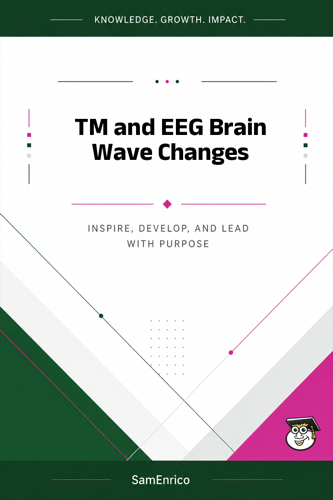
Non-FictionSelf-HelpNeuroscience
TM and EEG Brain Wave Changes eBook
Understand alpha, theta, and gamma coherence measu
Understand alpha, theta, and gamma coherence measured in practitioners.
Formats
Free sample
Chapter 1: The Missing Fourth...--The average human being will spend approximately 79 years on this planet. During that time, they will cycle through three familiar territories of consciousness: waking, dreaming, and deep sleep. These three states are so universally recognized that they have become the unquestioned foundation of psychology, neuroscience, and even philosophy. Ask anyone on the street how many states of consciousness exist, and they will confidently answer three. Ask a neurologist, and they will give you the same answer, albeit with more sophisticated terminology and perhaps a caution against oversimplification.But what if the map is incomplete?
What if, hidden in plain sight, there exists a fourth state of consciousness—one that is neither waking, nor dreaming, nor sleeping—that has been described for millennia by meditators, mystics, and sages, yet systematically ignored by mainstream science until the last half-century? And what if this fourth state leaves a measurable, unmistakable signature on the human brain, detectable with the right instruments and distinguishable from every other known mental condition?This book argues exactly that. The fourth state—which we will call Transcendental Consciousness—is not a metaphor, a religious belief, or a subjective illusion. It is a physiologically distinct state of restful alertness, characterized by a unique pattern of brain waves that scientists have only recently learned to measure with precision. And the most reliable, replicable method for accessing this state is a simple, effortless technique known as Transcendental Meditation, or TM.But before we dive into the brain waves, the coherence calculations, and the decades of peer-reviewed research, we must first understand why the fourth state has been so consistently overlooked.
The story of this oversight is not merely historical curiosity; it reveals deep assumptions within Western science about the nature of consciousness itself—assumptions that are now being challenged by the very data this book will present.The Blind Spot in Modern Psychology Modern psychology, for all its remarkable achievements, was built on a foundation that deliberately excluded the study of consciousness for much of its history. When John B. Watson founded behaviorism in 1913, he argued that psychology should concern itself only with observable behavior, not with subjective experience. "Consciousness," Watson wrote, "is neither a definable nor a usable concept." B.F. Skinner later doubled down on this position, treating the inner life of the mind as an unprovable fiction.This behaviorist orthodoxy dominated academic psychology from the 1920s through the 1960s.
During those decades, millions of dollars were spent studying how rats navigate mazes and how pigeons peck levers, but virtually nothing was spent on questions like "What is awareness?" or "Can consciousness be trained?" The very act of asking such questions was considered unscientific, a regression to the discredited introspectionism of Wilhelm Wundt and Edward Titchener.The cognitive revolution of the 1960s and 70s began to reverse this trend, bringing attention back to mental processes like memory, attention, and problem-solving. But even then, the focus remained largely on information processing—the computational functions of the mind—rather than on the raw, qualitative experience of being conscious. The "hard problem" of consciousness, as philosopher David Chalmers would later call it—explaining why and how physical processes give rise to subjective experience—was largely set aside as too difficult, too philosophical, or simply not amenable to empirical investigation.Within this context, the suggestion that there might be a fourth, scientifically unrecognized state of consciousness seemed, to many mainstream researchers, not merely unlikely but embarrassing. It sounded mystical, New Age, or outright cultish. The fact that the most prominent proponent of this idea was an Indian guru—Maharishi Mahesh Yogi—only made it easier for Western scientists to dismiss.
In the academic hierarchy of the 1960s and 70s, knowledge flowed from West to East, not the other way around. An Indian monk claiming to have discovered a new state of consciousness was about as credible, in the eyes of many Harvard professors, as a carnival psychic claiming to read minds.Yet something remarkable happened in 1970. A young physiologist named Robert Keith Wallace, working as a graduate student at the University of California, Irvine, and later at Harvard, published a paper in the prestigious journal Science that would begin to dismantle these prejudices. Wallace had done something that no one else had thought to do: he had hooked experienced TM practitioners to physiological monitoring equipment and measured what happened to their bodies during meditation. The results were astonishing and would eventually force the scientific establishment to take the fourth state seriously.The State That Should Not Exist To understand why Wallace's findings were so revolutionary, we must first understand what physiologists thought they already knew about the relationship between mind and body.
By 1970, the following facts were considered settled:First, there are three major states of consciousness, each with a distinct physiological signature. In waking, the brain exhibits fast, desynchronized activity (beta waves), the body maintains a baseline metabolic rate, and the autonomic nervous system is in a state of balanced activation. In sleep, the brain slows down (theta and delta waves), metabolic rate drops by approximately 8-10%, and the autonomic nervous system shifts toward parasympathetic dominance. In REM sleep (dreaming), the brain becomes highly active again, resembling waking in some respects, but the body is paralyzed and the metabolic rate remains low.Second, any state that involves mental activity necessarily requires metabolic expenditure. Thinking burns calories.
Concentration increases oxygen consumption. Even daydreaming requires energy. The brain, despite comprising only 2% of body weight, consumes about 20% of the body's oxygen at rest. This is a fundamental biological constraint.Third, the relaxation response—the physiological opposite of the fight-or-flight response—produces a specific pattern of reduced heart rate, reduced respiration, reduced muscle tension, and reduced oxygen consumption. This pattern is well-documented and occurs during sleep, during certain forms of rest, and during simple relaxation exercises.Wallace's findings, published in Science in 1970 and later in a more accessible form in Scientific American, threw a wrench into all three of these assumptions.What Wallace discovered was this: during TM, practitioners exhibited a hypometabolic state that was significantly deeper than ordinary rest or even light sleep.
Oxygen consumption dropped by 16-18%—nearly double the reduction seen during sleep. Carbon dioxide elimination dropped correspondingly. Heart rate decreased by about 3-5 beats per minute. Skin resistance increased dramatically, indicating deep relaxation of the sympathetic nervous system. Blood lactate levels, a marker of anxiety and metabolic stress, dropped by about 30% within the first 10-15 minutes of meditation.All of this suggested that TM was producing a state of profound physiological rest, even deeper than sleep.
But here was the paradox: the practitioners were not asleep. They remained alert, awake, and responsive. When asked to press a button in response to a tone, they did so quickly and accurately. Their EEG showed not the slow, synchronized waves of sleep, but rather high-amplitude alpha waves (8-12 Hz) and, in more advanced practitioners, emerging theta waves (4-8 Hz) alongside periods of gamma activity (30-100 Hz). This combination—deep rest coupled with alert awareness—was unprecedented in the physiological literature.Wallace had discovered a fourth state of consciousness: a state of restful alertness, or as he and his colleagues would later call it, Transcendental Consciousness.…
This is the end of the free sample. Get the eBook to keep going. Buy now
About this book
Details
- Author
- Murillo Carlotta
- Publisher
- SamEnrico
- Language
- English
- Genre
- Non-Fiction, Self-Help, Neuroscience
- Released
- 2026-06-06
- Pages (approx.)
- 138
- Available as
- eBook, Audiobook

Read better in the ZLOADR app
Your eBooks on your phone or tablet. Sign in with your SamEnrico account and start reading.
More by Murillo Carlotta
 Harvard Extension School Writing CenterMurillo Carlotta$11.99
 NVC For Social Justice DialogueMurillo Carlotta$11.99
 The Rotational LifeMurillo Carlotta$11.99
 The Last Stand of the Righteous Fists: The Boxer Rebellion's Forgotten WarriorsMurillo Carlotta$11.99
 Active Threat Drills GuideMurillo Carlotta$12.99
 How to Produce Bicycle Stands and StorageMurillo Carlotta$11.99
 Social Media Marketing CoordinatorMurillo Carlotta$11.99
 How to Become a StenocaptionerMurillo Carlotta$11.99
You may also like
 Hong Kong Handover 1997Dunn Johnnie$11.99
 Zumba For Postnatal Recovery CourseNeal Christian$11.99
 Zumba for BeginnersLadner Nikia$11.99
 YouTube Comment Mining GuideHumes Pandora$12.99
 Worry Box MeditationCarlin Rudy$11.99
 Workplace Stress MeditationNguyen Lynn$11.99
 Workplace Stress and Sleep RepairHawley Ivory$11.99
 Workplace Perfectionism CureDelaney Jeffry$11.99
 Workplace Injustice Anger GuideWallen Isabelle$11.99
 Work Addiction and Burnout LinkGreenwood Ester$11.99
 Women in Yoga and WellnessBeattie Galina$11.99
 Women in Stand Up ComedyChun Evangeline$11.99