
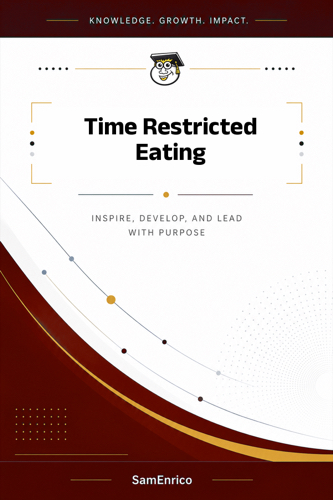
Non-FictionHealth & WellnessIntermittent
Time Restricted Eating eBook
Teaches 16:8 daily fasting window.
Teaches 16:8 daily fasting window.
Formats
Free sample
Chapter 1: The Calorie Deception...--–- Let me tell you something that the weight loss industry has spent billions of dollars hiding from you. Your body doesn't know how to count. It has no calorie ledger. There is no tiny accountant sitting inside your pancreas, tracking debits and credits. And yet, for the past fifty years, you have been told that weight loss is simple arithmetic.
Eat less. Move more. Calories in, calories out. If you are failing, the logic goes, you are either eating too much or exercising too little. The problem, they say, is your willpower.That is a lie.I want you to meet two people.
Let us call them Sarah and Michelle. They are both forty-two years old. They both weigh 180 pounds. They both have desk jobs and walk their dogs for thirty minutes each evening. They both want to lose thirty pounds.
And here is the kicker: over the next three months, they are both going to eat exactly two thousand calories per day. The same foods. The same portions. The same macronutrients.Sarah spreads her two thousand calories across a typical modern eating schedule. She wakes up at 7 AM and has breakfast—a bowl of oatmeal with berries and a splash of milk.
By 10 AM, she is feeling a little hungry, so she grabs a banana and a handful of almonds. Lunch at 12:30 PM is a turkey sandwich on whole wheat bread with an apple. By 3 PM, the afternoon slump hits, so she has a Greek yogurt and a granola bar. Dinner at 7 PM is grilled chicken, brown rice, and roasted vegetables. And because she has been "good" all day, she allows herself a small bowl of ice cream at 9:30 PM while watching television.
Her last bite of food hits her lips at 9:45 PM.Michelle eats the exact same two thousand calories. The same oatmeal. The same turkey sandwich. The same grilled chicken. The same ice cream.
But Michelle has one rule: she only eats between 12 PM and 8 PM. She wakes up at 7 AM and drinks black coffee—nothing else. Her first meal is lunch at 12:30 PM. She finishes her last bite of ice cream at 7:55 PM. Then she puts the kitchen to bed.Three months pass.
Sarah and Michelle return to the clinic for their final measurements. Sarah has lost four pounds. Her blood sugar has crept up. She reports feeling tired, hungry, and frustrated. Michelle has lost seventeen pounds.
Her blood sugar has improved. She reports having more energy than she has had in years.Same calories. Same foods. Same exercise. Different results.The only difference between Sarah and Michelle is timing.If calories were all that mattered, this would be impossible.
And yet, studies have replicated this exact pattern over and over again. A 2022 randomized controlled trial published in the journal Cell Metabolism followed 139 adults with obesity. One group ate within a 16:8 time-restricted window. The other group ate the same calories spread across the entire day. The time-restricted group lost significantly more body fat, improved their insulin sensitivity more dramatically, and reported greater satisfaction with the eating pattern.
The calorie-matched group? They lost some weight, yes. But their metabolic health markers barely budged.This chapter is going to dismantle the most persistent, damaging, and scientifically bankrupt myth in modern nutrition. You have been told that your body is a furnace. It is not.
You have been told that weight loss is thermodynamics. It is not. You have been told that you are failing because you lack discipline. You are not.The truth is far simpler and far more liberating: your body listens to hormones, not math. And the single most important hormone for fat storage is insulin.
When you understand insulin—really understand it—everything changes. The guilt disappears. The constant counting disappears. The shame of "failing" yet another diet disappears. In their place comes a simple, sustainable, almost effortless approach to eating that works with your biology instead of against it.This book is going to teach you that approach.
It is called time-restricted eating, and the version we are going to focus on is the 16:8 protocol. Sixteen hours of fasting. Eight hours of eating. No calorie counting. No weighing your food.
No complicated rules. Just a window.But before we get to the how, we need to burn the old house down. We need to understand why everything you have been told about weight loss is wrong. And we need to build a new foundation based on the science of hormones, clocks, and metabolic flexibility.So let us start with the biggest lie of all.The Invention of the Calorie The calorie as a unit of measurement was never meant to measure human metabolism. It was invented in the early nineteenth century by French physicists studying steam engines.
A calorie was defined as the amount of heat required to raise one kilogram of water by one degree Celsius. It was a tool for engineers, not doctors.In the late 1800s, a chemist named Wilbur Atwater decided to apply this engineering concept to human nutrition. He built a respiration calorimeter—essentially a sealed room that could measure heat output and gas exchange—and began stuffing men inside it. He fed them measured amounts of food, measured their waste, and calculated how much energy they extracted. From these experiments, he derived the famous values: four calories per gram of protein, four calories per gram of carbohydrate, nine calories per gram of fat.Atwater was a meticulous scientist.
His experiments were groundbreaking. But he made one assumption that has haunted us ever since: he assumed that calories were the same regardless of context. A calorie from protein, he believed, was identical to a calorie from carbohydrate. A calorie eaten at 8 AM was the same as a calorie eaten at 8 PM. A calorie eaten by a metabolically healthy person was the same as a calorie eaten by someone with insulin resistance.That assumption was wrong.We now know that the body processes different foods through entirely different metabolic pathways.
A calorie from glucose triggers insulin release, which tells your fat cells to lock their doors and hold onto stored energy. A calorie from fat triggers almost no insulin response. A calorie from protein triggers a moderate insulin response but also triggers satiety hormones that tell your brain you are full. The calorie is not a neutral unit. It is a messenger carrying instructions to your endocrine system.And we now know that timing matters just as much as source.
A calorie eaten when your body is primed for storage (high insulin, high cortisol, low light) gets shuttled into fat cells with remarkable efficiency. The same calorie eaten when your body is primed for burning (low insulin, low cortisol, daylight hours) gets used as fuel or stored as glycogen in your muscles and liver.The calorie is not just a calorie. It never was.The 95% Failure Rate Here is a number that should shock you. Ninety-five percent. That is the long-term failure rate of calorie-restriction diets.
Ninety-five percent of people who lose weight by eating less and moving more will regain all of that weight—and often more—within three to five years.I want you to…
This is the end of the free sample. Get the eBook to keep going. Buy now
About this book
Details
- Author
- Meyer Candace
- Publisher
- SamEnrico
- Language
- English
- Genre
- Non-Fiction, Health & Wellness, Intermittent
- Released
- 2026-06-06
- Pages (approx.)
- 158
- Available as
- eBook, Audiobook

Read better in the ZLOADR app
Your eBooks on your phone or tablet. Sign in with your SamEnrico account and start reading.
More by Meyer Candace
 Morning Mindset Reframe GuideMeyer Candace$11.99
 Logical Creativity HandbookMeyer Candace$11.99
 Relationship Anger RestructuringMeyer Candace$11.99
 The Sherman Alexie StoryMeyer Candace$11.99
 Okinawan Longevity SecretsMeyer Candace$11.99
 Gut Brain Immune TriangleMeyer Candace$11.99
 Affirmations For AgingMeyer Candace$11.99
 Pegasus and the Parthenon: Horses of Ancient AthensMeyer Candace$11.99
 The Last Supper: Australia's Death Row Meals and the Final Hours of the CondemnedMeyer Candace$11.99
 The Essential Guide to Contemporary FolkMeyer Candace$11.99
 B2B Sales for Maritime SectorMeyer Candace$12.99
 ROI Calculator for PromotionMeyer Candace$12.99
You may also like
 Hong Kong Handover 1997Dunn Johnnie$11.99
 Zumba For Postnatal Recovery CourseNeal Christian$11.99
 Zumba for BeginnersLadner Nikia$11.99
 YouTube Comment Mining GuideHumes Pandora$12.99
 Worry Box MeditationCarlin Rudy$11.99
 Workplace Stress MeditationNguyen Lynn$11.99
 Workplace Stress and Sleep RepairHawley Ivory$11.99
 Workplace Perfectionism CureDelaney Jeffry$11.99
 Workplace Injustice Anger GuideWallen Isabelle$11.99
 Work Addiction and Burnout LinkGreenwood Ester$11.99
 Women in Yoga and WellnessBeattie Galina$11.99
 Women in Stand Up ComedyChun Evangeline$11.99