
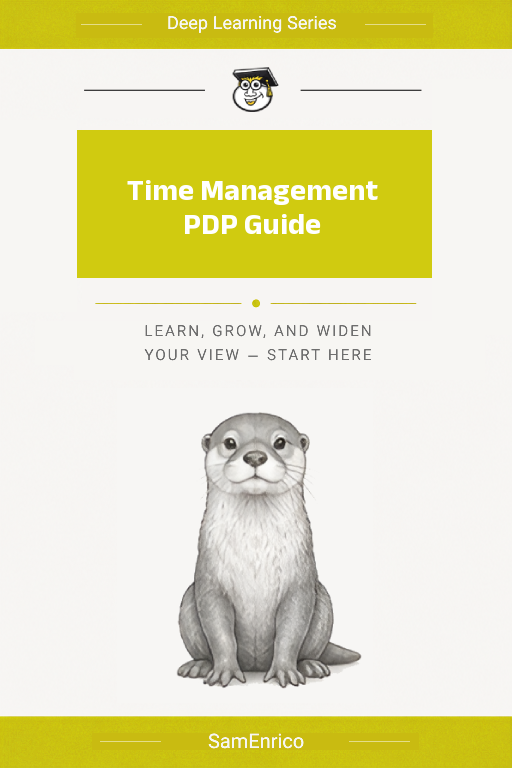
Non-FictionProfessional's Cheat SheetTime ManagementProductivity
Time Management PDP Guide eBook
Build personal development plan for time managemen
by Mack Pat
Build personal development plan for time management including productivity systems and meeting efficiency goals.
Formats
Free sample
Chapter 1: The 168-Hour Lie--We have been taught to believe that time management is about squeezing more into every hour. It is not. It is about discovering where your hours actually go versus where you believe they go. The gap between perception and reality is the single greatest source of chronic busyness, and closing that gap is the first and most critical act of your Personal Development Plan.Most people feel perpetually overwhelmed. They describe their weeks as “crazy,” “out of control,” or “too full.” When asked where the time went, they gesture vaguely at meetings, emails, and the general chaos of modern knowledge work.
But here is the uncomfortable truth that every best-selling productivity book eventually reveals: you cannot manage what you do not measure, and you have probably never measured your time with any real accuracy.This chapter introduces the foundational diagnostic tool of the entire PDP system: the 168-Hour Audit. Unlike the abstract advice you will find in articles about “prioritization” or “focus,” this audit is a forensic reconstruction of your last seven days. It will show you, with cold hard data, exactly where your life is going. And for many readers, the results will be shocking. You will discover that you are not too busy.
You are too fragmented.The 168-Hour Audit is not a guilt exercise. It is a baseline. Every subsequent chapter in this book—from habit design to deep work protocols to meeting minimalism—depends on the accuracy of this initial measurement. Without it, you are building a productivity system on the shifting sands of self-deception. With it, you have a foundation of truth.Let us begin.The Finite Container You have exactly 168 hours this week.
Every person on earth receives the same allotment. Billionaires, astronauts, single parents, and CEOs all operate within this identical constraint. The difference between those who feel constantly behind and those who feel in control is not the number of hours they have. It is how accurately they perceive their use of those hours.The average knowledge worker drastically overestimates the amount of time spent on deep, valuable work and dramatically underestimates time lost to transition, context switching, and unconscious distraction. This is not a moral failing.
It is a cognitive bias. The brain is not designed to track time accurately; it is designed to track meaning, threat, and reward. When you spend forty-five minutes “just checking” social media, your brain does not log that as forty-five minutes of waste. It logs it as a series of small dopamine hits. When you spend two hours in a meeting that should have been an email, your brain does not calculate the opportunity cost.
It simply marks the meeting as “completed.”The 168-Hour Audit forces your brain to confront reality. It is a mirror held up to your week, and like any good mirror, it shows you things you would rather not see. That is the point.The Four Buckets of Time Before you can measure, you need categories. The PDP system divides all waking time into four distinct buckets. These categories are not arbitrary; they are derived from the synthesis of dozens of productivity studies and best-selling books, including Cal Newport’s distinction between deep and shallow work and David Allen’s separation of actionable from non-actionable time.Bucket One: Deep Work Deep Work is professional activity performed in a distraction-free state that pushes your cognitive capabilities to their limit.
These are the tasks that create your highest value: strategic planning, complex writing, data analysis, creative problem-solving, coding, learning difficult material, and anything else that requires sustained, uninterrupted concentration.The key特征是 that deep work is hard. It feels effortful. You cannot do it while checking your phone, listening to a podcast, or glancing at email. Deep work produces the outputs that actually advance your career and your life. It is also the category that most people overestimate.
When asked, “How much deep work did you do this week?” the average knowledge worker will guess ten to fifteen hours. The actual number, revealed by the audit, is often three to five.Bucket Two: Shallow Work Shallow Work is logistical, low-cognitive-load activity that can be performed while distracted. This includes responding to routine emails, scheduling appointments, updating spreadsheets, filing documents, expense reporting, and most “administrative” tasks. Shallow work is necessary. It keeps the wheels turning.
But it does not create disproportionate value, and it should never consume your peak energy hours.The problem is not shallow work itself. The problem is that most people do shallow work during their biological prime time, leaving their depleted afternoon hours for deep work. This is like using a Ferrari to drive to the mailbox.Bucket Three: Administration Administration is a subset of shallow work that involves coordination with others: meeting logistics, calendar management, approval routing, and any task where you are waiting for someone else to respond before you can proceed. These tasks are uniquely dangerous because they create the illusion of progress without actual output. Sending an email feels productive.
It is often not.Bucket Four: Reactive Waste Reactive Waste is time lost to unintentional, default behaviors. This includes unconscious social media scrolling, ambiguous “transition time” between tasks, checking notifications out of habit, staring at a screen trying to remember what you were doing, and any activity that you did not consciously choose. Reactive Waste is not the same as rest, which is intentional. It is the opposite of intentional. It is the default mode of an unmanaged attention system.Crucially, Reactive Waste is different from what Chapter Twelve will call Intentional White Space.
White Space is scheduled, deliberate unstructured time for creativity and restoration. Reactive Waste is the collapse of intention into distraction. The distinction is intention versus reaction. Throughout this book, you will learn to eliminate Reactive Waste while protecting and even expanding Intentional White Space. But first, you must measure both.The Energy Map The 168-Hour Audit has a companion exercise called the Energy Map.
While the audit tracks where your time goes, the Energy Map tracks the quality of that time. You cannot simply move tasks around on a calendar; you must align tasks with your biological energy patterns.For one week, every hour that you are awake, you will rate your energy level on a scale from one to ten. One means you can barely keep your eyes open. Ten means you are sharp, focused, and ready for cognitive combat. You do not need special equipment.
A notebook or a notes app will suffice. Every hour, write down your energy number and a one-word description of what you were doing.At the end of the week, you will plot your energy levels on a timeline. Most people discover two startling patterns. First, their energy does not remain constant throughout the day. It peaks and troughs in predictable cycles, usually two to four hours after waking and again in the late afternoon for some chronotypes.
Second, their energy is drastically misaligned with their task difficulty. They do their hardest deep work at 3:00 PM, when their energy is at a six, and their shallow email processing at 9:00 AM, when their energy is at a nine.The Energy Map reveals your…
This is the end of the free sample. Get the eBook to keep going. Buy now
About this book
Details
- Author
- Mack Pat
- Publisher
- SamEnrico
- Language
- English
- Genre
- Non-Fiction, Professional's Cheat Sheet, Time Management, Productivity
- Released
- 2026-05-30
- Pages (approx.)
- 148
- Available as
- eBook, Audiobook

Read better in the ZLOADR app
Your eBooks on your phone or tablet. Sign in with your SamEnrico account and start reading.
More by Mack Pat
 Calisthenics Advanced Skills GuideMack Pat$11.99
 Hungarian Green Incentives HandbookMack Pat$11.99
 UK Electric Heat Pump Grant GuideMack Pat$11.99
 The Six Month Sleep GuideMack Pat$11.99
 Innocence Project Arizona CasesMack Pat$11.99
 The Ghost in the Machine: How a Teen Hacker Brought the Internet to Its KneesMack Pat$11.99
 Love in the Time of Spreadsheets: The Unlikely Romance of Bill Gates and Melinda FrenchMack Pat$11.99
 How to Start a Motor Vehicle Body Manufacturing BusinessMack Pat$11.99
 Understanding Chromosome 18, Trisomy 18qMack Pat$17.99
 ITA to PR Timeline GuideMack Pat$12.99
 Business Simplification for ScaleMack Pat$11.99
You may also like
 Hong Kong Handover 1997Dunn Johnnie$11.99
 Zumba For Postnatal Recovery CourseNeal Christian$11.99
 Zumba for BeginnersLadner Nikia$11.99
 YouTube Comment Mining GuideHumes Pandora$12.99
 Worry Box MeditationCarlin Rudy$11.99
 Workplace Stress MeditationNguyen Lynn$11.99
 Workplace Stress and Sleep RepairHawley Ivory$11.99
 Workplace Perfectionism CureDelaney Jeffry$11.99
 Workplace Injustice Anger GuideWallen Isabelle$11.99
 Work Addiction and Burnout LinkGreenwood Ester$11.99
 Women in Yoga and WellnessBeattie Galina$11.99
 Women in Stand Up ComedyChun Evangeline$11.99