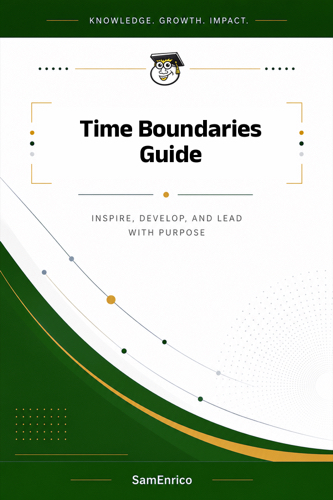
Time Boundaries Guide eBook
Protects your schedule and stops others from steal
Protects your schedule and stops others from stealing your hours.
Formats
Free sample
Chapter 1: The Interruption Tax--Most people believe that being constantly available is a virtue—a sign of dedication, teamwork, or kindness. I believed it too. For years, I kept my door open, my phone on, my notifications buzzing, and my calendar filled with "quick syncs" and "five-minute check-ins." I thought I was being helpful. I thought I was building relationships. I thought busyness was the same as importance.I was wrong.
And the cost of that mistake was measured not in stress or fatigue—though there was plenty of that—but in something far more concrete: hours. Actual, irreplaceable hours of my life that I would never get back.This chapter will introduce you to a concept that will appear throughout this entire book: The Interruption Tax. It is the single most important idea in understanding why you feel time-poor despite working harder than ever. Once you understand the Interruption Tax, you will never look at a "quick question" the same way again.The Myth of the Always-On Professional Let me start with a story.A few years ago, I was managing a team of twelve people in a fast-paced marketing agency. My calendar looked like a patchwork quilt of thirty-minute meetings, stacked back-to-back from 9 AM to 5 PM.
I prided myself on being responsive. If someone Slack messaged me, they got an answer within two minutes. If someone knocked on my door, I said "come in" before they finished knocking. I ate lunch at my desk while answering emails. I checked my phone during bathroom breaks.I thought I was a rockstar.Then one Friday afternoon, my boss asked me to send her a simple report.
It was a report I had written before. I knew exactly where the file was. It would take me, at most, fifteen minutes to pull the numbers, update the charts, and send it off.I started at 2:00 PM.By 5:00 PM, I had not sent the report. I had answered seventeen Slack messages, attended two "emergency" meetings that turned out to be non-emergencies, helped three teammates with their own problems, and replied to twenty-three emails. I had spent three hours being "productive" and had accomplished exactly nothing that I had intended to do.I stayed late.
I sent the report at 6:30 PM. I missed dinner with my family. I was exhausted, resentful, and confused. How could I have worked so hard and gotten so little done?The answer, I would later learn, was the Interruption Tax.What Is the Interruption Tax?The Interruption Tax is the hidden cost of switching your attention from one task to another. Every time you stop what you are doing to respond to an external demand—a message, a question, a notification, a knock on the door—your brain does not simply pause and resume.
It goes through a costly cycle of disengagement, context switching, and re-engagement. That cycle costs time, energy, and cognitive precision.Here is the shocking number: research on task switching shows that it takes an average of twenty minutes to fully return to your original level of focus after an interruption. Twenty minutes. That means a single "quick question" that takes thirty seconds to answer can cost you nearly half an hour of productive time.Let me say that again because it is so easy to dismiss: A thirty-second interruption costs twenty minutes.Now multiply that by the number of interruptions you experience in a typical day. If you are like most professionals, you experience between ten and twenty interruptions per day.
That is between three and six hours of lost productivity—every single day. The Interruption Tax is not a small inefficiency. It is a wholesale transfer of your time from you to everyone else who wants a piece of it.The Neuroscience of Task Switching To understand why the Interruption Tax is so costly, you need to understand a little bit about how your brain actually works. The popular idea of "multitasking" is a myth. Your brain is not capable of doing two attention-requiring tasks at the same time.
What you call multitasking is actually rapid task switching—your brain jumping back and forth between tasks so quickly that it creates the illusion of simultaneity.Here is what happens inside your brain during an interruption.Phase One: Disengagement. When you are focused on a task, your brain has activated a specific neural network. That network is like a spotlight, illuminating the information relevant to your task and dimming everything else. When an interruption occurs—a notification, a question, a knock—your brain has to disengage that network. This takes a few seconds, but those seconds are just the beginning.Phase Two: Attention Capture.
The interruption captures your attention. Your brain evaluates the new stimulus: Is it a threat? Is it a reward? Is it relevant? This evaluation happens automatically, but it consumes cognitive resources.
Even if you decide to ignore the interruption, the act of deciding has already cost you.Phase Three: Context Switching. This is the expensive part. Your brain has to unload the context of your original task from working memory and load the context of the interruption. Working memory is limited—it can hold only about four chunks of information at once. When you switch tasks, you are effectively deleting the previous context and writing a new one.
That process is metabolically expensive and time-consuming.Phase Four: Response. You respond to the interruption. This might take ten seconds or ten minutes. But here is the trap: even after the interruption is resolved, your brain is still in "interruption mode," primed for the next incoming demand. This is why checking one notification often leads to checking all of them.Phase Five: Re-engagement.
Now you need to return to your original task. But your brain does not remember exactly where you were. You have to reorient yourself. You have to re-read the last few paragraphs. You have to remember the thought you were developing.
This re-engagement phase is where the twenty minutes come from.The total cost of a single interruption is the sum of all five phases. That is the Interruption Tax.The Myth of the "Quick Question"The most dangerous interruption is the one that pretends to be harmless: the "quick question.""Hey, got a sec?""Just one quick thing.""Do you have five minutes?"These phrases are the linguistic camouflage of the Interruption Tax. They make the interruption sound small, trivial, and easy to accommodate. But as you now know, there is no such thing as a quick interruption. Every interruption—regardless of how long the interruption itself lasts—carries the full twenty-minute tax.I want you to pause and think about the last time someone asked you a "quick question." How long did the actual conversation take?
Probably less than five minutes. But how long did it take you to get back into your original task? Be honest with yourself. Did you immediately resume working at full focus? Or did you check your email, glance at your phone, or stare at the wall for a bit before diving back in?The answer is almost certainly that you did not resume immediately.
And that is not a personal failing. It is neurology.The Interruption Tax in Real Life Let me give you some…
This is the end of the free sample. Get the eBook to keep going. Buy now
About this book
Details
- Author
- Ambrose Cameron
- Publisher
- SamEnrico
- Language
- English
- Genre
- Non-Fiction, Self-Help / Time Management
- Released
- 2026-06-08
- Pages (approx.)
- 143
- Available as
- eBook, Audiobook

Read better in the ZLOADR app
Your eBooks on your phone or tablet. Sign in with your SamEnrico account and start reading.
More by Ambrose Cameron
 Keto For Cancer Metabolic TherapyAmbrose Cameron$11.99
 Anger De escalation for CoworkersAmbrose Cameron$11.99
 Enmeshed Family Self BoundariesAmbrose Cameron$11.99
 Stay at Home Parent GamblingAmbrose Cameron$11.99
 Underground Cave System TheoryAmbrose Cameron$11.99
 Therapist Guide To Nightmare RescriptingAmbrose Cameron$11.99
 Professor Communication TipsAmbrose Cameron$11.99
 The Healers of Nubia: The Lost Medical Wisdom of the Kushite KingdomAmbrose Cameron$11.99
 Armada: The Storm That Shattered Spain's DreamAmbrose Cameron$11.99
 How to Produce Golf ToysAmbrose Cameron$11.99
 How to Produce Spoon RestsAmbrose Cameron$11.99
 A Collector's Handbook to the Daimler Double-six Series IiiAmbrose Cameron$11.99