
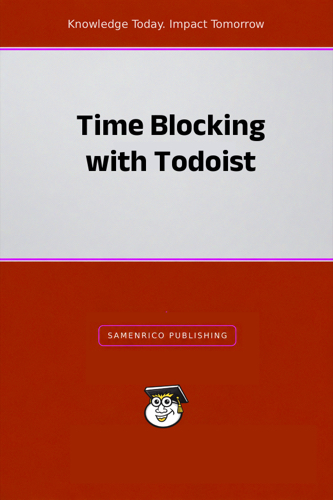
Time Blocking with Todoist eBook
Sync tasks with calendar for time blocked action i
by Kirk Jazmin
Sync tasks with calendar for time blocked action items.
Formats
Free sample
Chapter 1: The Inbox Lie--You have 847 completed tasks in Todoist this year. You feel like you’ve accomplished nothing.Let me say that again, because it’s important: eight hundred and forty-seven tasks. Checked off. Finished. Sent.
Filed. Done. And yet, sitting here reading these words, some part of you suspects that you’re falling behind. That you’re not really productive. That despite the endless stream of checkmarks, the important things—the big things, the career-defining projects, the creative work, the quality time with family—keep slipping through your fingers like water.I know this feeling intimately because I lived it.
For three years, I was a Todoist power user with a perfect system. Every task was captured. Every project was nested. Every label was color-coded. I had filters for everything: “Today,” “This Week,” “Waiting,” “Someday.” My Karma score was flawless.
I was, by every metric of the app, a productivity genius.And I was completely exhausted.Not the good kind of exhaustion—the kind that comes after a hard day of meaningful work. No, this was the hollow, brittle fatigue of someone who had spent all day shuffling digital paper while the real work sat untouched. I would lie in bed at night, scrolling through my completed tasks, and feel a strange emptiness. I had done so much. Why did it feel like so little?The answer, which took me years to understand, is the subject of this chapter and the foundation of this entire book: A task without a time block is merely a wish.The Open Loops That Haunt You David Allen, the father of the Getting Things Done methodology, coined a term that changed how I think about productivity: open loops.
An open loop is any unresolved commitment that your brain continues to process in the background. It’s the email you haven’t replied to. The project you haven’t started. The conversation you need to have. The errand you keep forgetting.Your brain is not a hard drive.
It’s not designed to store and manage lists of pending tasks. When you keep open loops rattling around in your head, two things happen: first, you experience low-grade, continuous anxiety (the feeling that you’re forgetting something). Second, your cognitive performance degrades because your brain is using precious working memory to track unfinished business instead of focusing on the present moment.Here’s what most people get wrong: they think dumping all their open loops into Todoist closes the loops. It does not.Dumping tasks into Todoist is like taking all the clutter from your kitchen counter and shoving it into a closet. The clutter is still there.
The mental weight is still there. You’ve just hidden it from view. Your brain knows the closet is full. Your brain knows those tasks are still waiting. And until those tasks are attached to a specific moment in time—a real block on a real calendar—they will continue to tax your cognitive resources.I call this phenomenon The Inbox Lie: the false belief that capturing a task is the same as committing to it.The truth is that capturing is only the first step.
The second step—the step almost everyone skips—is deciding when the task will happen. Not a due date. Not a deadline. A specific, calendared appointment with yourself.The Two-Bucket Myth Stephen Covey, in his timeless book The 7 Habits of Highly Effective People, introduced the world to the Time Management Matrix. You’ve seen it a hundred times: a two-by-two grid where one axis is Urgent vs.
Not Urgent and the other axis is Important vs. Not Important. The goal, Covey argued, is to spend most of your time in Quadrant II: Important but Not Urgent. That’s where strategic planning, relationship building, and deep work live.This matrix is brilliant. It’s also, for most people, completely useless.Why?
Because the matrix tells you what matters, but it doesn’t tell you when to do it. A task can sit in Quadrant II for months—years, even—and never get done. It’s important. It’s not urgent. So it waits.
And waits. And waits. Meanwhile, Quadrant I (Important and Urgent) and Quadrant III (Not Important but Urgent) consume your entire day because they come with screaming deadlines, ringing phones, and pinging notifications.I call this The Two-Bucket Myth: the belief that sorting tasks into “Important” and “Urgent” is enough to get them done.It is not enough. In fact, it’s barely the beginning.Here’s what Covey didn’t emphasize enough: the only thing that moves a task from “Important but Not Urgent” to “Done” is a calendar block. Not a priority flag.
Not a label. Not a due date. A specific, inviolable appointment with yourself where you sit down and do the work.Think about the last time you actually completed an important but non-urgent project. Maybe it was a business plan. Maybe it was a home renovation.
Maybe it was training for a marathon. How did it happen? Did it happen because you kept it on a list? No. It happened because you blocked out time.
You said, “Saturday morning, 8 AM, I’m running.” You said, “Tuesday and Thursday evenings, 7 PM, I’m working on the business plan.” You created appointments with yourself and you kept them.That is time blocking. That is the only thing that works.The Failure Guilt Cycle Let me describe a cycle that I suspect will feel painfully familiar.Monday morning. You open Todoist. Your “Today” view has twenty-three tasks. Some are leftovers from last week.
Some are new. Some are important. Most are not. You feel a small spike of anxiety—there’s no way you can do twenty-three things today—but you push through. You start checking off the easy ones: reply to that email, order those supplies, update that spreadsheet.
By 11 AM, you’ve completed seven tasks. You feel a tiny dopamine hit with each checkmark.By 3 PM, you’ve completed twelve tasks. But the four most important tasks—the ones that would actually move your career forward—are still untouched. They’re too hard. They require focus.
They require time you don’t have because you spent the morning doing easy things.By 5 PM, you’re exhausted. You’ve completed fifteen tasks. But the big ones remain. You tell yourself you’ll do them tomorrow. You drag them to the next day.
You close your laptop and feel… nothing. No satisfaction. No accomplishment. Just the hollow awareness that you spent another day being busy instead of being productive.Tuesday morning. The cycle repeats.
Only now, the big tasks are joined by new urgent tasks that arrived overnight. The pile grows. The anxiety intensifies. By Friday, you have forty-seven tasks in your “Today” view. You stop looking at it.
You stop trusting your own system. You start using Todoist as a dumping ground rather than a command center.This is The Failure Guilt Cycle. It has three stages:Over-capture. You add every task that crosses your mind, believing that more tasks on the list means more organization.Under-schedule. You assign due dates and priorities but never assign actual calendar blocks.…
This is the end of the free sample. Get the eBook to keep going. Buy now
About this book
Details
- Author
- Kirk Jazmin
- Publisher
- SamEnrico
- Language
- English
- Genre
- Non-Fiction, Self-Help, Todoist
- Released
- 2026-06-07
- Pages (approx.)
- 147
- Available as
- eBook, Audiobook

Read better in the ZLOADR app
Your eBooks on your phone or tablet. Sign in with your SamEnrico account and start reading.
More by Kirk Jazmin
 X Engagement Farming StudyKirk Jazmin$11.99
 Emotional Contagion InfluenceKirk Jazmin$11.99
 Remote Work Stress SolutionsKirk Jazmin$11.99
 Iron Deficiency and Restless Leg ConnectionKirk Jazmin$11.99
 Fenrir’s Lessons: The Wolf Who Shaped the GodsKirk Jazmin$11.99
 Understanding Karsch–neugebauer SyndromeKirk Jazmin$17.99
 Recruitment CoordinatorKirk Jazmin$11.99
 Night Before Presentation Sleep GuideKirk Jazmin$12.99
 Africa Talent Brain Drain GuideKirk Jazmin$12.99
 How to Start a Bus Carding Business (Beginners Guide)Kirk Jazmin$11.99
You may also like
 Hong Kong Handover 1997Dunn Johnnie$11.99
 Zumba For Postnatal Recovery CourseNeal Christian$11.99
 Zumba for BeginnersLadner Nikia$11.99
 YouTube Comment Mining GuideHumes Pandora$12.99
 Worry Box MeditationCarlin Rudy$11.99
 Workplace Stress MeditationNguyen Lynn$11.99
 Workplace Stress and Sleep RepairHawley Ivory$11.99
 Workplace Perfectionism CureDelaney Jeffry$11.99
 Workplace Injustice Anger GuideWallen Isabelle$11.99
 Work Addiction and Burnout LinkGreenwood Ester$11.99
 Women in Yoga and WellnessBeattie Galina$11.99
 Women in Stand Up ComedyChun Evangeline$11.99