
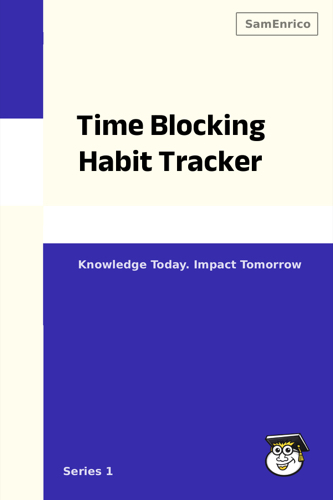
Time Blocking Habit Tracker eBook
Log completed blocks to build consistency and iden
Log completed blocks to build consistency and identify improvement areas.
Formats
Free sample
Chapter 1: The 40% Lie--–- You wake up convinced today will be different. You have a clear plan. Your calendar is blocked. Your to-do list is prioritized. By 11:00 AM, you are already behind.
By 3:00 PM, you have abandoned the plan entirely. By 9:00 PM, you collapse into bed, exhausted, wondering where the day went. You tell yourself you worked hard. You tell yourself you were productive. Deep down, you know the truth: you have no idea what you actually accomplished.This is not a failure of discipline.
This is a failure of measurement.Every night, millions of hardworking, well-intentioned people go to bed believing they put in a ten-hour day. Their calendars show back-to-back meetings. Their to-do lists have satisfying checkmarks next to low-value tasks. But when asked what they actually achieved—what meaningful progress they made on their most important priorities—they cannot answer. The gap between how busy they felt and what they actually accomplished is not small.
It is massive. And it is invisible to them precisely because they are not measuring the right thing.This book exists because that gap is not your fault. You have been trained to plan. You have been trained to prioritize. You have been trained to fill your calendar.
No one has ever trained you to log what you actually complete and compare it to what you planned. That single missing habit—the habit of tracking your completed blocks—is the difference between feeling busy and being effective. It is the difference between burnout and sustainable high performance. And it is the single most underrated productivity practice in the world.Let me show you the lie first. Then I will show you the way out.The Myth of the Full Calendar Let us start with a simple question: What did you actually accomplish yesterday?Not what did you do.
Not how many hours were you at your desk. Not how many emails did you send. What did you accomplish? What meaningful progress did you make on something that actually matters to your work, your goals, or your life?Most people cannot answer this question with specificity. They can describe activity.
They cannot describe outcome. And there is a reason for that. Your brain is not designed to remember what you accomplished. It is designed to remember what you did. Activity is memorable.
Accomplishment is not.This is not a character flaw. It is a cognitive bias called completion neglect. Your brain systematically overestimates productive time and underestimates distractions because it wants to protect your self-image. You feel busy, so you assume you were productive. You feel tired, so you assume you worked hard.
But feeling and reality are not the same thing. Your feelings are interpretations. Your log is data.Consider a typical knowledge worker’s day. They arrive at 9:00 AM. They check email for thirty minutes.
They attend a one-hour meeting that could have been an email. They spend forty-five minutes “transitioning” between tasks—checking Slack, grabbing coffee, organizing files. They do thirty minutes of focused work before lunch. After lunch, they are groggy. They answer more emails.
They attend another meeting. They spend the last hour of the day rushing to finish something—anything—so they do not leave empty-handed.At 6:00 PM, they look back and think: “I worked all day.” But how many hours of focused, meaningful work did they actually complete? Two? Maybe three? The rest was noise.
The rest was activity masquerading as productivity.The full calendar is a liar. A calendar packed with meetings, shallow tasks, and transitions feels productive because it looks full. But fullness is not a measure of value. A garbage can full of trash is full. That does not make it valuable.
Your calendar is the same. You can fill every hour with low-value activity and feel exhausted at the end of the day. That exhaustion is not evidence of hard work. It is evidence of energy spent on things that do not matter.The Feedback Loop You Never Knew You Needed Every successful system in the world has a feedback loop. Thermostats measure temperature and adjust.
Athletes watch game footage and adjust. Businesses track revenue and adjust. Feedback loops are how anything improves. Without a feedback loop, you are not improving. You are guessing.Traditional productivity systems—to-do lists, calendars, planners, even most time blocking methods—have no feedback loop.
You plan. You execute (or fail to execute). And then you plan again, using the same assumptions that failed you yesterday. You never measure the gap between your plan and your reality. You never ask: “How many of my planned blocks did I actually complete?” You never know.
So you never improve.This book introduces one new habit that changes everything: logging your completed blocks. Not your tasks. Not your hours. Your blocks—the discrete chunks of time you dedicate to specific activities. And not your intentions.
Your completions.Logging is not planning. Planning is what you do before you work. Logging is what you do during and after you work. Planning asks: “What do I intend to do?” Logging asks: “What did I actually do?” The two questions seem similar. They are not.
The gap between them is where your productivity lives or dies.Here is the core philosophy of this book, stated as simply as possible:Log ≠ Schedule Your schedule is your aspiration. It is what you hope will happen. Your log is your reality. It is what actually happened. You cannot improve what you do not measure.
And you cannot measure what you do not log.Most people spend 100% of their productivity energy on the schedule. They craft the perfect calendar. They color-code their blocks. They feel a sense of accomplishment simply from planning. But planning is not doing.
A beautiful schedule with zero completed blocks is worth exactly nothing. The only thing that matters is what you actually finish.The log is the mirror that never lies. It shows you exactly how you spent your time, not how you intended to spend it. It reveals the gap between your ambition and your execution. And it gives you the data you need to close that gap, one block at a time.Why Traditional Time Blocking Fails Time blocking is not a new idea.
Cal Newport made it famous in Deep Work. The concept is simple: instead of a to-do list, you assign specific tasks to specific blocks of time on your calendar. You do not just write “write report.” You write “write report, 9:00–11:00 AM.” This forces you to confront the reality of limited time.Time blocking works better than to-do lists. Research and experience both confirm this. But traditional time blocking has a fatal flaw: it stops at the schedule.
You block your time. You try to follow the blocks. And then you move on to tomorrow without ever measuring how well you actually followed through.This is like a basketball coach drawing up a brilliant play, sending the team onto the court, and then never watching the game footage. Did the play work? Did the players execute?
Were the assumptions correct? Without footage, you do not know. Without a log, you do not know either.Traditional time blocking fails…
This is the end of the free sample. Get the eBook to keep going. Buy now
About this book
Details
- Author
- Wharton Alease
- Publisher
- SamEnrico
- Language
- English
- Genre
- Non-Fiction, Self-Help, Habit Tracking
- Released
- 2026-06-12
- Pages (approx.)
- 138
- Available as
- eBook, Audiobook

Read better in the ZLOADR app
Your eBooks on your phone or tablet. Sign in with your SamEnrico account and start reading.
More by Wharton Alease
 Student Visa Dubai ProcessWharton Alease$11.99
 Parenting With EQ GuideWharton Alease$11.99
 LBO Value Realization GuideWharton Alease$11.99
 Self Hypnosis for Breathing SleepWharton Alease$11.99
 Reconstruction of HyperthermiaWharton Alease$11.99
 OKR For Health GoalsWharton Alease$11.99
 Emotional Validation for UnemployedWharton Alease$11.99
 The Witch Hunts of 21st Century: Modern Inquisitions and Mass HysteriaWharton Alease$11.99
 The Iron Storm: The Birth of the Tank in the Great War's Mud and BloodWharton Alease$11.99
 How to Produce DartsWharton Alease$11.99
 A Collector's Handbook to the Volkswagen 1600teWharton Alease$11.99
 How to Produce PET Steps and RampsWharton Alease$11.99
You may also like
 Habit Streak ReviewSpencer Jessica$11.99
 The Quit Smoking Accountability WorkbookPresley Sheryll$11.99
 Walking Meditation TrackerGreco Jaleesa$11.99Walking Meditation TrackerGreco Jaleesa$11.99
 The Spending Habit TrackerAyers Ma$11.99
 Mindful Checklist MBSR Daily LogGonsalves Thad$11.99
 Weekly Review Habit Tracker WorkbookCorcoran Caprice$11.99
 Transcendental Meditation Daily LogGarvin Corey$11.99
 Resentment Tracking LogCarvalho Ione$11.99
 Habit Tracker MethodJewett Rosalee$11.99
 Weekly Habit Tracker ReviewQuinn Charles$11.99