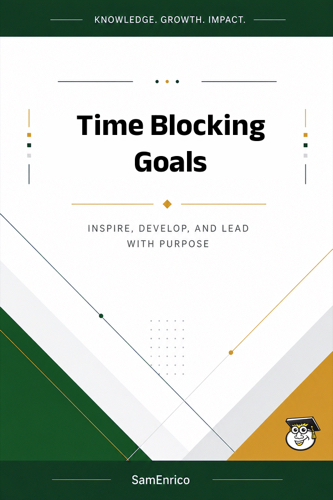
Time Blocking Goals eBook
Schedule specific blocks for goal related work.
Schedule specific blocks for goal related work.
Formats
Free sample
Chapter 1: The Calendar Lie--–- You are not too busy. You are too passive.Let me say that again, because your brain will try to reject it: You are not too busy. You are too passive. The difference between these two statements is the difference between a life spent reacting to everyone else’s priorities and a life spent building your own. And if you picked up this book, you already know which side you have been living on.For years, you have told yourself a story.
The story goes like this: “I have big goals. I want to write the book, start the business, get in shape, learn the skill, make the change. But I just don’t have enough time. Between work, family, emails, errands, and the thousand small fires I put out every day, there are no hours left for what actually matters.” That story feels true because it is repeated so often. It feels like gravity, like weather, like a fact of life.
But it is not a fact. It is a choice disguised as a constraint.Every person who has ever achieved anything extraordinary faced the same twenty-four hours you face today. The difference was never about having more time. The difference was about what they were willing to put on a calendar and defend. This chapter dismantles the myth of “finding time” and replaces it with something far more powerful: the act of allocation.
By the time you finish reading, you will understand why your to-do list has been lying to you, why your calendar is currently a crime scene, and how a simple shift in mindset from Reactor to Actor will change everything.The Myth of “Finding Time”Let us start with a simple experiment. Think about the last time you said the words, “I’ll get to that when I have time.” Now ask yourself honestly: Did that moment ever arrive? For the vast majority of people, the answer is no. “Someday” is not a day of the week. “When things calm down” is not a date on the calendar.
And “I’ll find time” is a promise you make to yourself that you almost never keep.The reason is simple: time is never found. Time is always allocated. You do not stumble across an extra hour like a twenty-dollar bill in an old coat pocket. You take an hour from something else. You steal it from sleep, from television, from social media, from the endless scroll, from the meeting that could have been an email, from the task you said yes to out of obligation rather than conviction.
Every moment you spend on one thing is a moment you have chosen not to spend on something else. That is not a limitation. That is the fundamental structure of reality.Most people live as if time were a renewable resource that will somehow expand to accommodate their ambitions. It will not. Your calendar is not a suggestion box.
It is a ledger. Every hour is a debit, and you cannot spend the same hour twice. Once you accept this—truly accept it—the question changes from “How do I find more time?” to “What am I currently spending my time on that does not deserve to be there?”That second question is uncomfortable. It forces you to look at your choices rather than your constraints. It forces you to admit that you spent forty-five minutes yesterday watching a video you do not even remember.
It forces you to acknowledge that you checked your email seventeen times before noon, not because any of those messages were urgent, but because checking email feels like productivity while requiring almost no mental effort. The myth of “finding time” protects you from this discomfort. It lets you blame the clock instead of your calendar. But the clock is innocent. The clock is neutral.
The only question is whether you will continue to let your calendar be a passive log of where your time went or transform it into an active blueprint for who you become.Busyness Is Not Productivity Here is a truth that will hurt: Being busy is not the same as being productive. In fact, busyness is often the enemy of productivity. Busyness is reactive. Busyness is the state of responding to whatever arrives next. Busyness feels like motion, but motion is not the same as progress.
You can run on a treadmill for hours and end up exactly where you started.Productivity, on the other hand, is proactive. Productivity is the state of making deliberate progress toward a chosen goal. It requires saying no to good things so you can say yes to great things. It requires sitting with the discomfort of unfinished tasks while you focus on what actually matters. And it requires something that busyness never demands: a calendar with blocks of time dedicated exclusively to your goals, not to other people’s emergencies.Think about your typical workday.
How many times do you switch between tasks? Research suggests that the average knowledge worker switches tasks every three to five minutes. Each switch costs not only the time of the switch itself but also the time required to regain focus afterward—what psychologists call “attention residue.” By the end of the day, you may have worked for eight hours, but you have spent most of those hours recovering from interruptions rather than making progress on anything meaningful. That is busyness. That is exhaustion without achievement.
And that is what most people mistake for a full day of work.Now consider a different approach. Imagine waking up and looking at your calendar. You see a block from 8:00 AM to 9:30 AM labeled with a specific goal: “Write 500 words of Chapter 3.” You see another block from 10:00 AM to 10:30 AM labeled “Email and admin.” You see a block from 11:00 AM to 12:30 PM labeled “Client project research.” You see a block from 1:30 PM to 2:00 PM labeled “Lunch and walk.” And then you see another goal block from 2:00 PM to 3:30 PM labeled “Outline quarterly plan.” At the end of that day, you have not been busy in the chaotic, reactive sense. But you have been productive. You have moved the needle on three different priorities.
You have handled your email without letting it hijack your morning. And you have ended the day with clear evidence of progress rather than the vague exhaustion of having “done a lot.”That is the difference between a Reactor and an Actor. The Reactor looks at the day and asks, “What demands my attention right now?” The Actor looks at the calendar and asks, “What did I decide to do right now?” The Reactor is a slave to the inbox. The Actor is the master of the block. And the only thing separating them is the willingness to schedule goal work as if it were a meeting with the most important person in your life—because it is.
That person is you.The Eisenhower Matrix: Urgent vs. Important To understand why your current approach is failing, you need a framework. One of the most powerful tools for distinguishing between busyness and productivity is the Eisenhower Matrix, named for President Dwight D. Eisenhower, who famously…
This is the end of the free sample. Get the eBook to keep going. Buy now
About this book
Details
- Author
- Connors Daryl
- Publisher
- SamEnrico
- Language
- English
- Genre
- Non-Fiction, Self-Help, Time Blocking
- Released
- 2026-06-09
- Pages (approx.)
- 150
- Available as
- eBook, Audiobook

Read better in the ZLOADR app
Your eBooks on your phone or tablet. Sign in with your SamEnrico account and start reading.
More by Connors Daryl
 Writing Goal SettingConnors Daryl$11.99
 Restaurant Dividend StocksConnors Daryl$11.99
 The Distraction Proof Parent GuideConnors Daryl$11.99
 Nonprofit Culture Shock Survival GuideConnors Daryl$11.99
 Meth Sexual DysfunctionConnors Daryl$11.99
 Grief and Medication After Child LossConnors Daryl$11.99
 Burnout Recovery Gratitude PracticeConnors Daryl$11.99
 The Oxford Conspiracy: Scholars, Spies, and the Birth of Modern ScienceConnors Daryl$11.99
 Odysseus Unbroken: The Mentor’s Last LessonConnors Daryl$11.99
 How to Produce Medical Cryogenic EquipmentConnors Daryl$11.99
 How to Produce Wiring AccessoriesConnors Daryl$11.99
 Growing AgastacheConnors Daryl$11.99