
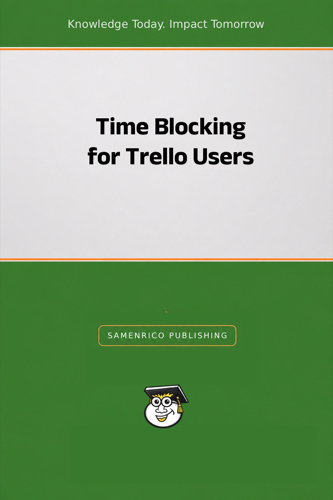
Time Blocking for Trello Users eBook
Turn Trello cards into time blocked calendar event
by Fields Daisy
Turn Trello cards into time blocked calendar events.
Formats
Free sample
Chapter 1: The Trello Trap--–- Maria was a true Trello believer. As a senior product manager at a fast-growing software company, she had built an elaborate Trello ecosystem that her entire team admired. Her main board contained over two hundred cards, organized into fifteen lists, color-coded by priority, tagged with custom fields for estimated effort, and filtered into dozens of saved views. She had mastered every Power-Up, every Butler automation, every keyboard shortcut. New employees shadowed her to learn Trello best practices.
Her teammates called her the "Trello whisperer."–- And yet, Maria was drowning.–- Every morning, she opened her perfect board and felt a wave of nausea. The cards stared back at her like accusatory fingers. "You haven't updated the Q3 roadmap," said the red label. "The client proposal is overdue," said the flashing due date. "The engineering spec needs review," said the attachment icon.
Maria would spend the first hour of her day just reorganizing—moving cards between lists, updating labels, adding comments, reassigning tasks. It felt productive. It felt like progress. But by 5 PM, she had barely touched the work that actually mattered.–- She tried everything. She read productivity books.
She listened to podcasts about deep work. She bought a fancy paper planner. She tried the Pomodoro Technique, the Eisenhower Matrix, GTD, and a half-dozen other acronyms. Nothing worked. Her Trello board remained a source of anxiety rather than clarity.–- The problem was not Maria.
The problem was not Trello. The problem was a fundamental misunderstanding that affects millions of Trello users worldwide. It is a trap so subtle and so seductive that most people never see it coming. I call it The Trello Trap.The Seduction of the Empty Board–- To understand the Trello Trap, we must first understand why we love Trello so much. Trello is not just a tool.
It is a psychological pacifier. Every time you create a new card, you experience a small dopamine hit. You have captured a thought, a task, a responsibility. It is no longer floating loose in your brain. It is contained.
It is organized. It is under control.–- Every time you move a card from "To Do" to "Doing," you feel progress. Every time you archive a card to "Done," you feel accomplishment. These micro-rewards are addictive. They make you feel productive even when you are not actually producing anything of value.–- I call this the seduction of the empty board.
You believe that your goal is to empty your Trello board—to move every card to "Done" and bask in the satisfaction of completion. This belief is understandable. It is also catastrophic.–- Here is the truth that Trello will never tell you: Your Trello board is not supposed to be empty. A truly empty board would mean you have no tasks, no projects, no ideas, no responsibilities. That is not productivity.
That is unemployment. The goal of a task manager is not emptiness. The goal is clarity. But clarity is much harder to achieve than emptiness, and it looks very different.–- Maria had fallen into this trap completely. She measured her success by how many cards she moved to "Done" each week.
When the number was high, she felt good. When the number was low, she felt bad. But the number had no relationship to the value of the work. She was celebrating the completion of trivial tasks while avoiding the difficult, important work that refused to fit into neat little cards.–- The Trello Trap is the belief that managing your tasks is the same as managing your time. It is not.
Task management is about what needs to be done. Time management is about when you will do it. These are two completely different skills, requiring two completely different tools. Trello is a magnificent task manager. It is a terrible time manager.
Using Trello to manage your time is like using a hammer to chop an onion. You can technically do it, but the results will be messy, frustrating, and potentially dangerous.Why Due Dates Are a Lie–- Let us examine the most common feature that Trello users rely on for time management: the due date. At first glance, due dates seem like a perfect solution. You have a card. It needs to be finished by Friday.
So you set the due date to Friday. Problem solved, right?–- Wrong. A due date tells you when something must be completed. It does not tell you when you will work on it. It does not tell you how long it will take.
It does not protect that time from meetings, interruptions, or emergencies. A due date is a finish line, not a starting block.–- Consider the difference between these two statements:"This report is due on Friday.""I will write the report on Wednesday from 9 AM to 11 AM."–- The first statement is a hope. The second statement is a plan. The first statement lives in Trello. The second statement lives on a calendar.
The first statement creates anxiety as Friday approaches. The second statement creates action when Wednesday arrives.–- I have analyzed the Trello boards of over five hundred professionals. The pattern is consistent and devastating. On average, users have forty-seven cards with due dates in the next seven days. But their calendars show an average of only three time blocks for focused work.
That means forty-four due dates are floating in the ether, attached to no actual scheduled time. Those forty-four cards are not going to get done. They are going to become overdue, then late, then abandoned. The due dates were not plans. They were wishes.–- Trello encourages this behavior because due dates are easy to set and satisfying to see.
They create the illusion of control without the reality of commitment. You can set a due date in two clicks. You can change it in one click. There is no consequence, no friction, no accountability. This ease is the enemy of execution.–- If you want to escape the Trello Trap, you must learn to treat due dates as what they actually are: external constraints, not internal commitments.
A client deadline is real. A regulatory filing date is real. But a due date you set for yourself on a Trello card is just a guess. Until that guess is attached to a specific time block on your calendar, it has no power to change your behavior.The "Doing" Column Delusion–- The most dangerous feature in all of Trello is the "Doing" column. It looks harmless.
It feels productive. It is a lie.–- When you move a card into your "Doing" column, what have you actually accomplished? You have not started the work. You have not finished the work. You have simply changed the card's position on a digital board.
That action takes less than one second and requires almost no mental effort. Yet it feels like progress. Your brain releases a tiny reward. You feel a small sense of relief. The card is now "in progress." You can move on to the next thing.–- This is the Doing column delusion.
You confuse the act of organizing with the act of doing. You mistake preparation for execution. You feel productive because…
This is the end of the free sample. Get the eBook to keep going. Buy now
About this book
Details
- Author
- Fields Daisy
- Publisher
- SamEnrico
- Language
- English
- Genre
- Non-Fiction, Self-Help, Trello Productivity
- Released
- 2026-06-09
- Pages (approx.)
- 148
- Available as
- eBook, Audiobook

Read better in the ZLOADR app
Your eBooks on your phone or tablet. Sign in with your SamEnrico account and start reading.
More by Fields Daisy
 Sahara Desert Convoy LeaderFields Daisy$11.99
 Mnemonic Nursery Rhyme PegsFields Daisy$11.99
 Body Scan Meditation Coloring BookFields Daisy$11.99
 Magnification Minimization ErrorFields Daisy$11.99
 Russian Programmer In BerlinFields Daisy$11.99
 Reverse Dieting GuideFields Daisy$11.99
 Atomic Habits For Habit AppFields Daisy$11.99
 The Clockwork Rebellion: How Machines Almost Overthrew Humanity in 1873Fields Daisy$11.99
 The Last Dance of the Shah: How Iran’s Crown Fell in 1979Fields Daisy$11.99
 A Collector's Handbook to the Singer 14Fields Daisy$11.99
 Growing CalophacaFields Daisy$11.99
 International Franchise Disclosure GuideFields Daisy$12.99