
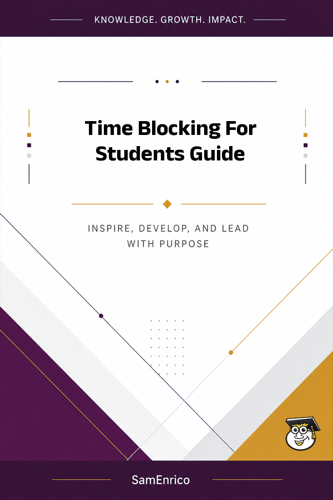
Time Blocking For Students Guide eBook
Schedule study sessions, classes, and assignments
Schedule study sessions, classes, and assignments to avoid cramming.
Formats
Free sample
Chapter 1: The Design Flaw--–- You are not lazy. You are not undisciplined. You do not lack willpower. If you have ever pulled an all-nighter, started an assignment at 11 PM the night before it was due, or walked into an exam having studied only the chapter you thought would appear, you have almost certainly told yourself a story about why. That story usually sounds something like: “I procrastinated again.
I just need more self-control. Next time, I will start earlier.” And then next time arrives, and you do not start earlier. You repeat the same cycle of guilt, panic, and exhausted relief when the deadline passes. This book exists because that story is wrong.The truth is that cramming is not a moral failure. It is a design failure.
Your environment, your calendar, and the invisible architecture of your daily choices are currently wired to make cramming the easiest, most automatic path. Your brain is not broken. Your schedule is. And unlike willpower, which is finite and exhaustible, your schedule can be redesigned from the ground up.Every semester, millions of students enroll in courses with the genuine intention of staying ahead. They buy planners, highlight syllabi, and swear that this term will be different.
By week three, they are behind. By week eight, they are cramming for midterms. By finals, they have accepted the all-nighter as an inevitable rite of passage. This cycle is so universal that most students assume it is simply how school works. It is not.
It is how a poorly designed relationship with time works.This chapter will reframe everything you think you know about procrastination, busyness, and cramming. You will learn why being “busy” is not the same as being productive, why your willpower is a limited resource that you have been wasting on pointless micro-decisions, and why the difference between reactive scheduling and proactive time blocking is the single most important distinction in this entire book. By the end of this chapter, you will take a diagnostic quiz that will tell you exactly which type of scheduler you currently are. And you will begin a one-week challenge that will open your eyes to where your time is actually going.Let us start with the lie that keeps you trapped.The Busyness Trap There is a specific feeling that has become the unofficial mascot of modern student life. It is the feeling of being perpetually behind, always rushing, always having something overdue or almost overdue.
You describe this feeling with a word that has lost all meaning: “busy.” When someone asks how you are, you say “busy.” When you look at your week ahead, you see a gray fog of obligations. When you finally collapse into bed, you cannot remember what you actually accomplished.Being busy and being productive are not the same thing. They are not even close.Busyness is reactive. It is the state of responding to whatever is loudest, most recent, or most urgent. You spend an hour answering emails that could have waited.
You switch between three partially finished assignments, making progress on none. You attend a study group that is mostly socializing. You watch a two-hour lecture recording at 1.5x speed while scrolling social media. At the end of the day, you are exhausted and anxious, but you cannot point to a single piece of work that is truly complete.Productivity, in contrast, is proactive. It is the execution of a plan you made when you were calm and clear-headed.
It means finishing one thing before starting another. It means knowing at 9 AM exactly what you will be doing at 2 PM. Productive students are not necessarily smarter or more disciplined. They have simply designed their days so that the path of least resistance leads to studying, not to distraction.The difference between busyness and productivity is the difference between being a passenger in a car that is speeding downhill and being the driver who chose the road. Right now, most students are passengers.
They wake up and ask, “What do I have to do today?” They look at their calendar—if they have one—and see a list of obligations that were imposed on them. Classes, work shifts, appointments, deadlines. Then they fill the remaining gaps with whatever feels most urgent or most逃避. This is reactive scheduling.A proactive time blocker asks a different question the night before: “What will I do tomorrow, and when?” They do not wait for urgency to dictate their actions. They decide in advance which hours will be spent on which tasks.
They protect those hours as if they were job shifts, because they are. When a friend asks to hang out at 2 PM, the proactive student does not feel guilty saying no. They simply say, “I have a study block until 4. Can we do 4:30?” They are not rejecting the friend. They are honoring a commitment they made to themselves.If you have ever felt like you are working all the time but never catching up, you are almost certainly stuck in the busyness trap.
The solution is not to work more hours. The solution is to stop reacting and start designing.Why Willpower Is a Scam There is a pervasive myth in student culture that successful students simply have more willpower. They are the ones who can sit down and study for six hours straight while you get distracted after twenty minutes. They are the ones who say no to Netflix and yes to flashcards. They are the ones who start their papers two weeks early while you start them two days early.This myth is dangerous because it implies that your failures are character flaws.
If you cannot study like them, you must be lazier or weaker. That belief leads to shame. And shame, as every psychologist will tell you, is a terrible motivator. Shamed students do not suddenly become disciplined. They procrastinate more to escape the feeling of shame.The truth, supported by decades of research in social psychology and behavioral economics, is that willpower is a finite resource that depletes with use.
Psychologists call this “ego depletion.” Every decision you make, every temptation you resist, every time you force yourself to do something you do not want to do, you burn a small amount of willpower. By the end of a long day of classes, decisions, and micro-stresses, your willpower reserves are low. That is why you are more likely to procrastinate at 9 PM than at 9 AM. You are not lazy at night. You are depleted.Here is the crucial insight that changes everything: you do not need more willpower.
You need to stop wasting the willpower you have on unnecessary decisions. Every time you ask yourself, “Should I study now or later?” you burn a unit of willpower. Every time you open your laptop and have to choose between three different assignments, you burn another unit. Every time you feel a notification buzz and have to decide whether to check it, you burn another. Over the course of a day, you might make hundreds of these tiny micro-decisions.
Each one seems insignificant. Together, they drain your cognitive battery.Time blocking removes those decisions entirely. When you have a pre-scheduled calendar…
This is the end of the free sample. Get the eBook to keep going. Buy now
About this book
Details
- Author
- Woody Rodrick
- Publisher
- SamEnrico
- Language
- English
- Genre
- Non-Fiction, Self-Help, Academic Success
- Released
- 2026-06-06
- Pages (approx.)
- 126
- Available as
- eBook, Audiobook

Read better in the ZLOADR app
Your eBooks on your phone or tablet. Sign in with your SamEnrico account and start reading.
More by Woody Rodrick
 Brand Ranking Customer AcquisitionWoody Rodrick$11.99
 Anger After Child Injury AccidentWoody Rodrick$11.99
 Cognitive Behavioral Pain EdWoody Rodrick$11.99
 The Great Pyramid Code: Engineering Secrets of the AfterlifeWoody Rodrick$11.99
 Blood and Jade: The Lost Kings of the OlmecWoody Rodrick$11.99
 Understanding Hyperinsulinism Due to Focal Adenomatous HyperplasiaWoody Rodrick$17.99
 Client Solutions ExecutiveWoody Rodrick$11.99
 Telehealth Workforce Shortage ResponseWoody Rodrick$12.99
 Mental Health Leave Explanation WorkbookWoody Rodrick$12.99
 How to Start a Pastry (retail) Business (Beginners Guide)Woody Rodrick$11.99
You may also like
 Academic Confidence BuilderValentine Sunday$11.99
 Method of Loci for StudentsStiles Chandra$11.99
 Anki for College StudentsMarino Angla$11.99
 Mindfulness Meditation for Students HandbookGilley Elanor$11.99
 Incubation For Academic Problems HandbookPartin Vonda$11.99
 Sleep For Students MemoryBryson Tania$11.99
 Student Procrastination SolutionsHeaton Wyatt$11.99
 Student Procrastination GuidePaul Rodney$11.99
 Sleep Hygiene For StudentsFreeman Rose$11.99
 Academic Confidence for TeensGaffney Jude$11.99
 Goal Setting for College StudentsMahan Larue$11.99