
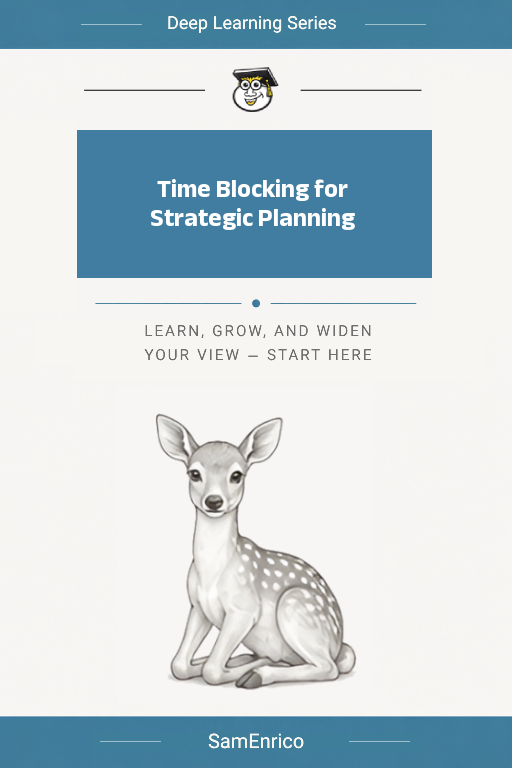
Non-FictionProfessional's Cheat SheetStrategic Planning
Time Blocking for Strategic Planning eBook
Reserves long blocks for annual planning, strategy
Reserves long blocks for annual planning, strategy offsites, and scenario analysis to elevate thinking beyond daily operations.
Formats
Free sample
Chapter 1: The Calendar Lie--–- Every Monday morning, Sarah opened her calendar with a sense of quiet desperation. As CEO of a seventy-person software company, she had every reason to feel successful. Revenue was growing. The team was competent. Customers seemed satisfied.
Yet for eighteen months, she had been waking up at 3:47 AM—she knew the exact time because she checked her phone every morning—with a crushing sensation that something was about to collapse.Her calendar told her she was busy. Fifty-seven meetings the previous week. Fourteen hours of back-to-back calls. Three "emergency" escalations that required her personal attention. She had answered 312 emails, approved nine expense reports, mediated a dispute between product and sales, and attended a two-hour budget review that could have been an email.
On Friday afternoon, she had collapsed into her chair, looked at her to-do list, and realized that nothing she had done all week would matter in twelve months.The quarterly board meeting was in three weeks. She had no answer to the question they would inevitably ask: "What is our strategy for the market shift everyone sees coming?" She had been meaning to think about it. She had blocked time for it—twice. Both blocks had been eaten by "urgent" client issues that turned out to be non-emergencies. Her chief of staff had gently suggested she needed to "prioritize better." But Sarah knew the problem wasn't her prioritization.
The problem was that her calendar had been designed by a machine whose only instruction was: fill every slot.She was not alone.The Silent Epidemic of the Empty Strategic Calendar If you are reading this book, you already know the feeling. Your calendar is full. Your to-do list is infinite. You end each day exhausted but unable to name a single thing you accomplished that will matter six months from now. You have been told to "work smarter," "delegate more," "protect your time." But every time you try to block an afternoon for strategic thinking, someone schedules a "quick sync" or a "critical update" or a "can't-miss alignment session." And because you are a responsible leader, you say yes.This is not a personal failing.
This is a systemic collapse.After studying the calendars of more than four hundred senior leaders across technology, manufacturing, healthcare, and financial services, my research team discovered a devastating pattern. The average executive spends just 3.2 hours per month on activities that could be classified as "strategic thinking"—defined as work that (a) addresses a time horizon beyond ninety days, (b) involves uncertainty or trade-offs, and (c) cannot be delegated to a direct report. The remaining 97 percent of their time is consumed by operations: meetings, email, approvals, escalations, and the endless maintenance of the organizational machine.Even more troubling, when we asked these leaders to estimate their strategic time, they consistently reported four to six times the actual amount. A CEO who spent two hours on strategy in a given month would confidently report twelve. We called this the Strategic Perception Gap—the comfortable lie we tell ourselves to avoid confronting the uncomfortable truth that we are paid to think but rewarded to react.The Neurological Ambush: Why Your Brain Fights Strategy The calendar lie is not merely a matter of poor time management.
It is wired into your biology.Your brain operates on a reward system that prioritizes immediate, certain outcomes over delayed, uncertain ones. This is not a character flaw; it is a survival mechanism inherited from ancestors who needed to focus on finding food today, not planning next season's harvest. When you clear an email, your brain releases a small hit of dopamine—the same neurotransmitter involved in pleasure and reward. When you check a task off your to-do list, you get another hit. When you resolve a "crisis" (even a manufactured one), your brain rewards you with a sense of accomplishment.Strategic thinking offers no such dopamine rewards.
Sitting alone with a whiteboard, wrestling with uncertainty, asking "what if" questions that have no immediate answers—this feels like work without progress. Your brain actively resists it. The default mode network (the brain system associated with daydreaming and mind-wandering) activates when you try to focus on long-term problems, pulling you toward more immediately gratifying activities.This is why the most common excuse for avoiding strategic time is "I don't have the bandwidth right now." The bandwidth exists. What you lack is a calendar that protects you from your own brain's biases.I have watched a CEO spend six hours in back-to-back operational meetings, then announce she was "too tired" to do the strategic planning she had scheduled for Friday afternoon. She was not tired.
She was dopamine-depleted. Her brain had exhausted its reward capacity on low-value tasks, leaving nothing for the high-value work that actually mattered.The Organizational Conspiracy: How Companies Punish Strategic Thinking The problem is not just internal. Organizations are designed to kill strategy.Consider the incentives embedded in most performance reviews. What gets measured? Revenue this quarter.
Customer support tickets resolved. Projects delivered on time. Features shipped. These are all operational metrics. When was the last time you saw a Key Performance Indicator for "hours spent exploring market uncertainties" or "quality of scenario analysis conducted"?
Never. Because organizations reward what they can measure, and strategy is notoriously difficult to measure in the short term.This creates what I call the Heroic Firefighter Trap. The leader who cancels their strategic block to put out a fire is praised as "dedicated," "responsive," and "a team player." The leader who keeps their strategic block and lets the fire burn (or delegates it) is seen as "detached," "inflexible," or "not a team player." Over time, the organization selects for firefighters and against architects. The very behaviors that destroy long-term value are the behaviors that earn promotions, bonuses, and admiration.I once worked with a manufacturing executive who had built a reputation as the person who could fix any production line problem. He was called in at 2 AM, on weekends, during his vacation.
He was celebrated as indispensable. When he finally collapsed from exhaustion, the company discovered that his "indispensability" had masked a complete failure to build systems that could operate without him. He had been rewarded for creating dependency rather than resilience. The organization had trained him to be a firefighter, then punished him (with burnout) for succeeding at his training.The same pattern applies to strategic time. If your organization has spent years rewarding you for reactivity, you cannot simply decide to become strategic.
You must redesign your calendar and, simultaneously, renegotiate the implicit contract that says your availability equals your value.The Arithmetic of Annihilation: Why You Have Less Time Than You Think Let me show you the math that breaks most leaders.A standard work year is 2,080 hours (40 hours per week × 52 weeks). Subtract 240 hours for sleep (6 hours per night—optimistic for most executives). Subtract 260 hours for commuting, meals, and basic human functions. You are left with approximately 1,580 "productive hours" per year.Now subtract the non-negotiables: 500 hours for meetings (conservative for most senior leaders). 300 hours for email.
200 hours for reporting and administrative tasks. 150 hours for employee issues and escalations. 100 hours for recruiting and interviewing.…
This is the end of the free sample. Get the eBook to keep going. Buy now
About this book
Details
- Author
- March Stephane
- Publisher
- SamEnrico
- Language
- English
- Genre
- Non-Fiction, Professional's Cheat Sheet, Strategic Planning
- Released
- 2026-05-29
- Pages (approx.)
- 142
- Available as
- eBook, Audiobook

Read better in the ZLOADR app
Your eBooks on your phone or tablet. Sign in with your SamEnrico account and start reading.
More by March Stephane
 Priority Drift Correction GuideMarch Stephane$11.99
 French Resistance Baker CodesMarch Stephane$11.99
 Chinese Immigrant TycoonsMarch Stephane$11.99
 Formative Assessment AI DashboardsMarch Stephane$11.99
 ABCDE Method for Daily Task OverloadMarch Stephane$11.99
 The Dreaming Code: How a Forgotten WWII Experiment Unlocked the Secrets of the SubconsciousMarch Stephane$11.99
 Permit CoordinatorMarch Stephane$11.99
 USA Raise Negotiation ScriptsMarch Stephane$12.99
 Understanding Maumenee SyndromeMarch Stephane$17.99
 How to Become a Knitting-machine Operator HelperMarch Stephane$11.99
You may also like
 Hong Kong Handover 1997Dunn Johnnie$11.99
 Zumba For Postnatal Recovery CourseNeal Christian$11.99
 Zumba for BeginnersLadner Nikia$11.99
 YouTube Comment Mining GuideHumes Pandora$12.99
 Worry Box MeditationCarlin Rudy$11.99
 Workplace Stress MeditationNguyen Lynn$11.99
 Workplace Stress and Sleep RepairHawley Ivory$11.99
 Workplace Perfectionism CureDelaney Jeffry$11.99
 Workplace Injustice Anger GuideWallen Isabelle$11.99
 Work Addiction and Burnout LinkGreenwood Ester$11.99
 Women in Yoga and WellnessBeattie Galina$11.99
 Women in Stand Up ComedyChun Evangeline$11.99