
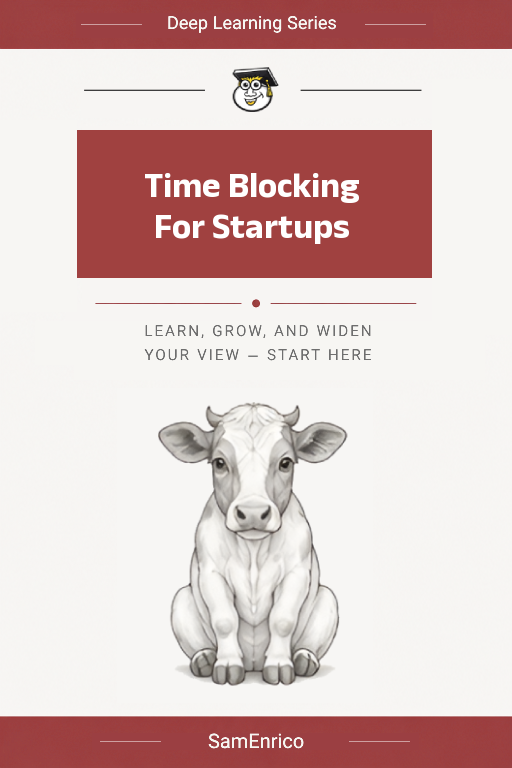
Non-FictionProfessional's Cheat Sheet
Time Blocking For Startups eBook
Wear multiple hats using flexible time blocks that
Wear multiple hats using flexible time blocks that adapt to startup chaos.
Formats
Free sample
Chapter 1: The Hat-Switching Tax--If you are reading this book, you have probably said something like this to yourself in the past thirty days: “I worked sixty hours this week. Why does it feel like I got nothing done?”You are not alone. This is the silent epidemic of the startup world. Founders wear more hats than anyone else in any other profession. You are the product manager at 9 AM, the sales closer at 11 AM, the support desk at 1 PM, the fundraising machine at 3 PM, and the strategy lead at 5 PM.
Then you go home, eat dinner while answering Slack, and wonder why you feel exhausted but unaccomplished.The problem is not your work ethic. The problem is not that you are lazy or unfocused. The problem is that your brain was never designed to switch between ten different jobs in a single day. And every time you switch, you pay a tax that most founders never even know exists.This chapter will show you exactly what that tax is, how to measure it, and why working longer hours is actually making you less effective. By the end, you will understand why “busy” is not the same as “productive” and why chaos is not a badge of honor.
You will also complete an audit of your own calendar that will likely shock you.Let us start with a story.The Twenty-Three Minute Question Maya was the founder of a fintech startup called Finvaro. She had raised a seed round, hired seven people, and was six months away from running out of cash. Every day felt like a fire drill. She woke up at 6 AM, answered emails until 7, then spent her morning “putting out fires” before finally opening her code editor around 2 PM. By then, she was already exhausted.
She worked until 8 PM most nights, often eating dinner at her desk. On paper, she was working sixty-five hours per week. In reality, her product had not shipped a major feature in two months.One Tuesday, Maya was finally in a flow state. She was debugging a payment integration that had been leaking five thousand dollars per week due to a rounding error. She had been searching for the bug for three days.
At 10:47 AM, she found it. She was thirty minutes into the fix when her Slack pinged. It was her co-founder: “Quick question—what is the investor deck password? Need to send to a prospect.”Maya looked away from her screen. She typed: “Finvaro2024.” Fourteen seconds.
She returned to her code. But something had changed. Her brain was no longer deep inside the payment logic. She was now partially thinking about the investor deck. Who was the prospect?
Should she be on that call? Did they send the right version of the deck? It took her twenty-three minutes to get back to the same level of focus she had before the interruption.That “quick question” cost her twenty-three minutes of recovery time. Over the next three days, similar interruptions happened seventeen more times. She never fixed the rounding error.
The leak continued for another week, costing Finvaro thirty-five thousand dollars. The “quick question” about a password indirectly cost her company more than the salary of a full-time employee.This is the Hat-Switching Tax. And it is the single biggest killer of startup productivity that no one talks about.The Hidden Cost of Context Switching Let us be precise about what happens when you switch between tasks. Cognitive science research has demonstrated that the human brain does not multitask. What we call multitasking is actually rapid task-switching.
And every switch carries a cost.When you are deeply focused on a single task, your brain enters what psychologists call a “flow state” or “deep work” mode. In this state, your prefrontal cortex—the part of your brain responsible for complex problem-solving—is fully engaged with the task at hand. Neural pathways are activated. Working memory is loaded with relevant information. You are efficient.
You are fast. You are effective.Then an interruption happens. A Slack ping. An email notification. A co-worker tapping your shoulder.
Your brain must do three things:First, it must disengage from the current task. This means saving your mental place—just like bookmarking a page in a book. But unlike a book, your brain cannot save a perfect bookmark. It loses some context every time.Second, it must switch to the new task. This requires loading new information into working memory while discarding the old information.
This process is not instantaneous. It takes time.Third, it must re-engage with the original task when the interruption ends. This is the most expensive part. Your brain has to reconstruct the mental state you were in before the interruption. What were you thinking?
What was the next step? Where were you in the logic?The total cost of a single interruption is approximately twenty minutes. This is not a rough estimate. Studies of software developers, writers, and knowledge workers have repeatedly found that after a brief interruption, it takes between fifteen and twenty-five minutes to return to the same level of cognitive performance. The average is twenty minutes.Let us run the math on your average startup founder.
If you experience five interruptions in a day—and most founders experience far more than five—you lose one hundred minutes to recovery time. That is nearly two hours. Over a five-day week, that is ten hours. Over a fifty-week year, that is five hundred hours. That is twelve and a half full forty-hour work weeks.
You are losing three months of productive time every year to the Hat-Switching Tax.But the math gets worse. Most founders do not experience five interruptions per day. They experience fifteen to thirty. The Leaky Calendar Audit, which you will complete later in this chapter, regularly reveals that founders are interrupted twenty or more times per day. Twenty interruptions at twenty minutes each is four hundred minutes of recovery time—nearly seven hours.
In a ten-hour workday, that means you are only getting three hours of actual productive work. The other seven hours are spent switching and recovering.This is why you feel exhausted at the end of the day but cannot point to what you accomplished. You were not working. You were switching.The Myth of the Sixty-Hour Week Founders love to brag about how many hours they work. “I pulled an eighty-hour week,” they say, as if exhaustion were a virtue.
But the data tells a different story.Research on knowledge work productivity has consistently shown that output per hour declines dramatically after approximately fifty hours per week. A famous study of software developers at a major tech company found that developers who worked sixty-hour weeks accomplished only slightly more than developers who worked forty-hour weeks. The extra twenty hours produced almost no additional output. Why? Because the developers working sixty hours were spending most of their extra time switching between tasks, recovering from interruptions, and working while exhausted—which led to mistakes that required rework.In startup terms, this means the founder who brags about working seventy hours is actually less effective per hour than the founder who works forty-five focused hours.
The seventy-hour founder is paying the Hat-Switching Tax on a larger scale. They are not getting more done. They are…
This is the end of the free sample. Get the eBook to keep going. Buy now
About this book
Details
- Author
- Matthew Angle
- Publisher
- SamEnrico
- Language
- English
- Genre
- Non-Fiction, Professional's Cheat Sheet
- Released
- 2026-05-29
- Pages (approx.)
- 150
- Available as
- eBook, Audiobook

Read better in the ZLOADR app
Your eBooks on your phone or tablet. Sign in with your SamEnrico account and start reading.
More by Matthew Angle
 Repossession LessonsMatthew Angle$11.99
 Long Distance Relationship Self WorthMatthew Angle$11.99
 Child Microbiome HealthMatthew Angle$11.99
 Reformation Sola Scriptura Battle GuideMatthew Angle$11.99
 The TM Sensory DeprivationMatthew Angle$11.99
 Step One Powerlessness GuideMatthew Angle$11.99
 Metta Breathing IntegrationMatthew Angle$11.99
 Celebratory Spending SubstitutesMatthew Angle$11.99
 Family Business BurnoutMatthew Angle$11.99
 Tunguska: The Sky That Fell SilentMatthew Angle$11.99
 The Great Swap: How a Single Trade Reshaped Baseball ForeverMatthew Angle$11.99
 Stuart's Iron Dream: The Mechanical Marvels of the Overland TelegraphMatthew Angle$11.99
You may also like
 Hong Kong Handover 1997Dunn Johnnie$11.99
 Zumba For Postnatal Recovery CourseNeal Christian$11.99
 Zumba for BeginnersLadner Nikia$11.99
 YouTube Comment Mining GuideHumes Pandora$12.99
 Worry Box MeditationCarlin Rudy$11.99
 Workplace Stress MeditationNguyen Lynn$11.99
 Workplace Stress and Sleep RepairHawley Ivory$11.99
 Workplace Perfectionism CureDelaney Jeffry$11.99
 Workplace Injustice Anger GuideWallen Isabelle$11.99
 Work Addiction and Burnout LinkGreenwood Ester$11.99
 Women in Yoga and WellnessBeattie Galina$11.99
 Women in Stand Up ComedyChun Evangeline$11.99