
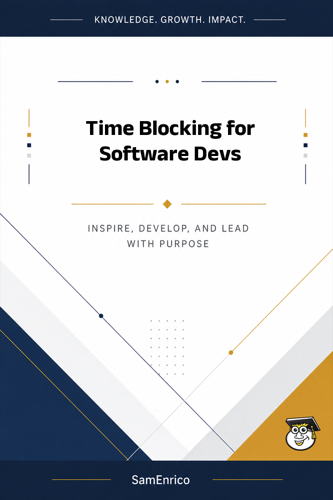
Time Blocking for Software Devs eBook
Schedules coding, debugging, and meetings.
Schedules coding, debugging, and meetings.
Formats
Free sample
Chapter 1: The 4:37 PM Confession--The cursor blinked on an empty VS Code window. It was 4:37 PM on a Wednesday, and I had been “at work” for seven hours and thirty-seven minutes. In that time, I had answered forty-seven Slack messages, attended four meetings, reviewed twelve pull requests, replied to eleven emails, and context-switched between three different coding tasks without completing any of them. I had written exactly zero lines of code that mattered.My wife texted: “Dinner at 6?”I typed back: “One more hour. Just need to finish this thing.”It was a lie.
Not a malicious one, but a tired one. The kind of lie you tell when you can’t explain where the day went because you genuinely don’t know. The kind of lie that becomes a habit. The kind of lie that, repeated five days a week for fifty weeks a year, becomes something heavier: a quiet, creeping certainty that you’re not actually good at your job.I was a senior software engineer at a well-funded startup. I had a computer science degree from a good school, eight years of experience, and a team that trusted me.
By every external metric, I was successful. But internally, I was drowning. Not in complexity—I could handle complex. I was drowning in chaos. In interruptions.
In the endless, buzzing parade of notifications that had somehow become indistinguishable from “work.”That night, after another “one more hour” turned into two, I closed my laptop at 8:15 PM, walked into the kitchen, and told my wife something I had never said out loud:“I think I want to quit software.”She didn’t look surprised. That was the worst part.The Great Paradox of Modern Development Here is a strange truth about software developers: we build systems that manage complexity at scales that would have seemed like magic twenty years ago. We orchestrate microservices, design fault-tolerant databases, and write code that ships to millions of users. We understand state machines, race conditions, and eventual consistency. We can debug a memory leak in a production environment while simultaneously reviewing a pull request and answering a question about the API documentation.And yet, most of us have no idea where our own time goes.This is the great paradox of modern software development.
We are masters of systems, but amateurs of our own calendars. We optimize everything except our own attention. We would never tolerate a database that responded to queries with a fifteen-minute delay, but we tolerate exactly that from our own brains every single day. We write automated tests for our code, but we run no diagnostics on our workdays. We refactor spaghetti logic without hesitation, but we accept meeting schedules that are pure technical debt.The numbers tell a sobering story.
According to research cited in The Effective Engineer by Edmond Lau, the average knowledge worker spends only about two hours per day on truly productive, creative work. The rest is swallowed by meetings, email, context switching, and the fog of shallow activity that feels like work but produces nothing of value. For software developers, the situation is even worse because our work requires deep, uninterrupted concentration. A single interruption—a Slack ping, a tap on the shoulder, a calendar reminder—can take fifteen to twenty-five minutes to recover from. Three interruptions per hour makes deep work mathematically impossible.And yet, we accept this.
We have internalized the chaos as normal. We wear our busyness like a badge of honor. “I’m so slammed” has replaced “I’m fine” as the default response to “How’s it going?” We measure our days by how many tabs we have open, how many notifications we cleared, how many meetings we endured. We have confused reaction with productivity and volume with value.This book exists because that confusion is killing our craft, our careers, and in too many cases, our mental health.The 10-Hour Lie Let me tell you about a myth that has caused more developer burnout than any deadline or legacy codebase: the myth of the marathon coding session.You know the fantasy. It usually involves headphones, dark mode, a cup of coffee that goes cold, and the glorious sight of the sun rising after an all-nighter spent refactoring an entire module.
It’s celebrated in movies, glorified on social media, and quietly expected in too many workplaces. The myth says that real developers code for hours—six, eight, ten hours straight—and that anything less is weakness.Here is what the myth does not show you.It does not show you the hour of context switching before you finally settle into focus. It does not show you the fifteen minutes lost every time a Slack notification pulls your attention away. It does not show you the afternoon meeting that arrives just as you hit flow, destroying not just the hour of the meeting but the hour before (because you couldn’t start anything deep) and the hour after (because you’re recovering). It does not show you the cognitive debt you accumulate when you push through fatigue, producing code that works today but becomes tomorrow’s debugging nightmare.The research on this is clear and consistent.
A study from the University of California, Irvine found that after an interruption, it takes an average of twenty-three minutes to return to the original task with the same level of focus. Not fifteen, not ten—twenty-three minutes. And that’s assuming you return at all. In many cases, an interruption leads to a cascade of new tasks, each one pulling you further from your original intention.I learned this the hard way. For years, I believed that my inability to code for long, uninterrupted stretches was a personal failing.
I thought other developers had some secret discipline that I lacked. I tried productivity apps, time trackers, blockers, and morning routines. Nothing worked because I was treating the symptom (my distraction) instead of the disease (the structural chaos of my workday).The disease, I eventually discovered, had a name: it was the absence of intentional time blocking. But before we get to the cure, we need to understand the sickness in detail.Busyness vs. Productivity: The Critical Distinction One of the most important distinctions in this entire book—one that will be referenced repeatedly—is the difference between busyness and productivity.
These two words are not synonyms, but we treat them as if they are. This confusion is the source of almost all developer time-wasting.Busyness is reactive. It is clearing notifications, responding to messages, attending meetings, fixing small bugs, updating tickets, and context-switching between low-impact tasks. Busyness feels productive because it creates activity. You see things happening: emails sent, chats answered, boxes checked.
The dopamine hit of completion is real, and it is addictive.Productivity, in the context of software development, is different. Productivity is shipping features that matter, reducing technical debt, writing maintainable code, designing systems that scale, and solving problems that unblock others. Productivity is not measured by how many tasks you completed but by how much value you created. A developer who writes one elegant, well-tested function that saves the team twenty hours of future debugging is more productive than a…
This is the end of the free sample. Get the eBook to keep going. Buy now
About this book
Details
- Author
- Caudill Dorinda
- Publisher
- SamEnrico
- Language
- English
- Genre
- Non-Fiction, Self-Help, Software
- Released
- 2026-06-05
- Pages (approx.)
- 146
- Available as
- eBook, Audiobook

Read better in the ZLOADR app
Your eBooks on your phone or tablet. Sign in with your SamEnrico account and start reading.
More by Caudill Dorinda
 Attachment Style ConflictCaudill Dorinda$11.99
 Jimi Hendrix Electric LadylandCaudill Dorinda$11.99
 Congressional Retirement CalculationsCaudill Dorinda$11.99
 Mindfulness for Focus TrainingCaudill Dorinda$11.99
 Scripting for PTSD RecoveryCaudill Dorinda$11.99
 Monthly Time Blocking GuideCaudill Dorinda$11.99
 Meeting Async Status BoardCaudill Dorinda$11.99
 The Hammer and the Anvil: The Battle of Stamford Bridge and the Fall of the Viking AgeCaudill Dorinda$11.99
 The Lion of Castile: Alfonso X and the Golden Age of SpainCaudill Dorinda$11.99
 Artichoke: Harvesting GuideCaudill Dorinda$11.99
 Supplier Evaluation SheetCaudill Dorinda$12.99
 French Stock Option Plan ComplianceCaudill Dorinda$12.99
You may also like
 Hong Kong Handover 1997Dunn Johnnie$11.99
 Zumba For Postnatal Recovery CourseNeal Christian$11.99
 Zumba for BeginnersLadner Nikia$11.99
 YouTube Comment Mining GuideHumes Pandora$12.99
 Worry Box MeditationCarlin Rudy$11.99
 Workplace Stress MeditationNguyen Lynn$11.99
 Workplace Stress and Sleep RepairHawley Ivory$11.99
 Workplace Perfectionism CureDelaney Jeffry$11.99
 Workplace Injustice Anger GuideWallen Isabelle$11.99
 Work Addiction and Burnout LinkGreenwood Ester$11.99
 Women in Yoga and WellnessBeattie Galina$11.99
 Women in Stand Up ComedyChun Evangeline$11.99