
Non-FictionSelf-HelpRemote Work
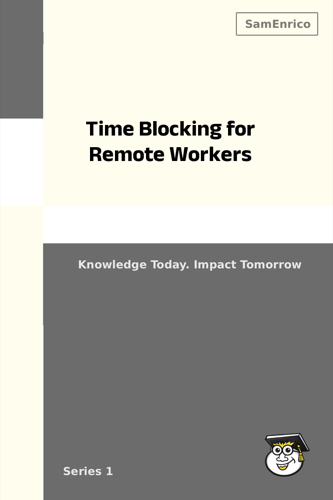
Time Blocking for Remote Workers eBook
Structures work from home days effectively.
Structures work from home days effectively.
Formats
Free sample
Chapter 1: The Flexibility Trap--–- Sarah had been a remote worker for three years when she finally admitted something was wrong. Not dramatically wrong—no single catastrophe, no screaming match with her boss, no tearful breakdown on a Tuesday afternoon. Just a quiet, creeping realization that she was always working. Not eight hours a day. Not ten.
More like fourteen, but fragmented into pieces so small she couldn't point to any single hour and say, "That was work." She answered emails while stirring pasta. She reviewed documents while half-watching her daughter's soccer practice. She joined Zoom calls from her bedroom, then stayed in bed afterward because the transition from "work mode" to "rest mode" had simply vanished.Her to-do list was a masterpiece of ambition. Every morning, she wrote down twelve to fifteen tasks. Every evening, she migrated the unfinished ones to tomorrow's list.
The list was never empty. It grew, like kudzu, like debt, like the pile of laundry she hadn't folded in two weeks. She told herself she was flexible. She told herself remote work gave her freedom. She told herself these things because admitting the alternative—that she had less control than ever—felt like failure.This chapter is for Sarah.
And for you, if you recognize her.The seductive promise of remote work is flexibility. Work when you want, where you want, how you want. No commute. No dress code. No one looking over your shoulder.
But for millions of remote workers, flexibility has not delivered freedom. It has delivered something far more insidious: Infinite Spillover—the tendency for work to bleed into every corner of life because there are no natural boundaries to stop it.This chapter will dismantle the myth of the flexible schedule. You will calculate your Spillover Score, diagnose the difference between reactive and intentional work, and learn why your to-do list is secretly your enemy. By the end, you will understand that time blocking is not a constraint—it is the only reliable fence you can build between your job and your life.The Infinite Spillover Epidemic Before the pandemic, work had walls. You drove to an office.
You sat at a desk. You drove home. The commute was annoying, but it served a critical psychological function: it was a ritual of transition. You left work behind because you literally left the building. Your laptop stayed on your desk.
Your inbox was someone else's problem until morning. There was a physical boundary between "work you" and "home you."Remote work erased that boundary in the name of convenience.Now, your office is your bedroom, or your kitchen table, or the corner of your couch. Your commute is fifteen feet. Your laptop follows you from room to room like a loyal but exhausting pet. The result is not work-life balance.
It is work-life bleeding.Consider the data. A 2022 study from the National Bureau of Economic Research found that remote workers logged an average of 48 minutes more per day than their in-office counterparts—not because they were more productive, but because the absence of a commute removed the natural signal to stop. Another study from Microsoft Research analyzed anonymized Teams data and found that after-hours messaging increased by 42% in fully remote organizations. People were not working longer hours because they had to. They were working longer hours because no one told them to stop, and they had not learned to tell themselves.This is Infinite Spillover.
It is the slow, quiet expansion of work into mornings (checking email before brushing teeth), evenings (one more Slack message before dinner), and weekends (just catching up on a few things). It is not dramatic enough to trigger alarm but persistent enough to cause burnout over months and years.The cruel irony is that the people who suffer most from Infinite Spillover are the ones who value flexibility the most. They say yes to every request because they can. They check email at 10 PM because they are "flexible." They work through lunch because they can "make up the time later" (they never do). Flexibility, in this framing, becomes a trap.
The absence of constraints does not create freedom. It creates the obligation to be always available.Your Spillover Score: A Diagnostic Tool Before we can fix the problem, we must measure it. This book introduces a simple metric called the Spillover Score. It has three components:Component A: Evening Work. Count how many nights per week you work after 6 PM (or after your official sign-off time).
Do not count occasional emergencies. Count the nights when you open your laptop "just to check something" and end up working for an hour.0–1 nights per week: 0 points2–3 nights per week: 2 points4–5 nights per week: 4 points6–7 nights per week: 6 points Component B: Weekend Work. Count how many weekend days per month you do any work—an email, a document review, a Slack message—that is not a genuine emergency.0 days per month: 0 points1–2 days per month: 2 points3–4 days per month: 4 points5+ days per month: 6 points Component C: Meals at Your Desk. Count how many times per week you eat lunch (or any meal) while working, without taking a true break.0–1 times per week: 0 points2–3 times per week: 2 points4–5 times per week: 4 points6–7 times per week: 6 points Add your points. This is your Spillover Score.0–5: You have healthy boundaries.
This book will help you optimize and protect them.6–15: You are in the warning zone. Spillover is happening, and you may not notice it until it becomes a problem.16+: You are on a direct path to burnout. Your work is bleeding into your life, and your life is losing.Take a moment. Calculate your score honestly. No one is watching.
There is no prize for a low score—only the possibility of change.Sarah, our remote worker from the opening, scored a 22. She worked after 6 PM five nights per week (4 points), worked on weekends three days per month (4 points), and ate lunch at her desk five times per week (4 points). Her total was 12—solidly in the warning zone, but she had been scoring 18+ for years before she finally admitted the problem. The Spillover Score does not judge. It diagnoses.Reactive Work vs.
Intentional Work Why does spillover happen? The superficial answer is "poor time management." But that is like saying a leaky roof is caused by "poor water management." It identifies the symptom, not the mechanism.The mechanism is a fundamental confusion between two kinds of work: Reactive and Intentional.Reactive Work is work that arrives in your inbox, your Slack channel, your text messages, or your calendar invitations. It is work requested by someone else, often with an implicit or explicit deadline. Reactive work feels urgent because it comes from other people, and other people are watching. Responding to a Slack message takes ten seconds and produces a small hit of dopamine—you helped someone, you cleared a task, you are responsive.
The problem is that reactive work is infinite. There is always another email, another message, another request. Responding to reactive work is like bailing water from a boat that has a hole in the hull. You can do it forever and never make progress.Intentional Work is work you choose to…
This is the end of the free sample. Get the eBook to keep going. Buy now
About this book
Details
- Author
- Ricker Florentina
- Publisher
- SamEnrico
- Language
- English
- Genre
- Non-Fiction, Self-Help, Remote Work
- Released
- 2026-06-06
- Pages (approx.)
- 136
- Available as
- eBook, Audiobook

Read better in the ZLOADR app
Your eBooks on your phone or tablet. Sign in with your SamEnrico account and start reading.
More by Ricker Florentina
 Menopause Supplement Safety GuideRicker Florentina$11.99
 First Time Parents After FiftyRicker Florentina$11.99
 Technology Boundaries CoupleRicker Florentina$11.99
 Personal Branding for SpeakersRicker Florentina$11.99
 Meeting Speaker Limit RuleRicker Florentina$11.99
 Daily Time Blocking MethodRicker Florentina$11.99
 Authenticity HypnosisRicker Florentina$11.99
 The Hammer and the Harp: Philip II and the Golden Symphony of SpainRicker Florentina$11.99
 Escape from Abidjan: The Tunnel That Shook Côte d'IvoireRicker Florentina$11.99
 How to Become a Bell MakerRicker Florentina$11.99
 Exploring Engraving: Incised Metal & WoodRicker Florentina$11.99
 Launch Week Action PlanRicker Florentina$12.99
You may also like
 Hong Kong Handover 1997Dunn Johnnie$11.99
 Zumba For Postnatal Recovery CourseNeal Christian$11.99
 Zumba for BeginnersLadner Nikia$11.99
 YouTube Comment Mining GuideHumes Pandora$12.99
 Worry Box MeditationCarlin Rudy$11.99
 Workplace Stress MeditationNguyen Lynn$11.99
 Workplace Stress and Sleep RepairHawley Ivory$11.99
 Workplace Perfectionism CureDelaney Jeffry$11.99
 Workplace Injustice Anger GuideWallen Isabelle$11.99
 Work Addiction and Burnout LinkGreenwood Ester$11.99
 Women in Yoga and WellnessBeattie Galina$11.99
 Women in Stand Up ComedyChun Evangeline$11.99