
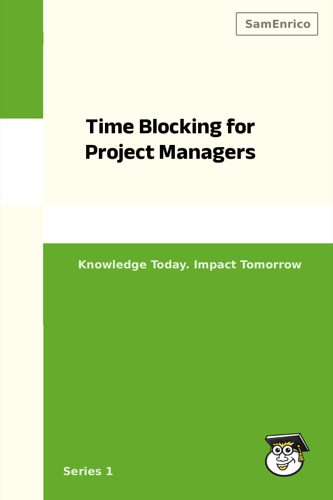
Time Blocking for Project Managers eBook
Schedules meetings and individual work.
by Talbot Rivka
Schedules meetings and individual work.
Formats
Free sample
Chapter 1: The Fragmentation Tax--–- Becky’s Monday looked perfect. At 8:45 AM, she had mapped out her entire week in green ink: Monday morning for risk register updates, a two-hour block for stakeholder alignment, afternoon deep work on the project budget. By Tuesday at 11 AM, she had answered forty-seven Slack messages, attended six hours of meetings, and accomplished exactly zero of those green-ink tasks. Her calendar looked busy. Her project plan had not moved.
She was exhausted, overwhelmed, and quietly convinced she was failing.Becky is not real. But you have been Becky.Every day, thousands of project managers walk into their offices—physical or virtual—with a clear plan. They know what matters: risk mitigation, stakeholder alignment, critical path analysis, budget forecasting. And every day, those same project managers walk out having done none of it. Instead, they answered emails.
They jumped between Slack channels. They attended meetings that could have been emails. They spent six hours being “productive” in the shallowest sense of the word, and they have nothing to show for it except a longer to-do list and a quieter sense of dread.This chapter is an autopsy of that day. You will learn exactly how fragmentation steals your time, your focus, and your career. More importantly, you will calculate your personal Fragmentation Tax—the dollar value of what you lose every year to context switching.
By the end of this chapter, you will never look at a Slack notification the same way again.The Anatomy of a Fragmented Hour Let us define our enemy. Fragmentation is not busyness. Busyness is the subjective feeling of having many things to do. Fragmentation is the objective state of having your attention chopped into tiny, unusable slices. A fragmented hour looks like this: seven minutes on email, three minutes on Slack, five minutes scanning a document, two minutes answering a question from a colleague, four minutes checking a calendar, six minutes on a status update tool, and so on.
At the end of that hour, you have started twelve things and finished zero.The human brain is not designed for fragmentation. When you switch from one task to another, your brain must perform a process called “goal shifting” (deciding to do something new) followed by “rule activation” (loading the rules and priorities for that new task). This takes time. Research from the University of California, Irvine, found that after an interruption, it takes an average of twenty-three minutes to return to the original task with full focus. Not two minutes.
Not five minutes. Twenty-three minutes.Now do the math. If you are interrupted every four minutes—the actual average for project managers in a 2024 workplace study—you never complete a full recovery cycle. You are constantly in the shallow, groggy state of half-returned focus. Your brain is like a computer with forty-seven browser tabs open: technically running, but glacially slow.The Data That Will Make You Angry Let us look at the numbers.
They are not abstract. They are your life.A 2024 study of 527 project managers across technology, construction, healthcare, and finance found the following:The average PM switches tasks every 4.2 minutes.The average PM is interrupted 87 times per day.Of those interruptions, 64 percent are self-initiated (checking email, checking Slack, switching tabs voluntarily).Only 36 percent come from other people.This last point is crucial. You are not primarily a victim of demanding stakeholders or noisy open offices. You are primarily a victim of your own attention habits. You check email because you are bored.
You glance at Slack because you are avoiding a hard task. You refresh the project dashboard because it feels like work while requiring no cognitive effort.The productivity cost of this fragmentation is staggering. Researchers at Carnegie Mellon University found that task switching reduces productive output by 40 percent. Not 10 percent. Not 20 percent.
Forty percent.Let us translate that into money. If you are a project manager earning $100,000 per year, 40 percent of your productive capacity is $40,000. That is not an abstract number. That is money your employer is paying for work you are not delivering because your attention is shattered into tiny pieces. If you earn $120,000, your Fragmentation Tax is $48,000.
If you earn $150,000, you are losing $60,000 every year.And that is just the direct cost. The indirect costs are worse: delayed projects, missed risks, poor stakeholder communication, and the slow erosion of your reputation as someone who delivers.The Fragmentation Tax Calculator Before you read another word, you will calculate your own Fragmentation Tax. This is not a metaphor. You will write down a number. That number will be uncomfortable.
That discomfort is the beginning of change.Step One: Find your annual salary (or hourly rate). If you are paid hourly, use your annualized earnings. Write it here: ____________Step Two: Multiply that number by 0.4 (40 percent). This is your Fragmentation Tax in dollars per year. Write it here: ____________Step Three: Divide that number by 12.
This is your monthly Fragmentation Tax. Write it here: ____________Step Four: Divide that number by 4.3 (average weeks per month). This is your weekly Fragmentation Tax. Write it here: ____________Step Five: Divide that number by 5 (average workdays per week). This is your daily Fragmentation Tax.
Write it here: ____________Now look at that number. Every single day, you are losing that much money in productive capacity. You are working for free for a portion of every day. Not because you are lazy. Not because you lack skill.
Because your attention is fragmented.One PM who completed this exercise earned $130,000 annually. Her Fragmentation Tax was $52,000 per year, $1,000 per week, $200 per day. “I almost threw up,” she said. “I realized I was giving my employer two full days of free work every week because I couldn’t stop checking my inbox.”That PM is now a director. She did not get promoted because she worked harder.
She got promoted because she stopped fragmenting her attention and started delivering strategic value. We will teach you how to do the same.The Four Types of Fragmentation Not all fragmentation is identical. You must learn to distinguish between four distinct enemies. Each requires a different solution.Type One: External Interruptions These are interruptions initiated by other people: a colleague tapping your shoulder, a Slack message that demands a response, a meeting that runs over, a stakeholder who “just needs five minutes.” External interruptions feel like violations because they are. Someone else has decided that their priority is more important than your focus.
The solution to external interruptions is boundaries, scripts, and communication protocols. You will learn these in Chapter 8.Type Two: Self-Initiated Fragmentation This is the most common and most dangerous type. You check email because you are avoiding a difficult task. You open Twitter because your brain is tired. You refresh your project dashboard because it gives you a small dopamine hit without requiring deep thought.
Self-initiated fragmentation is harder to solve because the enemy is you. The solution is environmental design and habit replacement. You will learn these in Chapters 4 through 6.Type Three: Tool-Induced Fragmentation Your software tools are designed to fragment your attention. Slack’s notification badge is red for a reason: red triggers urgency. Email’s inbox count is a psychological exploit.
Project management tools that send updates for every comment or status change are not helping you; they are training you…
This is the end of the free sample. Get the eBook to keep going. Buy now
About this book
Details
- Author
- Talbot Rivka
- Publisher
- SamEnrico
- Language
- English
- Genre
- Non-Fiction, Self-Help, Project Management
- Released
- 2026-06-06
- Pages (approx.)
- 129
- Available as
- eBook, Audiobook

Read better in the ZLOADR app
Your eBooks on your phone or tablet. Sign in with your SamEnrico account and start reading.
More by Talbot Rivka
 Meeting Water Cooler SlotTalbot Rivka$11.99
 Tina Turner Simply Best LifeTalbot Rivka$11.99
 Future Goals DisagreementTalbot Rivka$11.99
 Congressional Hearings SpectaclesTalbot Rivka$11.99
 Deep Work for Remote WorkersTalbot Rivka$11.99
 Job Loss and Children GuideTalbot Rivka$11.99
 Scripting for Relationship HealingTalbot Rivka$11.99
 The Lion of Aleppo: How a Syrian Wrestler Defied the Ottoman EmpireTalbot Rivka$11.99
 The Gilded Vision: How a Railway Tycoon Built America’s First Great Art MuseumTalbot Rivka$11.99
 Exploring Jewish Art: Ritual Objects & Illuminated TextsTalbot Rivka$11.99
 How to Produce Dog TreadmillsTalbot Rivka$11.99
 How to Produce a Polar S625xTalbot Rivka$11.99
You may also like
 Remote Project CommunicationMorse Kirby$11.99
 Todoist Advanced ProjectsBox Wendi$11.99
 Self Esteem for Project LeadersSilverman Johnny$11.99
 Pomodoro Goal Breakdown MethodHatley Ruthanne$11.99
 Active Listening For ScrumMackay Chin$11.99
 Weekly Project ReviewBustamante Soon$11.99
 Project Weekly Review GuideBraswell Janell$11.99
 EQ For Project ManagersEng Aretha$11.99
 Workaholism in Project ManagementMalcolm Misti$11.99
 Stakeholder Mapping GuideHutchinson Angle$11.99
 Project Manager Stress GuideDozier Asia$11.99
 Project Management CreativityHathaway Colene$11.99