
Non-FictionSelf-HelpProduct Management
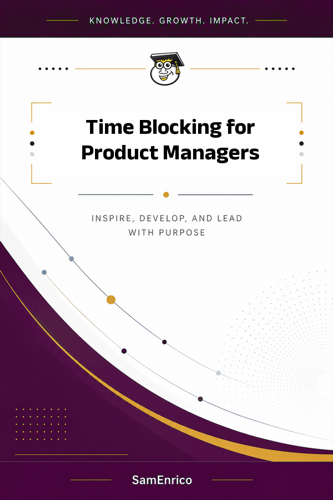
Time Blocking for Product Managers eBook
Schedules features and stakeholder calls.
by Foy Ping
Schedules features and stakeholder calls.
Formats
Free sample
Chapter 1: The Hidden Truth--–- The VP of Product stood at the front of the conference room, whiteboard marker in hand, drawing a familiar diagram. Four quadrants. Two axes. The Eisenhower Matrix, trotted out like a corporate mascot at yet another offsite."Important versus urgent," she said, tapping the board. "We need to spend more time in Quadrant Two.
Important but not urgent. That's where strategy lives. That's where innovation happens."Twenty Product Managers nodded. Twenty Product Managers took dutiful notes. Twenty Product Managers returned to their desks, opened their calendars, and found them already consumed by seven hours of meetings, twelve Slack threads demanding responses, three stakeholders asking for "just five minutes," and exactly zero time for Quadrant Two.The VP meant well.
The matrix was correct. But the matrix did not account for reality. And the reality, for almost every Product Manager in every company of every size, is this: your calendar is not a reflection of your priorities. Your calendar is a reflection of other people's emergencies.I learned this lesson seven years ago, two months into my first Product Manager role. I had been hired to build a new analytics dashboard for a B2B software company.
The roadmap was clear. The specifications were drafted. The engineering team was ready. All I needed was time to write the final PRD, review the data models, and align with stakeholders on the launch timeline.Instead, I spent my first sixty days in meetings. Dozens of meetings.
Hundreds of meetings. Meetings about features we had already decided not to build. Meetings about bugs that were already fixed. Meetings where I was the seventh person on a Zoom call and spoke exactly once, to say "I agree with what she said."I remember staring at my calendar one Thursday afternoon, feeling a sensation I would later learn to name: the vortex. My day had been split into seventeen fragments.
A thirty-minute sync here. A forty-five-minute planning session there. A fifteen-minute "quick check-in" that ran forty minutes. Scattered across these fragments, like pieces of a broken plate, were the real tasks I needed to do. Write PRD.
Review analytics. Talk to customers. But the fragments left no room for the whole.That night, I went home and calculated how much uninterrupted time I had actually had that week. The number was so small I thought I had made a math error. I recalculated.
Same number. I had spent less than four hours across five days on the work I was hired to do. The other thirty-six hours were meetings, email, Slack, and the invisible glue of context switching.I was working harder than I had ever worked. I was exhausted every evening. And I was failing.This book is the guide I wish I had that night.
It is not a collection of abstract theories about productivity. It is a battle-tested system for Product Managers who need to ship features, satisfy stakeholders, and protect their sanity. The system is called time blocking, and it will change everything about how you work.But before we build the system, we must diagnose the disease. And the disease has a name: the Calendar Vortex.The Architecture of a Broken Calendar Let me describe the typical Product Manager's calendar. I have seen hundreds of them.
They are shockingly similar.You wake up at 7:30 AM. You check your phone immediately. Three Slack messages from the engineering team in India. Two emails from the sales team about a feature request. A calendar invitation from the VP of Marketing for a meeting that starts in forty-five minutes.
You have not had coffee yet.You get to your desk at 9:00 AM. Your first meeting is at 9:15 AM. It is the daily standup. Fifteen minutes. You spend ten of those minutes listening to engineers describe tickets you have no context for.
You spend the last five minutes saying "no blockers" even though you are blocked on everything.Standup ends at 9:30 AM. Your next meeting is at 10:00 AM. You have thirty minutes. You open your PRD. You write two sentences.
A Slack notification appears. It is the designer, asking for feedback on a mockup. You switch to Figma. You leave a comment. You switch back to the PRD.
You have lost your train of thought. You re-read the two sentences. You write a third sentence. Another Slack notification. This time it is your manager: "Can you jump on a quick call before the 10 AM?"You join the call.
It lasts twelve minutes. It could have been an email. It is now 9:55 AM. You have five minutes to prepare for the 10 AM stakeholder meeting. You open the agenda.
You have not read the pre-read. You scan it quickly. You will be winging it.The stakeholder meeting runs from 10 AM to 11 AM. It should have been a thirty-minute meeting, but three people joined late, two people asked questions that were answered on page two of the pre-read, and one person wanted to "circle back" on a decision that was already made. You leave the meeting with four action items and no clarity.11 AM to 11:30 AM.
You were supposed to use this half-hour for PRD writing. Instead, you use it to answer the fifteen emails that arrived during the stakeholder meeting. You also respond to the Slack messages you ignored. You also take a deep breath. The half-hour disappears.11:30 AM to 12:30 PM.
Sprint planning. You love sprint planning in theory. In practice, it is ninety minutes crammed into sixty, with too many voices and not enough decisions. You leave with a headache and a vague sense that the team committed to more than they can deliver.12:30 PM to 1:00 PM. Lunch.
You eat at your desk. You check Twitter. You feel guilty.1:00 PM to 2:00 PM. Customer call. A top-ten customer is unhappy about a missing feature.
You listen. You empathize. You promise to "look into it." You will not have time to look into it.2:00 PM to 3:00 PM. Blocked for "deep work." In reality, this hour is consumed by the fallout from the customer call. You email the engineering team.
You escalate to your manager. You update the issue tracker. You do zero deep work.3:00 PM to 4:00 PM. Weekly status meeting. You spend forty-five minutes telling people what you already told them in Slack.
You spend fifteen minutes listening to other people tell you what they already told you in Slack. You leave with the profound realization that the meeting could have been an email.4:00 PM to 5:00 PM. You had no meetings scheduled. This was supposed to be your productive window. Instead, you spend the first twenty minutes answering Slack messages that piled up during the status meeting.
You spend the next twenty minutes trying to find the PRD you were writing this morning. You spend the last twenty minutes writing two more sentences. Your brain is fried. You give up.5:00 PM. You close your laptop.
You have been "working" for eight hours. You have written five sentences of a PRD. You have moved no project forward. You have made no decision that will matter a month from now. You have been busy.
You have not been effective.This is not a caricature. This is a Tuesday.The Three Lies Product Managers Believe About Their…
This is the end of the free sample. Get the eBook to keep going. Buy now
About this book
Details
- Author
- Foy Ping
- Publisher
- SamEnrico
- Language
- English
- Genre
- Non-Fiction, Self-Help, Product Management
- Released
- 2026-06-05
- Pages (approx.)
- 135
- Available as
- eBook, Audiobook

Read better in the ZLOADR app
Your eBooks on your phone or tablet. Sign in with your SamEnrico account and start reading.
More by Foy Ping
 Sephora Beauty Comparison GuideFoy Ping$11.99
 Meeting Contribution RuleFoy Ping$11.99
 Bootstrapper Financial PlanningFoy Ping$11.99
 Antonio Carlos Jobim WaveFoy Ping$11.99
 Evening Wind Down BlockFoy Ping$11.99
 Scripting for Sales SuccessFoy Ping$11.99
 Breath Awareness for Anger ManagementFoy Ping$11.99
 The Shadow of the Crown: Doping Scandals in Colonial Latin America's First Olympic GamesFoy Ping$11.99
 Kabaddi Kings: The Untold Story of a Global Underground SportFoy Ping$11.99
 How to Produce Dolls, Playsets and Toy FiguresFoy Ping$11.99
 Compliance and KYC for Exporters HandbookFoy Ping$12.99
 Finnish Stock Option Withholding RulesFoy Ping$12.99
You may also like
 Hong Kong Handover 1997Dunn Johnnie$11.99
 Zumba For Postnatal Recovery CourseNeal Christian$11.99
 Zumba for BeginnersLadner Nikia$11.99
 YouTube Comment Mining GuideHumes Pandora$12.99
 Worry Box MeditationCarlin Rudy$11.99
 Workplace Stress MeditationNguyen Lynn$11.99
 Workplace Stress and Sleep RepairHawley Ivory$11.99
 Workplace Perfectionism CureDelaney Jeffry$11.99
 Workplace Injustice Anger GuideWallen Isabelle$11.99
 Work Addiction and Burnout LinkGreenwood Ester$11.99
 Women in Yoga and WellnessBeattie Galina$11.99
 Women in Stand Up ComedyChun Evangeline$11.99