
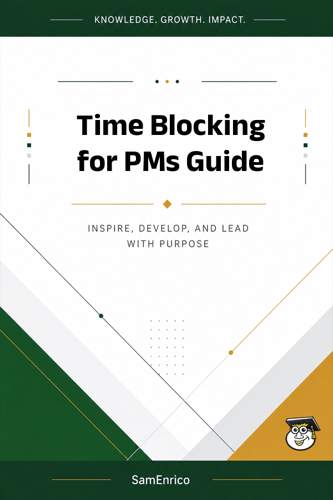
Non-FictionBusiness BriefTime Management
Time Blocking for PMs Guide eBook
Allocate deep work blocks across projects to avoid
Allocate deep work blocks across projects to avoid context switching.
Formats
Free sample
Chapter 1: The 23-Minute Heist--–- You are being robbed, and you have no idea it is happening. The thief does not wear a mask or carry a weapon. The thief does not break into your home or hack your bank account. The thief sits in your calendar, hides in your Slack notifications, and smiles every time you pat yourself on the back for juggling six projects at once. The thief’s name is the context switch, and it steals from you in units of twenty-three minutes at a time.This chapter exists to make one thing painfully clear: the romanticized image of the project manager who can spin ten plates while answering emails and updating a Gantt chart is not a sign of excellence.
It is a sign of cognitive bankruptcy. The myth of the juggling PM has ruined more careers, burned out more high-performers, and wasted more organizational money than any failed project launch in history. And the worst part? You have been taught to admire the very behavior that is destroying your productivity.Let us begin with a simple question. When did you last work on a single project, for a single uninterrupted hour, without checking another project’s Slack channel, without answering an email about a different initiative, without mentally drifting to the budget problem on Project C while trying to solve a dependency issue on Project A?
If you cannot remember, you are not alone. But you are also not productive. You are just busy. And busy is the cheapest form of labor a PM can offer.The Productivity Lie You Have Been Sold The corporate world has spent decades celebrating the wrong behaviors. We give awards to the PM who responds to emails at 11 PM.
We promote the PM who seems to have an answer for every stakeholder question within minutes. We admire the PM who can jump from a budget review to a design critique to a risk register update without missing a beat. We call this person “a natural,” “a firefighter,” “someone who can handle anything.”We are wrong.What we are actually admiring is a person who has trained their brain to operate in a state of constant, low-grade cognitive chaos. And because chaos feels energetic, we mistake it for effectiveness. But effectiveness is not measured by how many things you touch.
Effectiveness is measured by how many things you complete to a high standard. And you cannot complete complex work when your attention is fractured into a dozen pieces.The research on this is brutal and consistent. Every time you shift your attention from one cognitively demanding task to another, your brain does not simply pause one activity and resume another. Your brain must perform a series of expensive neurological operations: it must suppress the active neural networks of the first task, activate the dormant networks of the second task, reload contextual memory, reorient your working memory, and re-establish your cognitive momentum. All of this happens in milliseconds, but the cost accumulates in minutes.This is not multitasking.
Multitasking is a myth. What we call multitasking is actually task-switching at high speed, and every switch carries a toll.The Number That Will Change How You Work In 2014, researchers at the University of California, Irvine conducted a study that should be required reading for every project manager on earth. They observed information workers in their natural environments and measured how long it took them to return to a state of deep focus after an interruption. The number they found was twenty-three minutes and fifteen seconds.Twenty-three minutes.Not two minutes. Not five minutes.
Not even the fifteen minutes most PMs optimistically assume. Twenty-three minutes to fully re-engage with the cognitive depth required for complex work. In that twenty-three-minute window, you are not fully productive. You are in a state of cognitive recovery. You are scrolling, re-reading, re-orienting, and silently asking yourself, “Where was I?”Now let us do the math that will change your week.Imagine you are a PM managing five active projects.
On a typical day, you receive forty-seven Slack notifications, twelve emails that require responses, three meeting invitations, and four “quick questions” from stakeholders. You also have your own internal switches: you finish drafting a requirements document for Project A, then immediately open the budget spreadsheet for Project B, then glance at the risk register for Project C, then respond to a client question about Project D, then remember you never updated the status report for Project E.How many switches have you performed? A conservative estimate is ten to fifteen per hour. But let us be generous and assume you are disciplined. Let us assume you only switch projects six times per day.
Six intentional, unavoidable switches.Six switches multiplied by twenty-three minutes equals one hundred thirty-eight minutes. Two hours and eighteen minutes. Every single day, you lose more than two hours not to meetings, not to deep work, but to the invisible tax of switching from one project to another. Over a five-day week, that is eleven and a half hours. Over a forty-eight-week working year, that is five hundred fifty-two hours.
That is twenty-three full days. Nearly a month of work. Gone. Stolen. Wasted.And you did not even notice.This is the twenty-three-minute heist.
It is the most expensive line item in your calendar that you never budget for.Shallow Work vs. Deep Work: The Distinction That Saves Careers To understand why the twenty-three-minute rule matters so much for PMs, we must first understand the difference between shallow work and deep work. This distinction comes from Cal Newport’s seminal work on the subject, and it is the foundation upon which this entire book is built.Shallow work is cognitive light. It is the work of answering emails, updating status fields in Jira, moving tickets across a Kanban board, approving timesheets, responding to Slack messages, scheduling meetings, and filling out templates. Shallow work feels productive because it creates visible activity.
You can see the emails leave your outbox. You can see the tickets move to “Done.” You can see the calendar invites land in stakeholders’ inboxes. Shallow work provides immediate, satisfying feedback.But shallow work creates almost no lasting value. An email answered today generates a new email tomorrow. A status field updated now will be outdated in an hour.
A meeting scheduled is not a problem solved. Shallow work is the motion of project management without the progress.Deep work, by contrast, is the work that actually moves projects forward. Deep work is the cognitive labor of solving a dependency conflict between two workstreams. It is the strategic thinking required to re-route around a resource constraint. It is the analytical rigor of comparing three vendor proposals against your risk tolerance.
It is the creative effort of designing a communication plan that will actually keep stakeholders aligned. Deep work produces outputs that compound. One hour of deep work can save ten hours of shallow work later.Here is the brutal truth for most PMs: they spend eighty percent of their time on shallow work and twenty percent on deep work, but they believe the reverse is true. They feel exhausted because shallow work is psychologically draining…
This is the end of the free sample. Get the eBook to keep going. Buy now
About this book
Details
- Author
- Shepard Dierdre
- Publisher
- SamEnrico
- Language
- English
- Genre
- Non-Fiction, Business Brief, Time Management
- Released
- 2026-06-06
- Pages (approx.)
- 152
- Available as
- eBook, Audiobook

Read better in the ZLOADR app
Your eBooks on your phone or tablet. Sign in with your SamEnrico account and start reading.
More by Shepard Dierdre
 Summer School Accelerated Stress GuideShepard Dierdre$11.99
 The Gas Pump Wait Rage GuideShepard Dierdre$11.99
 Vegan Lunch Nutrition GuideShepard Dierdre$11.99
 The Pain Catastrophizing Reduction WorkbookShepard Dierdre$11.99
 Black Flag: The 1904 Olympic Scandal That Shook the WorldShepard Dierdre$11.99
 Novation Product ManagerShepard Dierdre$11.99
 Small Business AI Inventory AccountingShepard Dierdre$12.99
 African Scholarship Email GuideShepard Dierdre$12.99
 A Beginners Guide to Field target (Volume 1)Shepard Dierdre$11.99
 Understanding Neuronal HeterotopiaShepard Dierdre$17.99
You may also like
 Hong Kong Handover 1997Dunn Johnnie$11.99
 Zumba For Postnatal Recovery CourseNeal Christian$11.99
 Zumba for BeginnersLadner Nikia$11.99
 YouTube Comment Mining GuideHumes Pandora$12.99
 Worry Box MeditationCarlin Rudy$11.99
 Workplace Stress MeditationNguyen Lynn$11.99
 Workplace Stress and Sleep RepairHawley Ivory$11.99
 Workplace Perfectionism CureDelaney Jeffry$11.99
 Workplace Injustice Anger GuideWallen Isabelle$11.99
 Work Addiction and Burnout LinkGreenwood Ester$11.99
 Women in Yoga and WellnessBeattie Galina$11.99
 Women in Stand Up ComedyChun Evangeline$11.99