
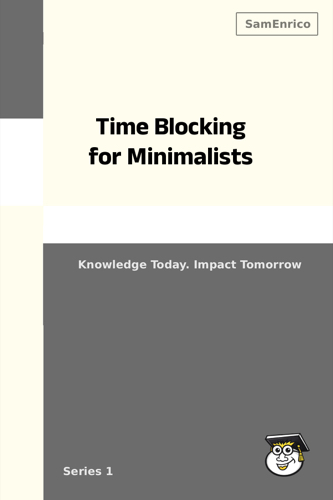
Non-FictionSelf-HelpMinimalism
Time Blocking for Minimalists eBook
Use fewer blocks and more whitespace for intention
by Trice Phylis
Use fewer blocks and more whitespace for intentional living.
Formats
Free sample
Chapter 1: The Cluttered Calendar Crisis--–- The average professional checks their calendar 37 times per day. The average executive spends 23 hours per week in meetings. The average knowledge worker switches between tasks every 10 minutes and 29 seconds. And yet, despite this frenzy of activity, 83% of employees report feeling burned out, 67% say they accomplish less than they want to each day, and 91% admit to attending meetings they know are completely unnecessary.This is not a productivity problem. This is a crisis of clutter.We have been told, relentlessly, that the solution to overwhelm is better organization.
Buy a new planner. Try a new app. Color-code your calendar with eight different categories. Wake up at 5 AM. Block every 15-minute increment.
The promise is always the same: if you just manage your time more efficiently, you will finally feel in control.But here is the truth that no productivity guru wants to admit: You cannot organize your way out of having too much.Imagine, for a moment, that you live in a 500-square-foot apartment. You have collected so much furniture, clothing, and random possessions that you can barely walk from room to room. Your kitchen counters are buried under mail. Your closet is so stuffed that you cannot close the door. Every surface holds a pile of things you "might need someday."Now imagine that someone hands you a beautifully designed, color-coded organization system.
Bins. Labels. Shelving units. A twenty-seven-step decluttering protocol.Would that solve your problem?Of course not. The problem is not that your possessions are disorganized.
The problem is that you have too many possessions. No amount of organization can compensate for the fundamental reality of surplus.And yet, when it comes to our calendars, we accept exactly this absurd logic. We do not ask whether we have too many commitments. We ask how we can organize them more efficiently. We do not question whether that meeting needs to exist at all.
We ask whether it can be moved from 2 PM to 3 PM. We do not wonder if we should say no to a project. We wonder how we can fit it into an already overflowing schedule.This book is built on a single, radical proposition: The opposite of clutter is not organization. The opposite of clutter is emptiness.Welcome to time blocking for minimalists.The Birth of Temporal Consumerism The minimalist movement has taught us, over the past two decades, that our possessions are not neutral. Every object in our home demands something from us.
It demands to be cleaned, maintained, stored, insured, worried about, and eventually disposed of. A cluttered home is not just an aesthetic problem; it is a cognitive and emotional drain. Research published in the Journal of Environmental Psychology found that women who described their homes as "cluttered" or "unfinished" had higher levels of the stress hormone cortisol throughout the day, regardless of their income, education, or employment status. The clutter itself was the stressor.But we have somehow failed to apply this same logic to our calendars.If every physical object in your home demands your attention, then every commitment on your calendar demands something even more precious: your time, energy, and attention during specific, irreplaceable hours of your life. A meeting on your calendar is not neutral.
It demands that you prepare for it, travel to it (physically or virtually), attend it, recover from it, and follow up on it. A deadline is not neutral. It demands that you think about it, worry about it, plan for it, execute it, and then clean up after it.I call this phenomenon temporal consumerism: the compulsive habit of acquiring commitments we do not need, simply because they are available.Just as a consumerist buys a shirt on sale because "it's a good deal" (ignoring the fact that they already own forty shirts), the temporal consumer says yes to a meeting because "it might be useful" (ignoring the fact that their calendar already contains forty hours of commitments). Just as the consumerist confuses the thrill of acquisition with the satisfaction of genuine need, the temporal consumer confuses the feeling of being busy with the reality of being productive.The numbers are staggering. According to a study by the Harvard Business Review, the average professional attends 62 meetings per month.
Of those, roughly half are considered "unproductive" or "unnecessary" by the attendees themselves. That is 31 meetings per month—over 350 per year—that knowledgeable, well-intentioned professionals believe are a waste of time. And yet they attend anyway.Why?Because we have been conditioned to believe that a full calendar is a virtuous calendar. Because we have been taught that saying no is rude, that availability is loyalty, and that busyness is the closest proxy for importance that our culture recognizes.This chapter diagnoses that conditioning. And then it begins the work of breaking it.The Busy Badge of Honor There is a peculiar status symbol in modern professional culture.
It is not a luxury watch or a corner office. It is the ability to say, with a mixture of exhaustion and pride, "I am so busy."Consider how this phrase functions in conversation. When someone asks, "How are you?" and you reply, "Busy!" you are not simply reporting a fact. You are signaling importance. You are implying that your time is in demand, that you are needed, that your life is full of meaningful activity.
"Busy" has become the default answer—not because everyone is genuinely overwhelmed, but because "not busy" feels like an admission of failure.I call this the Busy Badge of Honor, and it is one of the most destructive cultural forces in modern work.The Busy Badge of Honor operates through several psychological mechanisms. First, there is social comparison: when colleagues and peers talk about their packed schedules, we feel pressure to match or exceed their level of busyness. Second, there is identity reinforcement: we have built our self-concepts around being "the person who gets things done," and an empty calendar threatens that identity. Third, there is organizational reward: in many workplaces, the people who say yes to everything are promoted, while the people who protect their boundaries are labeled "difficult" or "not team players."The result is a collective arms race of busyness. No one wants to be the least busy person in the room.
So everyone adds more commitments. And more. And more.But here is the paradox: Busyness and productivity are inversely correlated.A landmark study published in the Journal of Applied Psychology tracked 1,500 knowledge workers over three years. The researchers found that employees who worked more than 50 hours per week showed no measurable increase in output compared to those who worked 40 hours. Beyond 55 hours, productivity dropped sharply.
Beyond 65 hours, employees produced less total output than those working 40 hours, while making significantly more errors.In other words, after a certain point, working more makes you less productive, not more. The same logic applies to commitments. After a certain point, adding more meetings, projects, and obligations does not increase your effectiveness. It decreases it.The Busy Badge of Honor is not a mark of success. It is a mark of poor boundaries, poor prioritization, and a culture that has lost sight of the difference between…
This is the end of the free sample. Get the eBook to keep going. Buy now
About this book
Details
- Author
- Trice Phylis
- Publisher
- SamEnrico
- Language
- English
- Genre
- Non-Fiction, Self-Help, Minimalism
- Released
- 2026-06-08
- Pages (approx.)
- 150
- Available as
- eBook, Audiobook

Read better in the ZLOADR app
Your eBooks on your phone or tablet. Sign in with your SamEnrico account and start reading.
More by Trice Phylis
 TikTok Age ComparisonTrice Phylis$11.99
 Office Politics Stress ManagementTrice Phylis$11.99
 Tax Basis Step Up Trust Planning CourseTrice Phylis$11.99
 Menopause and Acid Reflux Connection GuideTrice Phylis$11.99
 The Great Champagne Heist: Bubbles, Betrayal, and a Billion-Dollar BubbleTrice Phylis$11.99
 Ten Minute Presentation CalmerTrice Phylis$12.99
 India Talent Outflow GuideTrice Phylis$12.99
 Understanding Kaposi SarcomaTrice Phylis$17.99
 How to Start a Burial Service Business (Beginners Guide)Trice Phylis$11.99
 Ramie HarvestingTrice Phylis$11.99
You may also like
 Hong Kong Handover 1997Dunn Johnnie$11.99
 Zumba For Postnatal Recovery CourseNeal Christian$11.99
 Zumba for BeginnersLadner Nikia$11.99
 YouTube Comment Mining GuideHumes Pandora$12.99
 Worry Box MeditationCarlin Rudy$11.99
 Workplace Stress MeditationNguyen Lynn$11.99
 Workplace Stress and Sleep RepairHawley Ivory$11.99
 Workplace Perfectionism CureDelaney Jeffry$11.99
 Workplace Injustice Anger GuideWallen Isabelle$11.99
 Work Addiction and Burnout LinkGreenwood Ester$11.99
 Women in Yoga and WellnessBeattie Galina$11.99
 Women in Stand Up ComedyChun Evangeline$11.99