
Non-FictionSelf-HelpMeeting Efficiency
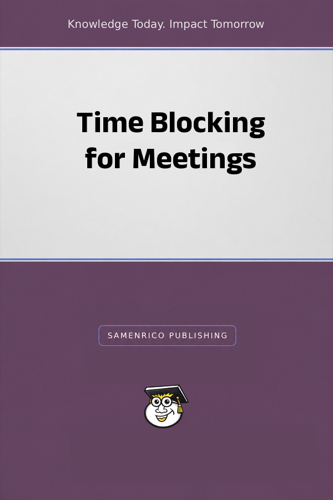
Time Blocking for Meetings eBook
Schedule shorter meetings and force end times with
Schedule shorter meetings and force end times with calendar blocks.
Formats
Free sample
Chapter 1: The Calendar Audit--–- Print your last thirty days of calendar entries. Go ahead. I will wait.Now take a highlighter—yellow works best—and mark every single block of time that directly advanced your top three professional goals for this year. Not meetings you attended because you were invited. Not status updates you sat through because it would have been rude to decline.
Not the recurring “sync” that has been on your calendar since the previous administration. Only the blocks where you can draw a straight line from the time spent to measurable progress on what you told your boss, your board, or yourself was most important.If you are like ninety-four percent of the professionals who have done this exercise across twelve different organizations, you have just highlighted less than ten percent of your calendar.Look at all that white space. All those unmarked hours. All those meetings that felt urgent at the time but, under the cold light of this audit, contributed nothing to your actual priorities. Your calendar is not a reflection of what you value.
It is a fossil record of what other people have asked for. And that gap—between what you say matters and what you actually schedule—is the single greatest source of professional burnout you have never named.This chapter is not about time management tips. It is about a fundamental reorientation: your calendar is not a passive log of events. It is a weapon. And right now, you are holding it backward.The Meeting Industrial Complex Before we fix your calendar, you need to understand who built it.
The answer is not your boss. It is not your team. It is a system—what I call the Meeting Industrial Complex—that profits from your fragmentation.Consider the incentives. Calendar software wants you to schedule more meetings because engagement metrics drive their valuation. Productivity gurus sell you frameworks to “survive” back-to-back calls, not eliminate them.
Middle managers justify their roles by convening people. Senior leaders demonstrate visibility by attending. And everyone, at every level, confuses a full calendar with importance.Parkinson’s Law is the engine of this machine. Work expands to fill the time allotted. Give a meeting sixty minutes, and it will take sixty minutes.
Give it thirty, and it will take thirty. The container creates the content, not the other way around. But here is what the Meeting Industrial Complex does not want you to know: most meetings could end at the halfway point if someone simply stood up and said, “We have what we need.”I have seen this in every industry. A product team that spends ninety minutes reviewing a document that could have been read in twelve. A leadership team that meets for two hours every Monday morning but makes all its real decisions in the hallway afterward.
A nonprofit board that discusses the same strategic question for six consecutive quarters because no one has the courage to say, “We decided this last time.”Your calendar is not full because your work is important. Your calendar is full because the system is designed to fill it.Reactive Versus Proactive: The Two Calendars Every block on your calendar falls into one of two categories: reactive or proactive. There is no third category.Reactive blocks are responses. You attend a status update because someone invited you. You join a troubleshooting call because a client escalated.
You sit through a demo because a vendor requested your time. In each case, the agenda, the duration, and the decision-making authority belong to someone else. You are not driving the car. You are a passenger who showed up because the invitation said “required.”Proactive blocks are initiatives. You block Tuesday from nine to eleven to finish the quarterly forecast.
You schedule Thursday afternoon for strategic planning on a new product line. You reserve Friday morning for the deep analytical work that only you can do. In these blocks, you control the agenda, the end time, and the definition of done.Here is the brutal truth that emerged from the calendar audit: the average knowledge worker spends seventy-two percent of their scheduled time in reactive blocks. That is nearly three of every four hours on your calendar doing what someone else decided was important.But wait, you might say. Some meetings are both.
I attend the weekly staff meeting to share my updates, but I also learn what others are doing. That is collaboration, not reaction.I hear this objection constantly. And it is wrong. A meeting can serve multiple purposes, but the core question remains: who defined the value? If you are attending because the meeting repeats every Wednesday at ten, regardless of whether there is an agenda, you are being reactive.
If you are attending because you determined that ninety minutes of cross-functional alignment will unblock your highest priority project, you are being proactive. The difference is not the meeting format. It is the locus of control.The Values Audit: What You Say Versus What You Do Now we arrive at the uncomfortable part. The Values Audit is not a feel-good exercise. It is a confrontation.Write down your top three professional goals for this year.
Not the ones your manager wrote in your performance review. The ones you actually care about. For most people, these goals fall into categories like: “Get promoted to director,” “Launch the new product by Q3,” “Reduce technical debt by thirty percent,” or “Write a book.”Now look back at your highlighted calendar. How many hours did you spend last month on activities that directly advanced these goals? Not adjacent activities.
Not “building relationships that might help someday.” Direct, measurable progress.I have run this audit with over two thousand professionals. The median result is ninety minutes per week. Ninety minutes. Out of forty hours. That means the average person spends less than four percent of their working week on what they claim matters most.The other ninety-six percent is not laziness.
It is not poor time management. It is the Meeting Industrial Complex, automated and unchallenged, colonizing your calendar one invitation at a time.A senior engineer at a fintech company did this exercise and discovered that she had spent twenty-three hours the previous month in meetings about a project that had been canceled. Not postponed. Canceled. The meetings continued because the calendar recurrence was never deleted.
She attended, contributed, prepared slides, and followed up—for a project that did not exist.A marketing director at a consumer goods company highlighted his calendar and found that his top three professional goals received a combined total of forty-five minutes of attention over thirty days. He spent more time that month in a weekly “innovation sync” that produced zero actionable ideas than he spent on his actual innovation goal.A hospital administrator printed her calendar and literally wept at her desk. She had blocked “Strategic Planning” every Friday from one to three. But when she looked closely, she realized that for six months, that block had been consumed by urgent operational fires. She had never once moved the fire into a contingency block.
She had simply let it burn through her proactive time.The Values Audit does not judge you. It shows you the…
This is the end of the free sample. Get the eBook to keep going. Buy now
About this book
Details
- Author
- Carson Darryl
- Publisher
- SamEnrico
- Language
- English
- Genre
- Non-Fiction, Self-Help, Meeting Efficiency
- Released
- 2026-06-07
- Pages (approx.)
- 125
- Available as
- eBook, Audiobook

Read better in the ZLOADR app
Your eBooks on your phone or tablet. Sign in with your SamEnrico account and start reading.
More by Carson Darryl
 Swimming Kickboard DrillsCarson Darryl$11.99
 Domestic Violence Scene ReconstructionCarson Darryl$11.99
 LBO Cross Border GuideCarson Darryl$11.99
 Emotion Labeling GuideCarson Darryl$11.99
 SMART For HR GuideCarson Darryl$11.99
 Self Hypnosis for Sleep TalkCarson Darryl$11.99
 Empathy for AutismCarson Darryl$11.99
 The Wirecard Scandal: Germany's Billion-Dollar IllusionCarson Darryl$11.99
 How to Produce PET Leash ExtensionsCarson Darryl$11.99
 How to Produce Dance ShoesCarson Darryl$11.99
 A Collector's Handbook to the Volkswagen 1500Carson Darryl$11.99
 Outland PR Application GuideCarson Darryl$12.99
You may also like
 Hong Kong Handover 1997Dunn Johnnie$11.99
 Zumba For Postnatal Recovery CourseNeal Christian$11.99
 Zumba for BeginnersLadner Nikia$11.99
 YouTube Comment Mining GuideHumes Pandora$12.99
 Worry Box MeditationCarlin Rudy$11.99
 Workplace Stress MeditationNguyen Lynn$11.99
 Workplace Stress and Sleep RepairHawley Ivory$11.99
 Workplace Perfectionism CureDelaney Jeffry$11.99
 Workplace Injustice Anger GuideWallen Isabelle$11.99
 Work Addiction and Burnout LinkGreenwood Ester$11.99
 Women in Yoga and WellnessBeattie Galina$11.99
 Women in Stand Up ComedyChun Evangeline$11.99