
Non-FictionSelf-HelpBusyCal Productivity
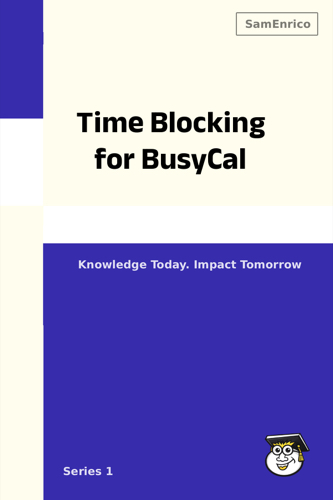
Time Blocking for BusyCal eBook
Leverage BusyCal's unique views for time blocking
Leverage BusyCal's unique views for time blocking across teams.
Formats
Free sample
Chapter 1: The Green Square--–- It was 2:47 on a Tuesday afternoon when Elena’s calendar betrayed her.She had been deep in flow for almost two hours, building a pricing model that would determine whether her company would enter the European market. The spreadsheet had five interconnected tabs. She had just discovered a formula error that, if uncorrected, would have cost them $2 million in projected revenue. Her fingers were flying across the keyboard. The answer was so close she could taste it.Then her screen flashed.
A new meeting invitation had arrived. Her boss, Mark, wanted a “quick 30-minute sync” at 3 PM. Elena glanced at her calendar. From 1 to 4 PM, she had blocked a single event: “Deep Work – EU Pricing Model.” But to Mark, looking at the standard corporate Outlook calendar, that block might as well have been invisible. The system showed a green square.
Available. Free. Ready to be filled.She accepted the meeting. She closed the spreadsheet. She spent 45 minutes in the sync, which was not about anything urgent.
By the time she returned to the pricing model, the threads of her thinking had unraveled. It took her another hour to rebuild the mental context she had lost. The formula error? She found it again, but now it was 6 PM, and she was exhausted. She saved the file and went home.The next morning, Mark asked her why the European market analysis was delayed.
Elena didn’t have an answer that wouldn’t sound like an excuse. So she said nothing. She worked through lunch. She stayed late. She got it done.
But something inside her shifted. She started blocking her calendar with fake meetings—“Product Sync,” “Strategy Review,” “Client Alignment”—just to keep people away. The lies worked, but they felt wrong. And they required constant maintenance. When someone rescheduled a meeting, she had to manually move her fake blocks.
When someone asked about a fake meeting afterward, she had to remember the lie.Elena was trapped in a system that punished her for protecting her best work. And the villain was not Mark, who was just trying to connect. The villain was the green square.The Most Dangerous Color in Business Green is supposed to mean go. On a calendar, it means available. It means you are free to meet, to chat, to collaborate.
It means your time belongs to whoever asks for it first. And that is precisely why green is the most dangerous color in business.Think about what a green square on a standard calendar actually represents. It represents a period of time during which you have not explicitly scheduled a meeting. That is all. It does not mean you are available to think deeply.
It does not mean you are available to solve complex problems. It does not mean you are available to do the work that actually moves the needle for your team and your company. It means you have no meetings. And somewhere along the way, we decided that meant the same thing as being free.This is the Great Confusion of modern knowledge work. We have conflated two entirely different states: “no scheduled meetings” and “able to focus.” The first is a structural condition.
The second is a cognitive one. They are not the same. They are rarely even related. Yet our calendar tools treat them as identical. A green square is a green square is a green square.
The calendar doesn’t know if you’re writing code or watching cat videos. It doesn’t know if you’re solving a critical production issue or reorganizing your desktop icons. It knows one thing: no meeting invite has claimed this slot. Therefore, you are available.The consequences of this confusion are not small. They are catastrophic.A study published in the journal Organization Science found that knowledge workers spend an average of only 2 hours and 48 minutes per day on their most cognitively demanding tasks.
The rest of the day is consumed by meetings, email, administrative work, and the dreaded “context switching” that happens when a green square gets claimed by an unscheduled interruption. The researchers called this “the fragmentation penalty.” And they found that the penalty was highest for workers whose calendars showed the most green—the very people who appeared, on the surface, to have the most available time.Here is the irony: the people with the most green squares are often the people doing the most important deep work. They are the engineers, the designers, the strategists, the writers, the analysts. They keep their calendars light because they need uninterrupted time to think. But their green squares invite interruption.
Their availability is their vulnerability. And so they learn to hide. They block fake meetings. They set Slack statuses to “Focus Time” (which everyone ignores). They work odd hours when no one else is online.
They become, in the words of one exhausted product manager I interviewed, “productivity ninjas” who do their real work in the shadows while their calendars perform a theater of availability.This is unsustainable. It is also unnecessary. Because the problem is not that green squares exist. The problem is that green squares are the only information our calendars provide. If we could add a second color—a color that meant “I am doing my most important work, please do not interrupt me, and no I will not tell you what it is because that is none of your business”—the entire dynamic would shift.
That color exists. It is called red. And Busy Cal lets you paint your calendar with it.The Economics of Interruption Before we solve the problem, let’s make sure we understand its true cost. I want you to do a simple calculation.Think about your most important task this week. The one that, if you completed it, would make everything else easier.
The one that requires your full attention, creative energy, and problem-solving ability. Now ask yourself: how many uninterrupted hours did you spend on that task? Be honest. Not “how many hours did you have available.” How many hours did you actually spend in a state of deep, uninterrupted concentration?For most knowledge workers, the answer is between zero and four hours per week. The rest of the time, the task gets nibbled to death by meetings, Slack messages, emails, and the endless parade of “quick questions” that arrive in green squares.
Each nibble costs something. And that something is not just the five minutes you spend answering the question. It is the recovery time.Research from the University of California, Irvine, has quantified this recovery time with stunning precision. When you are interrupted during a complex task, it takes an average of 23 minutes and 15 seconds to return to the same level of cognitive focus. Not to return to the task—to return to the same depth of concentration.
That means a two-minute interruption (“Hey, do you have the Q3 numbers?”) actually costs you more than 25 minutes of productive time. The two minutes are the interruption. The 23 minutes are the recovery. The 15 seconds are the rounding error.Now multiply that recovery cost by the number of times you are interrupted during a focus block. In…
This is the end of the free sample. Get the eBook to keep going. Buy now
About this book
Details
- Author
- Davies Malisa
- Publisher
- SamEnrico
- Language
- English
- Genre
- Non-Fiction, Self-Help, BusyCal Productivity
- Released
- 2026-06-09
- Pages (approx.)
- 145
- Available as
- eBook, Audiobook

Read better in the ZLOADR app
Your eBooks on your phone or tablet. Sign in with your SamEnrico account and start reading.
More by Davies Malisa
 Construction Worker Anger ShiftDavies Malisa$11.99
 Andes High Route LeaderDavies Malisa$11.99
 The Dream Rehearsal ProtocolDavies Malisa$11.99
 Pakistani Corner Shop EmpireDavies Malisa$11.99
 Webinar Hosting GuideDavies Malisa$11.99
 Sleeve GastrectomyDavies Malisa$11.99
 Peg System For Music TheoryDavies Malisa$11.99
 The Tokyo Subway Sarin Attack: Japan's Darkest Day of Terror (1995)Davies Malisa$11.99
 The Last Speakers of the Silk Road: A Linguistic Vanishing ActDavies Malisa$11.99
 How to Start a Knitting Needles Made of Metal Business (Beginners Guide)Davies Malisa$11.99
 How to Produce Network Storage SystemsDavies Malisa$11.99
 Part Time Jobs for Students TurkeyDavies Malisa$12.99
You may also like
 Hong Kong Handover 1997Dunn Johnnie$11.99
 Zumba For Postnatal Recovery CourseNeal Christian$11.99
 Zumba for BeginnersLadner Nikia$11.99
 YouTube Comment Mining GuideHumes Pandora$12.99
 Worry Box MeditationCarlin Rudy$11.99
 Workplace Stress MeditationNguyen Lynn$11.99
 Workplace Stress and Sleep RepairHawley Ivory$11.99
 Workplace Perfectionism CureDelaney Jeffry$11.99
 Workplace Injustice Anger GuideWallen Isabelle$11.99
 Work Addiction and Burnout LinkGreenwood Ester$11.99
 Women in Yoga and WellnessBeattie Galina$11.99
 Women in Stand Up ComedyChun Evangeline$11.99