
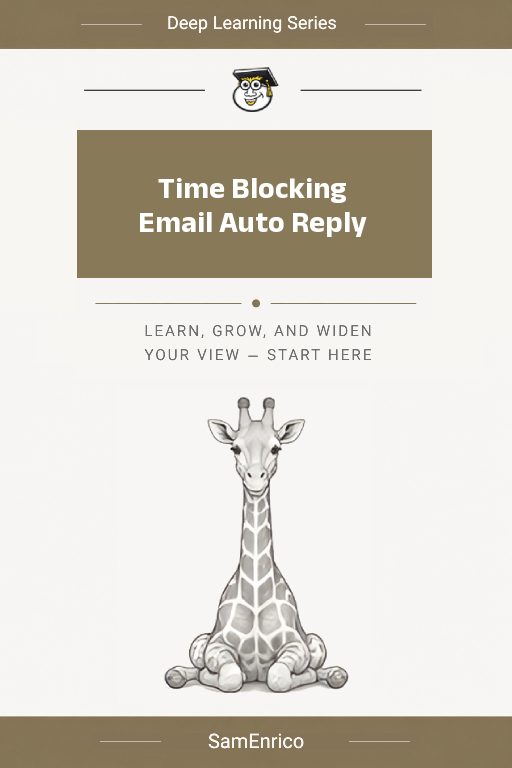
Non-FictionProfessional's Cheat Sheet
Time Blocking Email Auto Reply eBook
Draft out-of-office templates that explain your ti
by Loftin Bryce
Draft out-of-office templates that explain your time blocking system.
Formats
Free sample
Chapter 1: The Hyperactive Hive Mind...--–- The email arrived at 7:14 AM. Priya was still in bed, scrolling before her feet touched the floor. It was from her boss, marked “High Importance.” The subject line read: “Quick question – can you jump on a call at 8?” Priya had a strategic project due Friday. She had been “working on it” for six months. She typed back: “Of course.” Then she deleted the calendar block she had set aside for deep work and replaced it with a thirty-minute call.
By 8:15 AM, the call was over. By 8:45 AM, she had answered eleven emails. By 10:00 AM, she could not remember what the strategic project was even about.This is not a story about laziness. It is a story about a system. The system that governs most modern workplaces has a name, and Cal Newport gave it to us: the Hyperactive Hive Mind.
It is the implicit contract that any question can be asked at any time and answered almost immediately. It is the assumption that a “quick question” is always worth the interruption. It is the belief that responsiveness equals productivity, that a full inbox is a badge of honor, and that the person who replies fastest is the person who works hardest.This chapter dismantles that belief. It exposes the hidden cost of constant connectivity. It introduces the single most important statistic you will encounter in this book.
And it makes the case that email auto-replies are not a defensive shield for the lazy or the antisocial. They are a strategic tool for the serious. They are a signal that you are prioritizing something more important than the next notification.The Cost of a Single Interruption Let us begin with the number. It appears in peer-reviewed research from the University of California, Irvine, and it has been replicated across multiple studies in different industries. The number is twenty-three.
Not seconds. Minutes. Specifically, twenty-three minutes and fifteen seconds. That is how long it takes the average knowledge worker to fully refocus after a single email interruption.Let me repeat that, because it is the most important number in this book, and you will see it only once. After that, you will not need to be reminded.
It will haunt you every time you hear a notification chime. Twenty-three minutes and fifteen seconds.Here is what that means in practice. Imagine you are writing a quarterly report. You have gathered your data. You have outlined your argument.
You are deep in the flow, typing sentences that actually cohere, when a notification appears: “New message from Sarah.” You glance at it. It is a question about next week’s meeting. You decide to ignore it and return to your report. But you cannot. Not really.
Because your brain has already done something irreversible. It has switched contexts.The neurological cost of task-switching is well documented. Your brain does not multitask. It toggles. When you interrupt a deep cognitive task to process an email, even for ten seconds, your brain must:Disengage from the original task (saving a partial mental model of where you were),Shift attention to the email (reading, comprehending, deciding whether to act),Process any emotional response (anxiety, curiosity, annoyance),Decide on a course of action (reply, defer, delete),Begin the slow process of re-engaging with the original task,Reconstruct the mental model you abandoned,Find your place again,And finally resume productive work.That process takes an average of twenty-three minutes and fifteen seconds.
Not because you are slow. Because the brain is designed for sustained focus, not rapid switching. Every interruption carries a tax. And the tax compounds.The Math of a Fragmented Day Let us do the arithmetic. Suppose you check email ten times per day.
That is a conservative estimate. Many knowledge workers check email forty, fifty, even eighty times per day. But let us use ten. Ten interruptions, each costing twenty-three minutes of refocus time, equals two hundred and thirty minutes. That is three hours and fifty minutes.
Nearly four hours of cognitive clarity vaporized not by the time spent reading emails, but by the time spent recovering from reading emails.If you check email twenty times per day, you lose nearly eight hours. You have just worked a full day of recovery time. You have paid a full day’s wage for the privilege of being interrupted.Now add the actual time spent reading and replying. The average knowledge worker spends eleven hours per week on email. But here is the more troubling statistic from the same research: forty percent of that time is spent not writing replies, but rather re-reading, sorting, searching for lost threads, or waiting for responses from others.
This is what the author calls email theater – the performance of responsiveness without the substance of productivity. You appear busy. You are not effective.Priya, the manager from our opening story, checked email forty-seven times the day she received her boss’s 7:14 AM message. She knew this because she installed a tracking tool as part of her desperate attempt to understand why she felt so busy yet had accomplished so little. Forty-seven checks.
At twenty-three minutes per interruption, that is over eighteen hours of refocus time in a single day. Impossible, you say. She cannot work eighteen hours. Correct. The math reveals the truth: she was not refocusing at all.
By the fifth or sixth interruption of the morning, she had simply given up on deep work entirely. Her brain had surrendered. It had accepted that focus was impossible, that the only viable strategy was to stay in reactive mode, bouncing from notification to notification like a pinball.The Distinction That Changes Everything This book draws a hard line between two types of work. The distinction comes from Cal Newport’s Deep Work, but it is applied here specifically to email behavior.Reactive Work is the work of answering, approving, replying, triaging, sorting, delegating, and acknowledging. It is the work of keeping the machine running.
It is necessary. It is not evil. But it is almost never the work that advances your career, grows your business, or produces anything you will remember five years from now. Reactive work is the work of maintenance. It is the work of being a good colleague and a responsible citizen.
But it is not the work that matters most.Deep Work is the work of creating, strategizing, analyzing, writing, coding, designing, and problem-solving. It is the work that requires your full cognitive capacity. It is the work that cannot be done in five-minute increments between meetings. It is the work that, when completed, produces something new: a report, a product, a strategy, a solution. Deep work is the work that matters.Here is the problem.
The modern workplace is optimized for reactive work and hostile to deep work. Email arrives at all hours. Slack notifications ping. Meeting invitations appear with fifteen minutes’ notice. The implicit message of the Hyperactive Hive Mind is that your attention belongs to whoever asks for it first.
You are not the owner of your own focus. You are a resource to be allocated by the loudest request.Email auto-replies are introduced in this chapter not as a…
This is the end of the free sample. Get the eBook to keep going. Buy now
About this book
Details
- Author
- Loftin Bryce
- Publisher
- SamEnrico
- Language
- English
- Genre
- Non-Fiction, Professional's Cheat Sheet
- Released
- 2026-05-30
- Pages (approx.)
- 126
- Available as
- eBook, Audiobook

Read better in the ZLOADR app
Your eBooks on your phone or tablet. Sign in with your SamEnrico account and start reading.
More by Loftin Bryce
 Mobile App Data Leak ScriptsLoftin Bryce$11.99
 Mike Pompeo CIALoftin Bryce$11.99
 Legal Team ExhaustionLoftin Bryce$11.99
 The Monk Who Loved PlantsLoftin Bryce$11.99
 Reformation Zwingli Zurich Revolution GuideLoftin Bryce$11.99
 The TM Computer MantraLoftin Bryce$11.99
 Medication Nightmares GuideLoftin Bryce$11.99
 IBS Relief Through MicrobiomeLoftin Bryce$11.99
 One Room for Seven PeopleLoftin Bryce$11.99
 The Silent Summit: María de la Cruz and the Forgotten Ascent of ChimborazoLoftin Bryce$11.99
 The Codebreakers of Bletchley: Cracking the EnigmaLoftin Bryce$11.99
 Echoes of the Last Broadcast: The Mysterious Signals of the S.O.S. from the Mary CelesteLoftin Bryce$11.99
You may also like
 Hong Kong Handover 1997Dunn Johnnie$11.99
 Zumba For Postnatal Recovery CourseNeal Christian$11.99
 Zumba for BeginnersLadner Nikia$11.99
 YouTube Comment Mining GuideHumes Pandora$12.99
 Worry Box MeditationCarlin Rudy$11.99
 Workplace Stress MeditationNguyen Lynn$11.99
 Workplace Stress and Sleep RepairHawley Ivory$11.99
 Workplace Perfectionism CureDelaney Jeffry$11.99
 Workplace Injustice Anger GuideWallen Isabelle$11.99
 Work Addiction and Burnout LinkGreenwood Ester$11.99
 Women in Yoga and WellnessBeattie Galina$11.99
 Women in Stand Up ComedyChun Evangeline$11.99