
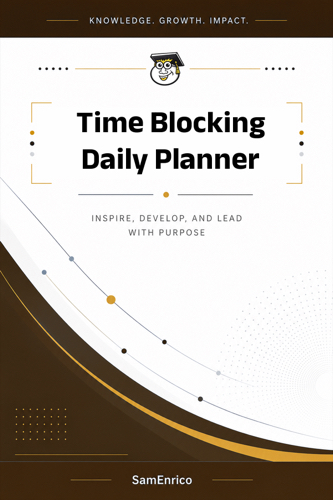
Non-FictionSelf-HelpTime Management
Time Blocking Daily Planner eBook
Teaches how to schedule every hour intentionally.
by Burke Teri
Teaches how to schedule every hour intentionally.
Formats
Free sample
Chapter 1: The Unstructured List...--Every morning, millions of professionals sit down at their desks, open a notebook or a fresh digital document, and write a list. They pour their anxieties, obligations, and aspirations onto the page. The list grows. Five items become ten. Ten become fifteen.
By 10:00 AM, the list is a sprawling document of everything they fear forgetting and everything they hope to accomplish. Then they spend the rest of the day feeling vaguely guilty about the items they did not touch, while secretly congratulating themselves for being so busy.That list is lying to you.I wrote my first to-do list when I was nineteen years old. I was a university student drowning in deadlines, and someone told me that if I just wrote everything down, my brain would stop spinning. They were right about one thing: writing things down did reduce my anxiety. But it did absolutely nothing to help me finish my work.
Instead, I developed a ritual that I now recognize as tragically common. I would write a list of twenty things. I would do the easiest five—the emails, the quick calls, the administrative busywork that required no real thinking. Then I would look at the remaining fifteen items, feel a wave of exhaustion, and declare the day a success because I had been so busy.I was not productive. I was busy.
There is a difference, and that difference is the subject of this entire book.The Tyranny of the Unstructured To-Do List Let me name the enemy clearly. The problem is not the to-do list itself. The problem is the unstructured to-do list—the long, unsorted, hourly-unassigned inventory of tasks that prioritizes urgency over importance, recency over relevance, and ease over impact. The unstructured list is a trap disguised as organization.When you write an unstructured list, your brain does something predictable and unhelpful. It scans the list for the easiest items because completing them gives you a small dopamine hit.
You answer three emails. You file two documents. You schedule a meeting. You feel productive. Meanwhile, the one task that would actually move your career or your life forward—the difficult phone call, the creative project, the strategic planning—sits at the bottom of the list, untouched, gathering psychological weight.
By 3:00 PM, that important task feels so heavy that you convince yourself it can wait until tomorrow. You rewrite the list. You move the important task to the top. And tomorrow, you repeat the same ritual.This is not a personal failing. This is how the human brain is wired, and the technology we use every day exploits that wiring ruthlessly.The Attention Economy: How Your Focus Became a Commodity We live in what economists call the Attention Economy.
In this economy, your attention is the most valuable resource—not for you, but for the companies that build the apps, websites, and notifications that compete for every waking second of your day. Facebook, Instagram, Tik Tok, You Tube, Slack, Outlook, Gmail, and even your text messages are designed by teams of behavioral psychologists to do one thing: interrupt you.Every notification is a tiny auction. Your attention is bid on by every app on your phone. The winner gets a few seconds of your focus, often in exchange for absolutely nothing of value. The cost to you is not just the five seconds it takes to glance at the notification.
The cost is the twenty-three minutes it takes to fully refocus on what you were doing before the interruption.This is not an exaggeration. It is a replicated finding from cognitive psychology, and it is called the Switch Cost Effect.The Switch Cost Effect: Why Multitasking Is a Myth For decades, popular culture has celebrated multitasking as a superpower. The best employees, we were told, could juggle email, spreadsheets, phone calls, and chat messages simultaneously. This advice was catastrophically wrong.Here is what actually happens in your brain when you switch between tasks. Imagine you are writing a report.
Your brain has loaded into working memory everything it needs: the argument structure, the key data points, the tone, the audience. This is called your "attentional set." Then a Slack message arrives. You glance at it. Your brain does not simply pause the report and resume later. Instead, it performs a complete "task-switch" operation.
It unloads the report from working memory. It loads the Slack message. You reply. Then, when you return to the report, your brain must reload the entire attentional set from scratch. That reloading process takes, on average, twenty-three minutes.Let me repeat that: every time you switch tasks, you lose approximately twenty-three minutes of productive focus.Now multiply that by the average number of task-switches per hour.
Gloria Mark, a researcher at the University of California, Irvine, studied knowledge workers and found that they switch tasks approximately every three minutes. That means the average professional spends their entire day in a state of constant reloading. They are never fully focused. They are never fully present. They are simply moving from one half-finished task to another, feeling busy while accomplishing almost nothing of value.The Case of the Five-Minute Blocks: How Elon Musk Actually Works When people think of time management, they often point to extreme examples like Elon Musk, who reportedly schedules his day in five-minute blocks.
The assumption is that Musk has superhuman focus. That is not correct. What Musk has is a clear understanding of the difference between structured time and unstructured lists.Musk uses what I will call Fixed Time Blocking throughout this book. He assigns specific tasks to specific hours on his calendar. A five-minute block is not an invitation to multitask.
It is a commitment to do exactly one thing for exactly five minutes, then stop and move to the next commitment. His calendar is not a list of aspirations. It is a contract with himself.Benjamin Franklin, two hundred years earlier, used a similar method, though his blocks were longer. He famously asked himself every morning, "What good shall I do this day?" He then scheduled his day in hourly increments, from 5:00 AM until 10:00 PM. Franklin did not keep a to-do list.
He kept a calendar.The distinction matters more than you might think. A to-do list asks, "What could I do?" A calendar asks, "What will I do, and when?" The first question invites procrastination. The second invites commitment.The Four Illusions of the Unstructured List Before I introduce the solution, let me name four illusions that keep people trapped in unstructured list-making. Recognizing these illusions is the first step toward escaping them.Illusion One: Urgency Equals Importance. Your inbox is full of urgent messages.
Most of them are not important. Urgency is often manufactured by the sender, who wants you to prioritize their problem over your own goals. The unstructured list cannot distinguish between the two, so every email you receive becomes a de facto priority.Illusion Two: Busyness Equals Productivity. Filling your day with small, completed tasks feels good. It feels like progress.
But completing a low-value task is not progress. It is motion. Productivity is not about how many boxes you check. It is about whether the work…
This is the end of the free sample. Get the eBook to keep going. Buy now
About this book
Details
- Author
- Burke Teri
- Publisher
- SamEnrico
- Language
- English
- Genre
- Non-Fiction, Self-Help, Time Management
- Released
- 2026-06-05
- Pages (approx.)
- 125
- Available as
- eBook, Audiobook

Read better in the ZLOADR app
Your eBooks on your phone or tablet. Sign in with your SamEnrico account and start reading.
More by Burke Teri
 Weekly Relationship ReviewBurke Teri$11.99
 Emotional Flooding ManagementBurke Teri$11.99
 Menopause And EndometriosisBurke Teri$11.99
 Stress and Dry MouthBurke Teri$11.99
 Ivan Pavlov Conditioned ReflexBurke Teri$11.99
 The Personal Brand Statement WorkbookBurke Teri$11.99
 Physical Confidence HypnosisBurke Teri$11.99
 The Last Empress: Meijis Fallen Heir and the Forgotten RevolutionBurke Teri$11.99
 The Bloodlands: Wallenstein's Fall and the Shattering of EuropeBurke Teri$11.99
 Mastering Property Tax: Mill Rates & AppealsBurke Teri$11.99
 How to Start a Hobby in Cross-StitchBurke Teri$11.99
 How to Produce Play SwingsBurke Teri$11.99
You may also like
 Hong Kong Handover 1997Dunn Johnnie$11.99
 Zumba For Postnatal Recovery CourseNeal Christian$11.99
 Zumba for BeginnersLadner Nikia$11.99
 YouTube Comment Mining GuideHumes Pandora$12.99
 Worry Box MeditationCarlin Rudy$11.99
 Workplace Stress MeditationNguyen Lynn$11.99
 Workplace Stress and Sleep RepairHawley Ivory$11.99
 Workplace Perfectionism CureDelaney Jeffry$11.99
 Workplace Injustice Anger GuideWallen Isabelle$11.99
 Work Addiction and Burnout LinkGreenwood Ester$11.99
 Women in Yoga and WellnessBeattie Galina$11.99
 Women in Stand Up ComedyChun Evangeline$11.99