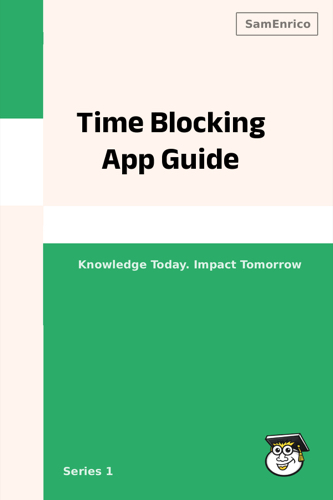
Time Blocking App Guide eBook
Reviews dedicated tools like Clockwise, Reclaim, a
Reviews dedicated tools like Clockwise, Reclaim, and Motion.
Formats
Free sample
Chapter 1: The 10,000 Unmade Decisions...--It is 2:47 PM on a Tuesday, and you have just spent eleven minutes staring at your calendar. You are not planning. You are not executing. You are not even procrastinating on something important. You are simply...
rearranging. You move the 3:00 PM meeting to 4:00 PM, which bumps the task you were supposed to finish by 5:00 PM to tomorrow morning, which means you will have to skip your workout, which means you tell yourself you will “make it up on Wednesday,” which you know, in the quietest part of your brain, is a lie.This is not a failure of discipline. This is not a character flaw. This is the predictable result of using a tool—the traditional to-do list—that was never designed for the way modern work actually functions. And you are not alone.
Researchers estimate that the average knowledge worker makes more than ten thousand micro-decisions about their schedule every single week. Ten thousand tiny drains on your cognitive battery. Ten thousand moments when you ask yourself: Is this still right? Should I move that? What am I forgetting?
By the time you actually sit down to do real work, your brain has already run a marathon.This chapter is about why the to-do list is a psychological trap, why “just write it down” has become toxic advice, and how a new class of AI scheduling tools—Motion, Reclaim, and Clockwise—can eliminate those ten thousand decisions entirely. By the end of this chapter, you will understand why lists fail, what “decision fatigue” actually costs you, and how shifting from managing tasks to assigning tasks to an AI scheduler can double your output while cutting your anxiety in half.The Quiet Violence of the To-Do List Let us start with a confession. The to-do list is not evil. It is simply incomplete—catastrophically, deceptively incomplete. When you write “Finish Q3 report” on a list, your brain does not see a task.
It sees a question mark. How long will it take? Do I have the data? What needs to happen before I can start? Where will I fit it between the 10:00 AM meeting and the 2:00 PM deadline?
The list offers no answers. It only offers the illusion of control.David Allen, the author of Getting Things Done, identified this problem decades ago. He argued that an unprocessed task—one without a defined next action, context, and time estimate—creates “open loops” in your brain. These loops consume mental energy whether you are aware of them or not. Every incomplete task sits in the background of your consciousness, quietly demanding attention.
The to-do list, in Allen’s framework, is not a solution. It is a storage unit. It moves the open loop from your brain to paper (or pixels), but it does not close the loop.Alec Mackenzie, writing in The Time Trap in the 1970s, went further. He observed that most lists fail for three structural reasons. First, they lack context.
A task like “Call Sarah” requires a phone, a quiet environment, and Sarah’s availability. None of that is on the list. Second, they lack duration. “Write proposal” could take thirty minutes or six hours. Without an estimate, your brain defaults to the worst case, which triggers avoidance.
Third, and most critically, lists lack priority decay. Urgency changes by the hour. A task that was critical at 9:00 AM may be irrelevant by 2:00 PM. But the list does not know that. The list is static.
Your life is not.Here is what these three failures create in practice. You open your list at 9:00 AM. You see fifteen items. You scan for the most urgent—usually the one with the loudest stakeholder, not the most important outcome. You do that task.
You cross it off. You feel a small hit of dopamine. Then you look at the remaining fourteen items. You feel a wave of anxiety. So you check email.
You move to Slack. You attend a meeting that could have been an email. By 5:00 PM, you have crossed off maybe four items, but you cannot remember what you actually accomplished. You feel busy but not productive. You feel exhausted but not fulfilled.That is the quiet violence of the to-do list.
It tricks you into measuring effort instead of output. It rewards the dopamine of deletion without requiring the discipline of completion. And it leaves you, at the end of every day, with the same sinking feeling: I worked all day. What did I actually do?Decision Fatigue: The Hidden Tax on Your Calendar The problem is not that you are bad at managing your time. The problem is that your brain was never designed to manage a calendar.
Evolution prepared you to hunt, gather, and avoid predators. It did not prepare you to juggle seventeen Slack channels, four project management tools, two email accounts, and a calendar with meetings booked in thirty-minute increments across three time zones.This gap between evolutionary design and modern work is where decision fatigue lives. The term was popularized by social psychologist Roy Baumeister, who found that the quality of a person’s decisions degrades over time as they make more decisions. The first decision of the day is usually solid. The hundredth decision is often terrible.
By the time you are deciding whether to move the 3:00 PM meeting or skip lunch, your brain is running on fumes.Here is what most people misunderstand about decision fatigue. It is not about big decisions. Big decisions—whether to accept a job, buy a house, end a relationship—happen rarely. Your brain can rally for those. Decision fatigue comes from micro-decisions.
Should I check email now or after this task? Should I reply to that message or mark it unread? Should I move this meeting or ask for an agenda? Should I take lunch now or push through?Every time you look at your calendar, you make a series of micro-decisions. Is this meeting still relevant?
Do I have the materials? Do I need to prepare? Should I reschedule? Am I double-booked? What is the travel time between this meeting and the next?
By some estimates, a single glance at a busy calendar triggers seven to twelve separate micro-decisions. If you look at your calendar twenty times per day—and most knowledge workers look far more often—you are making hundreds of micro-decisions before lunch.Now multiply that by five days. By fifty weeks. By a career.You are not tired because you work too much. You are tired because you decide too much.The Second Brain: What AI Schedulers Actually Do The solution is not to try harder.
The solution is to offload the decisions entirely. This is where AI schedulers—specifically Motion, Reclaim, and Clockwise—enter the picture.An AI scheduler is not a calendar. A calendar is a passive container. It shows you where events are placed, but it does not tell you whether that placement is optimal. An AI scheduler is an active decision engine.
It looks at your tasks, your meetings, your habits, your deadlines, your energy patterns, and your priorities. Then it assigns specific start and end times to everything. You do not ask “When…
This is the end of the free sample. Get the eBook to keep going. Buy now
About this book
Details
- Author
- Steiner Lashawnda
- Publisher
- SamEnrico
- Language
- English
- Genre
- Non-Fiction, Self-Help, Productivity Apps
- Released
- 2026-06-07
- Pages (approx.)
- 148
- Available as
- eBook, Audiobook

Read better in the ZLOADR app
Your eBooks on your phone or tablet. Sign in with your SamEnrico account and start reading.
More by Steiner Lashawnda
 Walmart Savings Comparison GuideSteiner Lashawnda$11.99
 Deep Work Reward SystemSteiner Lashawnda$11.99
 Nostril Breath Focus TechniqueSteiner Lashawnda$11.99
 George Harrison Quiet BeatleSteiner Lashawnda$11.99
 Scripting for Flying PhobiaSteiner Lashawnda$11.99
 Focus For Creative WorkersSteiner Lashawnda$11.99
 Email Archival By ProjectSteiner Lashawnda$11.99
 Zero Day Protocol: The Ghost in the MachineSteiner Lashawnda$11.99
 The Visionary Behind Dubai's Skyline: The Untold Story of Mohamed AlabbarSteiner Lashawnda$11.99
 How to Produce a DokorderSteiner Lashawnda$11.99
 Exploring Lithography: Stone & Offset PrintingSteiner Lashawnda$11.99
 Multi Currency Pricing for Exporters WorkbookSteiner Lashawnda$12.99