
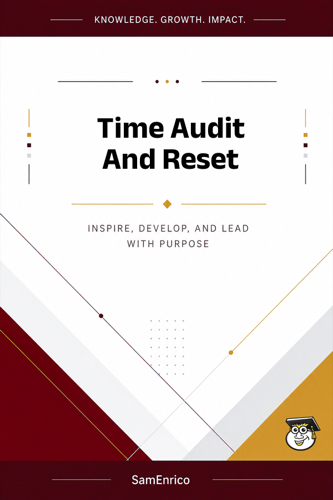
Non-FictionSelf-HelpTime Audit
Time Audit And Reset eBook
Track where your hours actually go and rebuild you
by Himes Carl
Track where your hours actually go and rebuild your schedule from scratch.
Formats
Free sample
Chapter 1: The 2:17 PM Feeling--–- Sarah cried in her car at 2:17 PM on a Tuesday. She couldn't remember what she'd actually accomplished that week. Her calendar was full. Her energy was empty. And then her boss asked for "just five minutes" — the fifth time that day.She is not lazy.
She is not disorganized. She is not failing.She is suffering from something far more common and far more隐蔽 than a lack of discipline. She is suffering from the Perception Gap.This book is the fire extinguisher for the 2:17 PM feeling. But before we can put out the fire, we have to understand what's burning.The Myth of "Busy"Let's start with a question that sounds simple but isn't: How many focused hours do you believe you have each week?Not hours at your desk. Not hours with your calendar blocked.
Not hours "available for work." Focused hours. Uninterrupted, deep, meaningful attention on a single task that moves your life or your career forward.Write down your answer. Seriously. Grab a pen. I'll wait.Most people say between 25 and 35 hours.
Knowledge workers, especially, tend to estimate around 30 focused hours per week. Entrepreneurs say 35. Parents juggling work and childcare say 20.Now here is the truth that every time audit in the last twenty years has revealed: the actual number is almost always half of the estimate. The average knowledge worker has between 10 and 15 focused hours per week. The average executive has 12.
The average parent working from home has 8.This gap between perception and reality — between what you think you have and what you actually have — is the Perception Gap. And it is the single greatest source of chronic overwhelm in modern life.Why? Because if you believe you have 30 focused hours and you only have 12, you will spend every single week failing to meet your own expectations. You will blame yourself. You will work later.
You will wake up earlier. You will download another productivity app. And none of it will work, because you are trying to solve a data problem with willpower.You cannot out-discipline a broken system.The Planning Fallacy (Your Brain Is Lying to You)The Perception Gap is not your fault. It is a feature of human cognition, not a bug in your character.Psychologists have studied this phenomenon for decades under a different name: the planning fallacy. First identified by Daniel Kahneman and Amos Tversky in 1979, the planning fallacy is the tendency for human beings to underestimate the time required to complete a task, even when we have historical evidence that similar tasks took much longer.Here is the classic experiment.
Researchers asked students to estimate how long it would take them to complete their senior theses. The average estimate was 34 days. The researchers then asked: "What is the absolute worst-case scenario? How long would it take if everything went wrong?" The average worst-case estimate was 48 days.The actual average completion time? 73 days.The students were wrong by more than double.
And here is the cruelest part: when the researchers showed the students the historical data — "previous students like you took 73 days" — the students still believed their own estimates. They said, "Yes, but those students were different. I am more organized. I have a better plan."We all believe we are the exception. We are not.The planning fallacy applies to everything: how long it takes to write an email (3 minutes?
try 7), how long it takes to get ready in the morning (20 minutes? try 35), how long it takes to complete a project at work (two weeks? try four). We systematically underestimate every task. Then we systematically overestimate how many tasks we can fit into a day.
Then we systematically feel like failures when the day ends with unfinished work.This is not a moral failing. This is a cognitive bias. And cognitive biases can be corrected — but only with data.Time Confetti vs. Deep Blocks: The Two Modes of Modern Work To understand where your focused hours actually go, we need two metaphors. Keep these in your back pocket for the rest of this book.
They will reappear often.Time Confetti is the first metaphor. Imagine throwing a handful of confetti into the air. Each tiny piece is beautiful on its own — colorful, harmless, festive. But try to build something with confetti. Try to assemble a chair.
Try to write a book. Try to have a difficult conversation. You cannot. Confetti is the enemy of construction.Time confetti is the fragmentation of your day into tiny, unusable pockets of 5 to 15 minutes. A notification buzzes.
You glance at your phone for 4 minutes. A colleague stops by your desk for 7 minutes. You switch from email to a spreadsheet for 12 minutes, then back to email. You wait 8 minutes for a meeting to start. You spend 6 minutes finding a file.
You scroll social media for 10 minutes while your coffee brews.None of these fragments feel like waste. Each one is too small to notice. But collectively, they shred a 50-hour work week into thousands of confetti pieces. You are busy. You are moving.
You are doing things. But you are not building anything.Deep Blocks are the second metaphor. A deep block is an uninterrupted period of 90 minutes (or longer) dedicated to a single, cognitively demanding task. Deep blocks are how books get written, software gets architected, strategies get formulated, and hard problems get solved. Deep blocks are the opposite of confetti.
They are bricks — heavy, substantial, and capable of construction.Here is the problem: most knowledge workers have zero deep blocks in a typical week. Zero. Not one. Their calendars are a mosaic of 30-minute meetings, 15-minute phone calls, and open-door availability. They feel busy because they are constantly reacting.
But they are not producing anything that matters to them.A 2018 study of 1,000 knowledge workers found that the average employee had 3.5 hours of "focused work" per week — and that was self-reported. The actual number, measured by computer activity tracking, was closer to 2 hours.Two hours per week. Out of 40. That means 95% of the work week is consumed by meetings, email, context switching, and transition waste. And then we wonder why we feel behind.The "Before" Exercise: Your Perception Gap Number Before we go any further, I want you to commit to a number.
This is not a test. There is no wrong answer. But you need a baseline.Take out your phone or a piece of paper. Write down the following:This week, I believe I have ______ focused hours.Fill in the blank with your best estimate. How many hours will you spend this week in deep, uninterrupted, meaningful work on your most important priorities?Now write down a second number:Last week, I actually had ______ focused hours.If you are like most people, that second number is a guess.
You do not actually know. You have a feeling. You have a vague sense of whether you were "productive" or "unproductive." But you do not have data.That is the problem this book solves.Why "Watching" Is Harder Than "Doing"Most productivity advice makes the same mistake: it assumes you already know where your time goes. "Just block your calendar," they say. "Just wake up earlier," they say.
"Just use the Pomodoro technique," they say.But you cannot fix what you cannot see.Imagine a doctor who prescribes medication before…
This is the end of the free sample. Get the eBook to keep going. Buy now
About this book
Details
- Author
- Himes Carl
- Publisher
- SamEnrico
- Language
- English
- Genre
- Non-Fiction, Self-Help, Time Audit
- Released
- 2026-06-06
- Pages (approx.)
- 141
- Available as
- eBook, Audiobook

Read better in the ZLOADR app
Your eBooks on your phone or tablet. Sign in with your SamEnrico account and start reading.
More by Himes Carl
 Self Regulation ToolboxHimes Carl$11.99
 Postpartum Babywearing GuideHimes Carl$11.99
 Streaming Media CapitalHimes Carl$11.99
 Sheppard Case Evidence LogHimes Carl$11.99
 The Equestrian Loss GuideHimes Carl$11.99
 IBS Meal Prep CookbookHimes Carl$11.99
 Alcohol Recovery and ConcertsHimes Carl$11.99
 Anger After InfidelityHimes Carl$11.99
 When the Sun Stole the Moon: The Hopi Emergence MythHimes Carl$11.99
 Paws of Justice: The K9 Heroes of 9/11Himes Carl$11.99
 Gilded Shadows: The Secret Life of Marie Antoinette’s PerfumerHimes Carl$11.99
 How to Become a Infantry Weapons CrewmemberHimes Carl$11.99
You may also like
 Hong Kong Handover 1997Dunn Johnnie$11.99
 Zumba For Postnatal Recovery CourseNeal Christian$11.99
 Zumba for BeginnersLadner Nikia$11.99
 YouTube Comment Mining GuideHumes Pandora$12.99
 Worry Box MeditationCarlin Rudy$11.99
 Workplace Stress MeditationNguyen Lynn$11.99
 Workplace Stress and Sleep RepairHawley Ivory$11.99
 Workplace Perfectionism CureDelaney Jeffry$11.99
 Workplace Injustice Anger GuideWallen Isabelle$11.99
 Work Addiction and Burnout LinkGreenwood Ester$11.99
 Women in Yoga and WellnessBeattie Galina$11.99
 Women in Stand Up ComedyChun Evangeline$11.99