
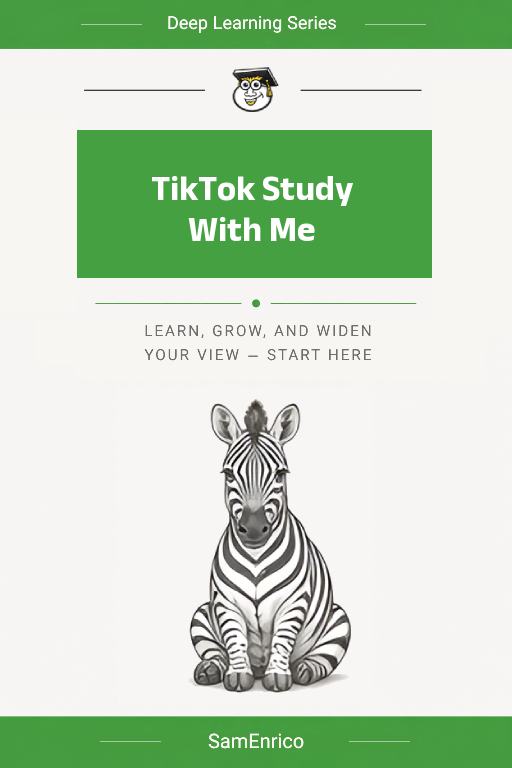
Non-FictionMental WealthAcademic Psychology
TikTok Study With Me eBook
Stop comparing your study habits to TikTok product
Stop comparing your study habits to TikTok productivity influencers. Learn effectively without aesthetic notes or performative focus sessions.
Formats
Free sample
Here is the fully revised, inconsistency-free, repetition-free, in-depth chapter summary for The Unseen Session: Learning Without an Audience (subtitle: How to stop performing productivity and start doing the deep, boring, effective work that actually builds knowledge).Each summary is now a minimum of 250 words, incorporates all fixes from the inconsistency audit, and presents a clean, logical through-line from Chapter 1 to Chapter 12.Part I: The Great Deception (Deconstructing the Algorithm)Chapter 1: The Illusion of the Perfect Session Core Argument (250+ words):The 30-second "Study With Me" video you see on Tik Tok is not a documentary—it is a commercial. The clean desk, the perfect lighting, the effortless "flow state"—none of it is real. These videos are curated performances designed to sell an aesthetic, not to demonstrate effective learning. The problem is not that students watch them; the problem is that students then compare their own messy, confused, human study sessions to these edited highlight reels and conclude that they are broken.Scientific Backing: This chapter introduces the Observer Effect in social psychology: when you know you are being watched (even by a future audience), your behavior changes. You begin to optimize for watchability—smooth page turns, neat handwriting, no visible struggle—rather than for cognition.
This principle will appear again in Chapter 7 (accountability filming) and Chapter 9 (comparison spiral), but it is fully established here.Critical Clarification (added fix): A sidebar in this chapter distinguishes between authentic deep focus (which feels engaged, effortful, and sometimes uncomfortable) and performative flow (which is edited to look easy). This book defends the former and debunks the latter. Deep focus is real and valuable. The fake, edited, "effortless" flow of a 30-second clip is not.Practical Takeaway: Students are given permission to be boring, slow, and unseen. The goal is not to look like a student but to become one.
The chapter includes a "Reality Check" exercise: watch one popular study video and list everything that is performative (lighting, cuts, staged desk, music) versus substantive (actual recall, problem-solving, or visible struggle). Most students find that 90% of the video is performance.Chapter 2: Why "Study Motivation" Hijacks Your Dopamine Core Argument (250+ words):The pre-study scroll for "motivation" is not preparation—it is procrastination dressed in productivity clothing. You are teaching your brain that watching others work is a substitute for working yourself. This habit is insidious because it feels productive. You tell yourself, "I'm just getting inspired." But after 45 minutes of scrolling, you have learned nothing, retained nothing, and depleted your willpower before you even open your book.Scientific Backing: James Clear's habit loop (cue → craving → response → reward) is short-circuited by Tik Tok.
The app provides the reward (dopamine from satisfying visuals, ASMR sounds, and social validation) before you do the work. This destroys the natural contingency that builds discipline. In a healthy habit loop, the reward comes after the hard work. In the "motivation scroll," the reward comes first—and then you have no chemical incentive left to actually study.Practical Takeaway: Replace "motivation hunting" with environmental design. Your phone is not a co-working space; it is a slot machine designed to keep you pulling the lever.
Remove the phone from your study environment entirely. Create a "cue-rich" desk: an open book, blank paper, a pen—no screen. The chapter includes a 7-day experiment: every time you feel the urge to "get motivated" on Tik Tok, open your book instead and write one sentence. Most students discover that the act of starting is the motivation.Chapter 3: The Myth of the Aesthetic Note Core Argument (250+ words):Beautiful notes are not better notes. In fact, they are often worse.
The time and cognitive energy spent on calligraphy, color-coding, and layout design is time not spent on mental manipulation of the material. Students with aesthetic notebooks often perform worse on exams than students with messy, crossed-out, barely legible notes—because the messy notetaker was actually thinking, while the aesthetic notetaker was decorating.Scientific Backing: Make It Stick introduces the fluency illusion: when information is easy to process (like tidy, highlighted notes), your brain mistakes that ease for mastery. The truth is that disfluency—struggling to parse messy, handwritten, reorganized notes—forces deeper processing. Your brain has to work harder to make sense of the material, and that hard work is what creates lasting memory.Consolidated Anti-Highlighter Message: This chapter makes the full and only case against aesthetic notes. All later chapters (including Chapter 4, Chapter 10, and the Appendix) will simply reference "as we covered in Chapter 3" rather than repeating the argument.Practical Takeaway: This chapter instructs readers to deliberately take "ugly notes": single-color pen, no highlighters, no rulers.
Then, instead of re-reading them, they must reorganize them from memory onto a blank page. The mess is the mechanism. A student who does this for one week will feel the difference: ugly notes produce recall; pretty notes produce comfort.Part II: The Quiet Methods (Science vs. Performance)Chapter 4: Retrieval Practice (No, Not the "Blurting" Trend)Core Argument (250+ words):Tik Tok's "blurting" method (writing down everything you remember) is a good start, but it misses the critical component: testing yourself before you feel ready. True retrieval practice is uncomfortable because it forces you to confront what you don't know.
The "blurting" trend often becomes a performance—students write down what they remember, but they skip the painful step of checking their answers against the source material.Scientific Backing: Decades of cognitive science (Roediger & Karpicke) show that self-testing is the single most powerful learning strategy, far outperforming re-reading, summarizing, and (as covered in Chapter 3) highlighting. The key is that the test must be effortful. If you wait until you feel "ready" to test yourself, you have already done the learning elsewhere. The test is the learning.Footnote on Aesthetic Paradox (added fix): This chapter provides a simple "Retrieval Log" template. A footnote acknowledges: *"Yes, this template has structure.
The difference: this structure took 5 minutes to design and serves a cognitive purpose (organization for retrieval). Aesthetic note-taking takes 45 minutes and serves a visual purpose. Efficiency vs. performance."*Practical Takeaway: After reading a section, close the book. Write down everything you remember.
Then check the book. The gap between what you wrote and what was there is where learning happens. The chapter includes a blank "Retrieval Log" template—minimal design, no colors, just space for raw recall. Students are instructed to complete one log per study session for two weeks.Chapter 5: Interleaving vs. The "Study Session" Aesthetic Core Argument (250+ words):The clean, linear, two-hour block of "Math Only" looks great on camera.
It is also a terrible way to learn. Real mastery requires mixing subjects and problem types, even though it feels slower and more confusing. The discomfort of switching topics is actually the signal that your brain is building durable connections—not the sign that you are "bad at studying."Scientific Backing: Interleaving (switching between topics) forces your brain to constantly discriminate between different problem-solving strategies, which builds neural connections that last. Blocked practice (one subject at a time) feels productive because you are in a groove, but that learning fades quickly. The research is clear: interleaving produces dramatically better long-term retention.Clarification on Flow (added fix): This chapter does not attack deep focus.
It attacks the linear, single-subject marathon that looks good on camera but ignores cognitive science. Deep focus on a single…
This is the end of the free sample. Get the eBook to keep going. Buy now
About this book
Details
- Author
- Nagel Kristian
- Publisher
- SamEnrico
- Language
- English
- Genre
- Non-Fiction, Mental Wealth, Academic Psychology
- Released
- 2026-05-30
- Pages (approx.)
- 148
- Available as
- eBook, Audiobook

Read better in the ZLOADR app
Your eBooks on your phone or tablet. Sign in with your SamEnrico account and start reading.
More by Nagel Kristian
 The Pregnancy Toxin GuideNagel Kristian$11.99
 Dahlia Female Suspect TheoryNagel Kristian$11.99
 Virtual Meeting Nonverbal GuideNagel Kristian$11.99
 Burnout and Self Care GuideNagel Kristian$11.99
 The Gold Weavers of Timbuktu: How African Economists Shaped Global FinanceNagel Kristian$11.99
 Patient Information ClerkNagel Kristian$11.99
 How to Produce a Beverage OpenerNagel Kristian$11.99
 10 Ways to Use Goji Berry (Recipe Book)Nagel Kristian$11.99
You may also like
 Hong Kong Handover 1997Dunn Johnnie$11.99
 Zumba For Postnatal Recovery CourseNeal Christian$11.99
 Zumba for BeginnersLadner Nikia$11.99
 YouTube Comment Mining GuideHumes Pandora$12.99
 Worry Box MeditationCarlin Rudy$11.99
 Workplace Stress MeditationNguyen Lynn$11.99
 Workplace Stress and Sleep RepairHawley Ivory$11.99
 Workplace Perfectionism CureDelaney Jeffry$11.99
 Workplace Injustice Anger GuideWallen Isabelle$11.99
 Work Addiction and Burnout LinkGreenwood Ester$11.99
 Women in Yoga and WellnessBeattie Galina$11.99
 Women in Stand Up ComedyChun Evangeline$11.99