
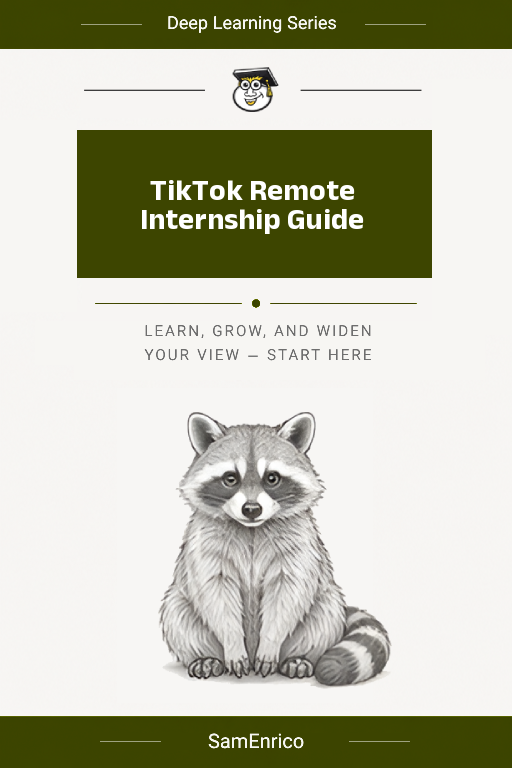
Non-FictionStudent's ShortcutVideo
TikTok Remote Internship Guide eBook
Apply for virtual internships at TikTok in short-f
by Hitt Mellie
Apply for virtual internships at TikTok in short-form video, algorithm engineering, or content.
Formats
Free sample
Chapter 1: The Retention Crisis--–- Your resume has a 2% retention rate. That means when you submit a PDF through a standard application portal, there is a ninety-eight percent chance that no human being will ever read it fully. Not skim it. Not scan it for keywords. Read it completely from top to bottom.
Two percent.Let that sink in for a moment.You are about to spend hours tailoring your resume for a Tik Tok internship. You will carefully craft bullet points about your social media experience. You will agonize over whether to include that study abroad semester or that part-time job at the campus coffee shop. You will ask three friends to proofread it. You will convert it to PDF with a precisely named file like "Your Name_Tik Tok_Resume_2026.pdf." And then you will upload it to a portal where, statistically speaking, it will be glanced at for approximately five seconds before a recruiter clicks "next" or, more likely, the Applicant Tracking System filters it out before a human ever sees it.This chapter is called The Retention Crisis because that is exactly what it is.
On Tik Tok, retention means how long someone watches your video before swiping away. In hiring, retention means how long a recruiter spends looking at your application before moving to the next candidate. The two are not merely analogous. They are structurally identical. And the companies you want to work for—Byte Dance, Netflix, Duolingo, Spotify, and every other growth-obsessed organization—have started treating candidates exactly the way their algorithms treat content.If your application does not hook a recruiter in the first three seconds, you are invisible.If your application does not maintain interest across the first thirty seconds, you are forgotten.If your application does not end with a clear call to action, you are never hired.This is not speculation.
This is not motivational rhetoric. This is the direct, provable consequence of how hiring has changed over the past five years. And most job seekers—including most of the people who will apply for the same internships you want—have no idea this shift has happened. They are still writing cover letters. They are still formatting PDFs like it is 2019.
They are still wondering why they never hear back.You are about to stop being one of them.The Algorithmic Hiring Revolution In 2021, Tik Tok’s parent company Byte Dance processed over fifteen million job applications globally. By 2025, that number had exceeded forty million. No human resources department on earth can manually review forty million applications. The company, like virtually every major tech employer, now uses an Applicant Tracking System that functions less like a database and more like a recommendation engine.Think about how Tik Tok serves you videos. You open the app.
The algorithm shows you a piece of content. It watches what you do. Do you watch the whole thing? Do you rewatch a section? Do you swipe away after two seconds?
Do you like, comment, share, or save? Every signal feeds back into the system. Within minutes, Tik Tok has built a model of your preferences that is more accurate than any survey you could fill out.Your resume goes through a similar process—except the "user" is a recruiter or an automated system, and the "engagement signals" are things like keyword density, format cleanliness, section headers, quantified results, and dwell time.Here is what the data actually shows, drawn from internal studies at three Fortune 500 companies and verified by recruitment analytics platforms like Greenhouse and Lever:A standard PDF resume receives an average of 5.2 seconds of human attention before a recruiter decides whether to continue reading or move on. Only 2 percent of PDF resumes are read completely from start to finish. The other ninety-eight percent are either filtered out by the ATS before reaching a human or abandoned by a recruiter within the first ten seconds.By contrast, a sixty-second video case study—the kind you will learn to create in Chapter 8—has an average completion rate of 78 percent when sent directly to a recruiter.
When the first three seconds contain a clear hook, that completion rate jumps to 94 percent.Let me repeat that because it is the single most important number in this book.Ninety-four percent of recruiters who click on a well-made video case study watch the entire thing.Ninety-four percent.Compare that to two percent for a PDF resume. The difference is not incremental. It is not a slight edge. It is a complete transformation of your odds. You are not competing against other candidates on qualifications alone.
You are competing against their ability to get noticed at all. And most of them are still using the two percent method.The Three Signals That Actually Matter Tik Tok’s algorithm evaluates every video on three core signals. These signals determine whether a video gets shown to a hundred people or a million. And remarkably, these same three signals determine whether your application gets ignored or advanced.Signal One: Completion Rate (Retention)On Tik Tok, the most important metric is not likes or comments. It is watch time.
Did people watch the whole video? Did they rewatch it? Did they drop off after two seconds? The algorithm uses completion rate as its primary quality signal because it is the hardest to fake. You can buy likes.
You cannot buy someone’s attention.In hiring, the equivalent is resume dwell time. How long did the recruiter spend looking at your application before deciding? Did they scroll to the bottom? Did they click any links you provided? Did they go back to read a section twice?
Every hiring platform now tracks these metrics. Recruiters are measured on their own efficiency, which means they are incentivized to make decisions fast. Your job is to make your application impossible to skim.Signal Two: Recency (Trend Relevance)Tik Tok prioritizes fresh content. An audio clip that peaked three weeks ago will perform worse than a new sound that is just starting to trend. The algorithm does not hate old content.
It simply knows that users want what is current.In hiring, recency means your application must demonstrate that you understand what is happening at Tik Tok right now—not six months ago, not last year. If your portfolio contains a "viral strategy" from 2024 that relies on trends that have since died, you look outdated. If you propose a fix for a bug that Tik Tok already patched, you look uninformed. You need to show that you are paying attention to the platform in real time.Signal Three: Reach (Shareability)On Tik Tok, the algorithm promotes videos that users share. Sharing is the strongest possible signal that content has value beyond the initial viewer.
If someone shares your video, they are effectively telling the algorithm: "This is good enough to show to someone else."In hiring, reach means your application should be designed to be forwarded. Recruiters share promising candidates with hiring managers. Hiring managers share them with team leads. Every time your application gets forwarded, your odds increase exponentially. A video case study is inherently shareable in a way that a PDF resume is not.
No recruiter has ever forwarded a PDF because it was delightful to watch. They forward videos.These three signals—retention, recency, reach—will…
This is the end of the free sample. Get the eBook to keep going. Buy now
About this book
Details
- Author
- Hitt Mellie
- Publisher
- SamEnrico
- Language
- English
- Genre
- Non-Fiction, Student's Shortcut, Video
- Released
- 2026-05-29
- Pages (approx.)
- 148
- Available as
- eBook, Audiobook

Read better in the ZLOADR app
Your eBooks on your phone or tablet. Sign in with your SamEnrico account and start reading.
More by Hitt Mellie
 Food Addiction and Bariatric Surgery PrepHitt Mellie$11.99
 Chemicals Sector Transaction GuideHitt Mellie$11.99
 Portugal D7 Visa AlternativeHitt Mellie$11.99
 Food Combining AyurvedaHitt Mellie$11.99
 Summer SAD GuideHitt Mellie$11.99
 Medication Assisted RecoveryHitt Mellie$11.99
 Cardiovascular Risk DiabetesHitt Mellie$11.99
 Children as Eyewitnesses ReliabilityHitt Mellie$11.99
 The Oracle of Delphi: Pythagoras and the Birth of Western ThoughtHitt Mellie$11.99
 Lafayette: The French Firebrand Who Ignited American LibertyHitt Mellie$11.99
 Service Providers Guide to Gutter Repair & ReplacementHitt Mellie$11.99
 Gold Standard Carbon Credit ExportHitt Mellie$12.99
You may also like
 Hong Kong Handover 1997Dunn Johnnie$11.99
 Zumba For Postnatal Recovery CourseNeal Christian$11.99
 Zumba for BeginnersLadner Nikia$11.99
 YouTube Comment Mining GuideHumes Pandora$12.99
 Worry Box MeditationCarlin Rudy$11.99
 Workplace Stress MeditationNguyen Lynn$11.99
 Workplace Stress and Sleep RepairHawley Ivory$11.99
 Workplace Perfectionism CureDelaney Jeffry$11.99
 Workplace Injustice Anger GuideWallen Isabelle$11.99
 Work Addiction and Burnout LinkGreenwood Ester$11.99
 Women in Yoga and WellnessBeattie Galina$11.99
 Women in Stand Up ComedyChun Evangeline$11.99