
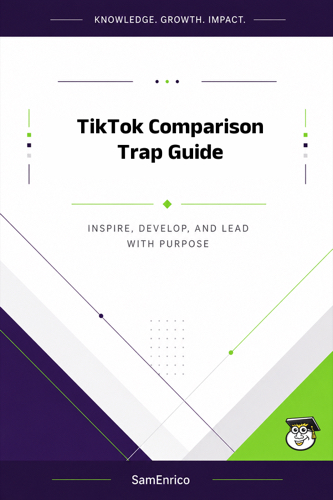
Non-FictionSelf-HelpSocial Media Detox
TikTok Comparison Trap Guide eBook
Stop envying influencers and reclaim your self wor
Stop envying influencers and reclaim your self worth with this practical workbook.
Formats
Free sample
Chapter 1: The Dopamine Coffin--–- You are not broken. You are not weak-willed. You are not lazy, undisciplined, or somehow less capable than the generations who came before you. These are the first and most important words you will read in this book, so let them land. Let them settle into the parts of you that have been quietly whispering otherwise every time you close Tik Tok after forty-five minutes and feel the hollow ache of lost time.The shame spiral is real, and it is by design.
Every time you tell yourself "just five more minutes," every time you swear you will stop after this video (and then this one, and then this one), you are not failing a moral test. You are doing exactly what a trillion-dollar industry has engineered you to do. The question is not whether you have willpower. The question is whether you understand the machinery that has been deliberately constructed to bypass your willpower entirely.This chapter is called "The Dopamine Coffin" for a reason. Not because it is overly dramatic, but because the metaphor is precise: a coffin is a container that encloses you, separates you from the living world, and restricts your movement.
Dopamine, when weaponized by algorithms designed by former casino engineers, does exactly that. It encloses your attention. It separates you from embodied reality. It restricts your ability to choose otherwise.By the end of this chapter, you will understand the neuroscience of why you cannot stop scrolling, the economics of why the platform does not want you to stop, and the first concrete step toward reclaiming your attention. You will also complete your first workbook exercise—the Scroll Log—which will transform vague guilt into specific, actionable data.Let us begin with a question: What is the one thing every slot machine, every casino, and every addiction psychologist knows that you do not?The answer is intermittent variable rewards.
And that answer is the key to the coffin.The Neuroscience of "Just One More"Your brain is not ancient. In evolutionary terms, it is still learning how to navigate the modern world. The dopamine system evolved to reward you for behaviors that kept your ancestors alive: finding food, securing shelter, forming social bonds. When you did something beneficial, your brain released a small amount of dopamine—not as pleasure, but as a prediction mechanism. Dopamine says, "That thing you just did?
Do it again. It might lead to something good."Here is what most people get wrong about dopamine. They think it is the pleasure chemical. It is not. Dopamine is the anticipation chemical.
It is released in the moment before a reward, not necessarily during the reward itself. This distinction is everything.When you see a notification badge on your phone, your brain releases dopamine in anticipation of what might be inside. When you refresh your For You Page, dopamine spikes in anticipation of the next video—the one that might be hilarious, or validating, or beautiful, or shocking. The anticipation is the hook. The reward itself is almost secondary.Now let us introduce the concept of intermittent variable rewards.
This is the mechanism that makes slot machines addictive, and it is the exact same mechanism Tik Tok uses.A fixed reward schedule looks like this: every time you pull the lever, you get a piece of candy. Predictable. Boring. Your brain stops releasing dopamine because there is no uncertainty. A variable reward schedule looks like this: you pull the lever, and sometimes you get nothing, sometimes you get one coin, sometimes you get fifty coins, and you never know which it will be.
Your brain, desperate to solve the pattern, releases dopamine continuously. You keep pulling. You keep refreshing.Tik Tok is a slot machine where every video is a pull of the lever. Most videos are forgettable. Some are mildly entertaining.
A few are electrifying—the ones that make you laugh out loud, or cry, or feel deeply understood. Because you never know which video will be the electrifying one, you keep scrolling. The algorithm learns what electrifies you and feeds you more of it, but never so much that you become satiated. The goal is not to satisfy you. The goal is to keep you hungry.This is not a metaphor.
This is neuroscience. Researchers who have scanned the brains of social media users find the same patterns of activation as problem gamblers. The nucleus accumbens—the brain's reward center—lights up not when you receive a like, but when you are waiting to see if you received one. The waiting is the addiction. The uncertainty is the drug.The $1.5 Trillion Attention Economy Let us zoom out from the brain and look at the business model.
Tik Tok's parent company, Byte Dance, is valued at over two hundred billion dollars. The platform generates tens of billions of dollars in annual revenue. That money comes from advertisers. Advertisers pay to show you ads. They pay more when you watch those ads for longer.
Therefore, Tik Tok's primary business goal—its only real goal—is to maximize the amount of time you spend with your eyes on the screen.The platform does not care if you are happy. It does not care if you are learning. It does not care if you are comparing yourself to influencers and feeling terrible. It cares about one metric: time on screen. Every feature, every notification, every design choice is optimized for that single variable.Consider the following design decisions that are not accidental:The full-screen vertical video.
You cannot see the time. You cannot see how many videos you have watched. You cannot see an exit button without deliberately tapping. The app has removed all environmental cues that might remind you that you have been scrolling for an hour.The infinite scroll. There is no natural endpoint.
A magazine ends. A television episode ends. A movie ends. Tik Tok never ends. You could scroll for ten thousand hours and the next video would still load.
This is called "loss of boundary" in behavioral design, and it is intentional.The removal of the clock. When was the last time you saw the time inside Tik Tok without deliberately looking for it? The app hides the status bar by default. You have to swipe to see what time it is. That is not a bug.
That is a feature.The auto-play sound. Videos start playing with sound on, immediately capturing your auditory attention before you have time to decide whether you want to engage. This bypasses your prefrontal cortex—the decision-making part of your brain—and hands control directly to your limbic system.The "For You" Page algorithm. This is the most sophisticated attention-hijacking machine ever built. It tracks not just what you watch, but how long you watch, whether you rewatch, whether you pause, whether you scroll away quickly, whether you engage with comments, whether you share.
It builds a model of your psychological vulnerabilities more accurate than any therapist could. It knows whether you are more susceptible to envy, to fear, to humor, or to outrage. And it feeds you accordingly.These are not the actions of a neutral tool. These…
This is the end of the free sample. Get the eBook to keep going. Buy now
About this book
Details
- Author
- Schulze Lottie
- Publisher
- SamEnrico
- Language
- English
- Genre
- Non-Fiction, Self-Help, Social Media Detox
- Released
- 2026-06-07
- Pages (approx.)
- 123
- Available as
- eBook, Audiobook

Read better in the ZLOADR app
Your eBooks on your phone or tablet. Sign in with your SamEnrico account and start reading.
More by Schulze Lottie
 Gambling Addiction and Social GamblingSchulze Lottie$11.99
 Startup Founder Negotiation GuideSchulze Lottie$11.99
 Setting Professional Boundaries WorkbookSchulze Lottie$11.99
 Divorce and Work PerformanceSchulze Lottie$11.99
 The Operation Span TaskSchulze Lottie$11.99
 HIIT Hydration GuideSchulze Lottie$11.99
 Purpose For Parents GuideSchulze Lottie$11.99
 The Deluge: Poland's Last Stand Against the Invaders (1655-1660)Schulze Lottie$11.99
 The Phantom Ships of Magellan: Ghosts of the First Global VoyageSchulze Lottie$11.99
 Generative AI Email Marketing GuideSchulze Lottie$12.99
 Co Founder Commitment Level GuideSchulze Lottie$12.99
 How to Produce Motor Vehicle Roll Cages and BarsSchulze Lottie$11.99
You may also like
 Hong Kong Handover 1997Dunn Johnnie$11.99
 Zumba For Postnatal Recovery CourseNeal Christian$11.99
 Zumba for BeginnersLadner Nikia$11.99
 YouTube Comment Mining GuideHumes Pandora$12.99
 Worry Box MeditationCarlin Rudy$11.99
 Workplace Stress MeditationNguyen Lynn$11.99
 Workplace Stress and Sleep RepairHawley Ivory$11.99
 Workplace Perfectionism CureDelaney Jeffry$11.99
 Workplace Injustice Anger GuideWallen Isabelle$11.99
 Work Addiction and Burnout LinkGreenwood Ester$11.99
 Women in Yoga and WellnessBeattie Galina$11.99
 Women in Stand Up ComedyChun Evangeline$11.99