
Non-FictionBiographyPublic Speaking
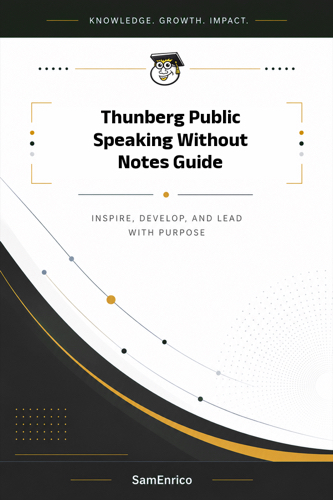
Thunberg Public Speaking Without Notes Guide eBook
Master Greta's intense, memorized, unscripted spea
Master Greta's intense, memorized, unscripted speaking style, speaking truth without teleprompters.
Formats
Free sample
Chapter 1: Moral Panic Fuel--–- The first time you speak truth to power without a script, your body will betray you. Your palms will sweat. Your throat will close. Your voice will tremble on the first syllable of the first word. This is not a sign that you are doing something wrong.
This is the evidence that you are doing something real.Most public speaking advice begins with calming you down. It offers breathing exercises. It tells you to imagine the audience naked. It promises that practice will make you smooth, polished, and professional. This book offers the opposite promise.
Greta Thunberg does not sound polished. She sounds like someone delivering a warning from the edge of a catastrophe. Her voice cracks. Her sentences are not always grammatically elegant. She repeats herself.
And yet, when she speaks, the room goes silent. World leaders squirm. Millions listen.The difference is not technique. The difference is what she is willing to feel.This chapter introduces the foundational mindset of the Thunberg Method: the deliberate cultivation and channeling of moral panic as the engine of unscripted authority. You will learn why feeling genuinely terrified about your topic is more powerful than any amount of rehearsed calmness.
You will discover the ancient Greek concept of parrhesia—frank speech to power—and why it transforms public speaking from a performance into a civic duty. And you will begin the work of distinguishing between performance anxiety (the fear of looking stupid) and moral panic (the fear that the truth is catastrophic). The former paralyzes. The latter propels.The Failure of Conventional Public Speaking Advice Before we can build the Thunberg Method, we must first understand what it is not. Conventional public speaking training, from Toastmasters to corporate communication seminars, operates on a single underlying assumption: the goal is to make the audience comfortable with you.
You are taught to smile. To make eye contact without staring. To vary your vocal tone so you do not sound monotone. To use hand gestures that are open and inviting. To tell a personal story that humanizes you.
To avoid controversy. To bridge from disagreement to agreement. To be, above all, likeable.This model works if you are selling a product, pitching a startup, or giving a wedding toast. It fails catastrophically when your goal is to tell powerful people that they are destroying the future.Thunberg's 2019 United Nations speech is the anti-Ted Talk. She did not smile.
She did not tell a charming anecdote about her childhood. She did not thank the audience for having her. She opened with a flat, accusatory statement: "This is all wrong. I shouldn't be up here. I should be back in school on the other side of the ocean." Within thirty seconds, she had rejected the very premise of the invitation.
She was not honored to be there. She was not grateful. She was angry.The conventional speaking coach would have advised against this. "You'll alienate your audience," the coach would say. "You need to build rapport before you criticize." But Thunberg understood something that the conventional coach does not: when your audience has already failed at their most basic moral obligation, they do not deserve rapport.
They deserve accusation.This is the first and most important lesson of this chapter. You must decide, before you ever open your mouth, whether you are seeking approval or delivering a warning. You cannot do both. The attempt to do both produces the worst of all outcomes: a speech that is neither warm enough to comfort nor sharp enough to cut. The Thunberg Method requires you to choose.
And once you choose to deliver a warning, you must also choose to feel the full weight of that warning in your own body.Parrhesia: The Ancient Art of Fearless Speech The term for what Thunberg practices comes from ancient Athens. Parrhesia (παρρησία) translates literally as "all-speaking"—the act of saying everything, holding nothing back, speaking without fear or favor to those who hold power. In the democratic assemblies of classical Greece, parrhesia was not merely a speaking technique. It was a civic right and a moral obligation. The citizen who saw the city steering toward disaster was expected to stand and speak the truth, regardless of whether the powerful wanted to hear it.The philosopher Michel Foucault, in his late lectures at the Collège de France, revived the concept for modern audiences.
Foucault identified several characteristics of parrhesia that distinguish it from rhetoric, persuasion, and other forms of public address.First, parrhesia involves a direct relationship between the speaker and the truth. The parrhesiastes does not simply state facts. The parrhesiastes commits to the facts, stakes their own reputation on the facts, and is willing to suffer consequences for speaking the facts. This is why Thunberg's trembling voice matters. She is not a detached news anchor reading a script.
She is a person who has calculated the cost of speaking and has decided to pay it.Second, parrhesia is directed at a specific audience: those who have the power to act but have failed to do so. The parrhesiastes does not preach to the choir. The parrhesiastes looks the king in the eye and says, "You are wrong." This is terrifying. It is also why Thunberg addresses the United Nations General Assembly, not a gathering of climate activists. She goes where the power is.Third, parrhesia involves risk.
The speaker must be willing to be punished—exiled, mocked, dismissed, silenced. Thunberg has been called hysterical, manipulative, ill-informed, and worse. She continues to speak. The risk does not make her pause. The risk is the proof that she means what she says.Fourth and most relevant to this chapter, parrhesia is dangerous to the speaker.
It produces physiological responses. The heart races. The voice shakes. The hands tremble. These are not signs that the speaker is weak.
These are signs that the speaker is telling the truth in a situation where lying would be safer. The body knows the difference.This is the central insight that conventional public speaking advice gets backwards. Most speakers try to eliminate physical signs of nervousness because they believe those signs undermine authority. Thunberg does not eliminate them. She allows them to exist as evidence.
Her trembling is not a flaw in her delivery. Her trembling is part of the message: I am so terrified by what I know that my body cannot hide it.Panic as Fuel: The Counterintuitive Engine Let us be precise about what we mean by "panic." We are not discussing the frozen, hyperventilating, mind-blank panic of a speaker who has forgotten their lines. That is performance anxiety, and it is useless. We are discussing moral panic: the visceral, gut-level terror that comes from fully contemplating the consequences of inaction.If you are speaking about climate change, moral panic means truly imagining a world with collapsing agriculture, mass migration, and failed states. Not as abstract concepts.
As lived reality. If you are speaking about racial injustice, moral panic means truly imagining the weight of centuries of violence. If you are speaking about corporate fraud, moral panic means truly imagining the lives destroyed by embezzlement or negligence.Most speakers protect themselves…
This is the end of the free sample. Get the eBook to keep going. Buy now
About this book
Details
- Author
- Durant Aubrey
- Publisher
- SamEnrico
- Language
- English
- Genre
- Non-Fiction, Biography, Public Speaking
- Released
- 2026-06-11
- Pages (approx.)
- 144
- Available as
- eBook, Audiobook

Read better in the ZLOADR app
Your eBooks on your phone or tablet. Sign in with your SamEnrico account and start reading.
More by Durant Aubrey
 Failure Fear for ADHD MindsDurant Aubrey$11.99
 Menopause Mouth Discomfort GuideDurant Aubrey$11.99
 George Jones No Show MemoirDurant Aubrey$11.99
 Green Tea Catechins Brain HealthDurant Aubrey$11.99
 The Clockwork Conspiracy: How a 19th-Century Timekeeper Almost Stopped the Industrial RevolutionDurant Aubrey$11.99
 The Hollow Crown: Merlin’s Forgotten ProphecyDurant Aubrey$11.99
 Waterbed CraftDurant Aubrey$11.99
 Understanding Fragile X Syndrome Type 1Durant Aubrey$17.99
 AI Presentation Workflow BlueprintDurant Aubrey$12.99
 AI Credit Card Recon GuideDurant Aubrey$12.99
 Ultimate Handbook Guide to Wanyuan : (China) Travel GuideDurant Aubrey$11.99
You may also like
 Hong Kong Handover 1997Dunn Johnnie$11.99
 Zumba For Postnatal Recovery CourseNeal Christian$11.99
 Zumba for BeginnersLadner Nikia$11.99
 YouTube Comment Mining GuideHumes Pandora$12.99
 Worry Box MeditationCarlin Rudy$11.99
 Workplace Stress MeditationNguyen Lynn$11.99
 Workplace Stress and Sleep RepairHawley Ivory$11.99
 Workplace Perfectionism CureDelaney Jeffry$11.99
 Workplace Injustice Anger GuideWallen Isabelle$11.99
 Work Addiction and Burnout LinkGreenwood Ester$11.99
 Women in Yoga and WellnessBeattie Galina$11.99
 Women in Stand Up ComedyChun Evangeline$11.99