
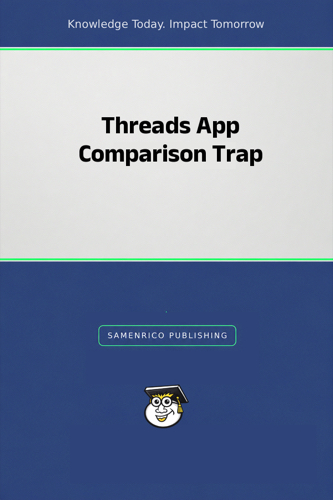
Threads App Comparison Trap eBook
Reduces algorithm induced anxiety and engagement.
Reduces algorithm induced anxiety and engagement.
Formats
Free sample
Chapter 1: The Second Life...--–- On a Tuesday morning in July 2023, one hundred and fifty million people did something strange. They downloaded an app that didn't yet have a web version, a desktop interface, a working search function, or even a clear reason to exist. Within five days, Threads became the fastest-growing consumer software product in human history, surpassing Chat GPT, Pokémon Go, and even the original launch of Instagram itself. The technology press called it a "slam dunk." Investors called it a "Meta comeback." Users called it... confusing.Within two weeks, the same people who had rushed to claim their usernames began to notice a peculiar sensation.
It wasn't excitement. It wasn't joy. It was a low-grade, persistent, almost embarrassing anxiety. They opened the app, scrolled for twelve minutes, saw a stranger's detailed account of their mother's funeral, saw a brand tweeting like a zoomer, saw a three-day-old hot take about a movie nobody had seen, and then closed the app feeling worse than when they opened it. They couldn't explain why.
The app wasn't mean like Twitter could be. It wasn't polished like Instagram had become. It was just... off. And the off-ness made them feel guilty, as if their discomfort was the problem, not the platform.This book is about that feeling.
It is about the specific, insidious, and largely undiagnosed form of anxiety generated not by conflict or outrage, but by the illusion of low-effort community. It is about the Threads App Comparison Trap—the quiet, ambient dread that comes from scrolling through a feed that promises connection but delivers only the hollow echo of other people's carefully curated vulnerability.Before we can escape the trap, we must understand how we fell into it. And to understand that, we must first confront an uncomfortable truth: you probably didn't join Threads because you wanted to. You joined because you were afraid of being left behind.The Negative Space Hypothesis Every successful social platform in history has succeeded on its own merits. Facebook offered a directory of real human identities when the internet was anonymous.
Twitter offered real-time public conversation when blogs were slow. Instagram offered beautiful photography when camera phones were finally good enough. Tik Tok offered algorithmic serendipity when users were tired of choosing what to watch. Each platform won because it did something genuinely new or genuinely better than what came before.Threads won for the opposite reason. Threads won because of negative space.The term "negative space" comes from visual art and architecture.
It refers to the empty area around and between the subjects of an image—the silence between the notes, the pause between the breaths. In market terms, negative space is what consumers will accept simply because the alternatives have become unbearable. Threads did not succeed because it was great. Threads succeeded because X (formerly Twitter) had become a chaos engine of rage-bait, blue-check paywalls, algorithmic hostility, and owner-driven instability. At the same time, Instagram—Threads' parent platform—had calcified into a museum of curated perfection where nobody felt authentic anymore.
The museum was beautiful but exhausting. The town square was chaotic but dangerous.Threads occupied the negative space between them. It promised a "clean slate." It promised text-first conversation without the visual pressure of Instagram. It promised no likes (initially), no retweet-style amplification (initially), and a chronological feed (initially, and then not really). It promised integration with Instagram's existing social graph, meaning you didn't have to rebuild your network from scratch.
You simply logged in, and your Instagram mutuals were already there, waiting.This was both the genius and the trap. By lowering the friction of adoption to near zero, Threads bypassed the normal social network problem—the cold start, the empty feed, the lonely first week. But it also bypassed intentionality. You didn't decide to join Threads. You defaulted into it because the app was pre-installed on your social graph.The Third Space Fallacy To understand why this matters, we need a vocabulary for what Threads claims to be and what it actually is.
The sociologist Ray Oldenburg, in his 1989 book The Great Good Place, introduced the concept of "third places." First places are home. Second places are work. Third places are the neutral, informal gathering spots where people socialize without obligation—coffee shops, pubs, barbershops, parks, community centers. Third places are essential for mental health because they offer low-stakes, low-pressure, high-accidental social connection. You don't have to perform at a third place.
You just have to show up.Threads, and platforms like it, market themselves as digital third places. "Come hang out," the invitation says. "No pressure. Just conversation." This is the Third Space Fallacy.A real third place has several properties that no digital platform can replicate. First, it is physically bounded.
You cannot be in the coffee shop and at home simultaneously; the act of going to the third place requires a deliberate transition. Second, it is temporally finite. The coffee shop closes. The pub has last call. The park gets dark.
Third places end, and the ending provides relief and closure. Third, it is spatially shared but psychologically private. You can sit in a coffee shop and read a book without anyone expecting you to talk. You can exist in a third place without performing for it. Fourth, and most critically, a real third place is not owned by a corporation that profits from your attention.
The coffee shop owner wants you to buy a latte, yes, but they do not have an algorithm designed to keep you there until you feel terrible.Threads is not a third place. It is what this book will call a Corporate Backyard.A Corporate Backyard looks like a shared space. It has benches (the feed). It has lighting (the algorithm's visibility). It has a fence (content moderation).
It even has other people (your mutuals). But unlike a real third place, the Corporate Backyard is owned entirely by Meta. The company controls the benches—whether you sit in chronological order or algorithmic chaos. It controls the lighting—which posts get seen and which disappear into shadow. It controls the fence—what is allowed inside and what gets quietly removed.
And most importantly, it controls the exit. You can leave the backyard anytime, but the moment you do, you fear that the conversation continued without you. That fear is not accidental. That fear is the product.The Anxiety of the Disappearing Group Chat Let us name the specific emotion that Threads monetizes. It is not dopamine, though dopamine plays a supporting role.
It is not outrage, though outrage appears occasionally. It is not even the familiar FOMO (Fear Of Missing Out) that drove early Facebook usage. The emotion Threads monetizes is more precise than FOMO. It is the fear that your social circle has migrated without telling you.Consider the mechanics of group chat migration. When a friend group moves from Whats App to Signal, or from SMS to Telegram, the transition is explicit.
Someone sends a message: "Hey, we're moving to Signal. Here's the link." The group moves together. The old channel goes quiet. The new channel activates. You know where everyone went.Threads did not work this way.…
This is the end of the free sample. Get the eBook to keep going. Buy now
About this book
Details
- Author
- Clark Alfredo
- Publisher
- SamEnrico
- Language
- English
- Genre
- Non-Fiction, Self-Help, Meta Addiction
- Released
- 2026-06-06
- Pages (approx.)
- 145
- Available as
- eBook, Audiobook

Read better in the ZLOADR app
Your eBooks on your phone or tablet. Sign in with your SamEnrico account and start reading.
More by Clark Alfredo
 The Distraction Log Method CourseClark Alfredo$11.99
 Senior Meditation Self WorthClark Alfredo$11.99
 Self Hypnosis Workout MotivationClark Alfredo$11.99
 The Healing Hands of the Nile: The Love Story of Two Ancient Egyptian PhysiciansClark Alfredo$11.99
 How to Produce an AgcamClark Alfredo$11.99
 Remote Termination Severance Calculator WorkbookClark Alfredo$12.99
 Satsuma HarvestingClark Alfredo$11.99
 How to Start a Hobby in AquariumClark Alfredo$11.99