
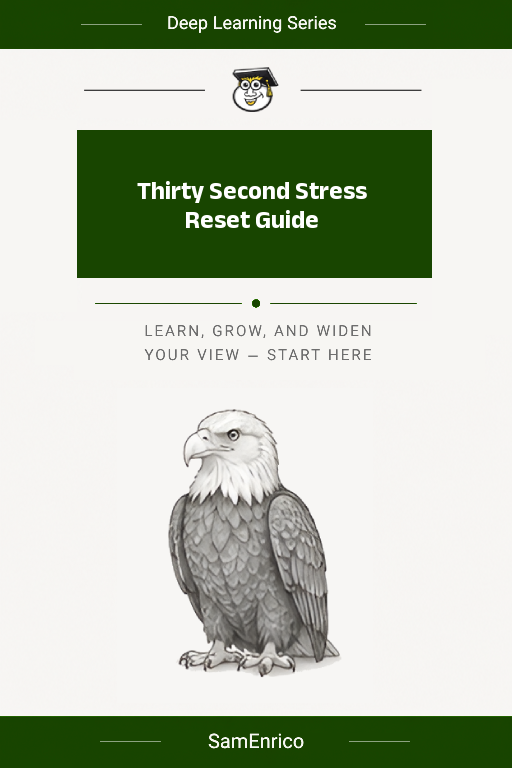
Non-FictionMental WealthStress Physiology
Thirty Second Stress Reset Guide eBook
Learn rapid micro-break techniques that calm your
by Glynn German
Learn rapid micro-break techniques that calm your vagus nerve and lower cortisol in under one minute anywhere.
Formats
Free sample
Chapter 1: The Traffic Light Inside--–- You are about to learn something that most people never discover: your stress has a secret language. It speaks not through thoughts or worries, but through physical signals your body has been sending all along. You have felt them thousands of times. A tightness in your chest before a difficult conversation. A knot in your stomach when you check email.
A sudden urge to snap at someone you love for no good reason. A fog that descends on your brain at 2:00 PM making simple decisions feel impossible.These signals are not random. They are not weakness. They are not something to push through with more caffeine or discipline.They are data.And once you learn to read them, you can change them in thirty seconds or less.This chapter is your field guide to the internal map of stress. By the time you finish reading, you will never again wonder why you feel the way you do.
You will know exactly which zone you are in, what your body is trying to tell you, and why thirty seconds is the perfect window to intercept stress before it steals your afternoon, your evening, or your sleep.The Lie You Have Been Told For decades, the self-help industry sold you a beautiful lie. The lie said that stress management requires time, space, silence, candles, apps, retreats, journals, and the ability to sit still for twenty minutes while your mind races through tomorrow's to-do list.The lie said you were failing because you weren't trying hard enough.The truth is simpler and more forgiving. Traditional stress management fails busy people not because it is ineffective, but because it is inaccessible in the moment of need. By the time you could sit for twenty minutes, the stress cascade has already done its damage. Your cortisol has spiked.
Your heart rate has accelerated. Your digestion has shut down. Your immune system has been suppressed for the next several hours.The research is stark. A single stressful email can elevate cortisol for sixty to ninety minutes. A traffic jam on the way to work can dysregulate your nervous system for four hours.
An argument with your partner before leaving the house can impair your cognitive performance until lunch.And what do most stress management programs suggest you do about this?Meditate. Take a yoga class. Go for a long walk. Schedule a therapy session.All of these are wonderful practices. I recommend them.
But they are like suggesting someone learn to swim while they are actively drowning. They address the problem too late, in the wrong location, with the wrong tool.This book exists because the gap between "stress happens" and "you can do something about it" has been catastrophically wide. That gap is where burnout lives. That gap is where marriages fray. That gap is where sleep disappears and anxiety takes root.The thirty-second reset closes that gap.The Micro-Stress Problem Let me introduce you to a concept that will change how you see your daily experience.
I call it the Micro-Stress Problem.We tend to think of stress as a big event. A divorce. A job loss. A health crisis. A death in the family.
These are major stressors, and they absolutely matter. But they are not what drives most modern burnout.What drives burnout is the thousand small cuts.An email from your boss that says "we need to talk." A notification from your child's school. A text from a friend that ends without a period, leaving you wondering if they are angry. A deadline that moved up by two days. A meeting that could have been an email.
A passive-aggressive comment in a team chat. The sixteenth news alert about something you cannot control. The car that cuts you off. The line at the grocery store. The phone battery at 4%.
The Wi-Fi that drops during a video call.Each of these micro-stressors lasts only a few seconds. Each one triggers a tiny spike in cortisol and a brief activation of your sympathetic nervous system. And each one, by itself, is harmless. Your body is designed to handle acute stress. It is good at it.
A tiger jumps out, you run, the tiger is gone, you recover.The problem is that modern life has replaced the tiger with a thousand pings.Your nervous system cannot tell the difference between a tiger and a rude email. Biologically, the response is identical. The only difference is that the tiger is gone in sixty seconds, while the rude email is followed by another email, then a notification, then an alert, then a headline, then a reminder.The cascade never stops.So your nervous system stays in a low-grade, simmering state of yellow alert. Not full panic, but never full rest. You are not running from a tiger, but you are also not digesting your food properly.
You are not in danger, but you are also not sleeping deeply. You are not under attack, but you are also not feeling safe enough to laugh, connect, or create.This is the Micro-Stress Problem. And it is why thirty-second resets are not a nice-to-have luxury. They are a biological necessity for anyone living in the twenty-first century.The Three Zones You Need to Know To solve the Micro-Stress Problem, you first need a map. Not a complicated neuroscience textbook map with Latin names and confusing pathways.
A simple, color-coded map that you can access in one second, anywhere, without thinking.I call this the Three Zones framework. You will use it for the rest of your life.Green Zone: Safe and Social Green Zone is where you want to spend most of your time. This does not mean you are happy or excited. It means your nervous system has determined that the environment is safe, and therefore it can allocate energy toward growth, connection, digestion, immunity, and rest.When you are in Green Zone, you feel calm but not sedated. You are present.
You can focus. You can listen to someone without planning what to say next. You can eat a meal and actually digest it. You can fall asleep without racing thoughts. You can laugh genuinely.
You can handle frustration without losing your temper.The official name for Green Zone is the ventral vagal state. But you do not need to remember that. Just think of a traffic light. Green means go. Go toward connection.
Go toward creativity. Go toward calm.Yellow Zone: Fight or Flight Yellow Zone is where most chronically stressed people live. It is not full panic. It is not a crisis. It is a persistent, low-grade activation of the sympathetic nervous system.
Your body believes there might be a tiger around the corner, so it keeps one foot on the gas pedal at all times.When you are in Yellow Zone, you feel on edge. Small annoyances feel like major threats. Your heart rate is elevated. Your breathing is shallow. Your jaw might be clenched without you noticing.
Your shoulders are creeping toward your ears. You are impatient. You interrupt people. You check your phone compulsively. You cannot sit still.
You feel busy but not productive.The most deceptive thing about Yellow Zone is that it can feel normal. If you…
This is the end of the free sample. Get the eBook to keep going. Buy now
About this book
Details
- Author
- Glynn German
- Publisher
- SamEnrico
- Language
- English
- Genre
- Non-Fiction, Mental Wealth, Stress Physiology
- Released
- 2026-06-01
- Pages (approx.)
- 139
- Available as
- eBook, Audiobook

Read better in the ZLOADR app
Your eBooks on your phone or tablet. Sign in with your SamEnrico account and start reading.
More by Glynn German
 Slave Trade British RoleGlynn German$11.99
 Bryan Stevenson Hinton DefenseGlynn German$11.99
 The Safety Stock Formula GuideGlynn German$11.99
 Reconstruction of ExecutionsGlynn German$11.99
 Social Security for Stay at HomeGlynn German$11.99
 Memory Palace For EconomicsGlynn German$11.99
 Digital Dream Journal Apps GuideGlynn German$11.99
 Pomodoro for ChefsGlynn German$11.99
 The Sweet Deception: How the Sugar Lobby Shaped Global Health PoliciesGlynn German$11.99
 The Opium Bankers: How Hong Kong’s First Financial Scandal Fueled a Colonial Witch HuntGlynn German$11.99
 How to Start a Communication Lines Construction Business (Beginners Guide)Glynn German$11.99
 College Essay Reading Aloud TestGlynn German$12.99
You may also like
 Hong Kong Handover 1997Dunn Johnnie$11.99
 Zumba For Postnatal Recovery CourseNeal Christian$11.99
 Zumba for BeginnersLadner Nikia$11.99
 YouTube Comment Mining GuideHumes Pandora$12.99
 Worry Box MeditationCarlin Rudy$11.99
 Workplace Stress MeditationNguyen Lynn$11.99
 Workplace Stress and Sleep RepairHawley Ivory$11.99
 Workplace Perfectionism CureDelaney Jeffry$11.99
 Workplace Injustice Anger GuideWallen Isabelle$11.99
 Work Addiction and Burnout LinkGreenwood Ester$11.99
 Women in Yoga and WellnessBeattie Galina$11.99
 Women in Stand Up ComedyChun Evangeline$11.99