
Non-FictionCrisis ManagementSupply Chain
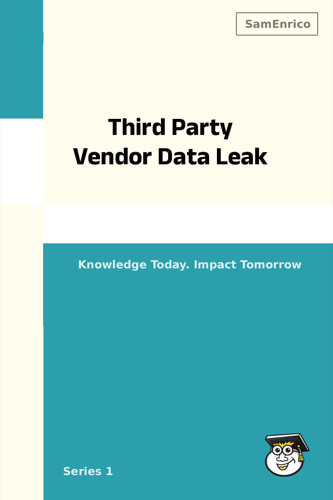
Third Party Vendor Data Leak eBook
Notifies customers of breach via partner.
by Ennis Lily
Notifies customers of breach via partner.
Formats
Free sample
Chapter 1: The Broken Link...--–- It begins the way most disasters do: not with a bang, but with an email. The subject line is innocuous—"Security Update"—or perhaps it arrives as a Slack message from a vendor relationship manager you have spoken with twice in three years. The timestamp is 11:47 PM on a Friday, because bad news has a theatrical preference for weekends. You open it. Your eyes catch the words "compromise," "unauthorized access," and "your data." Your heart rate doubles before your brain has fully processed the sentence.
And then you realize the most terrifying part of the message: the breach did not happen to you. It happened to someone you trusted. Someone you paid. Someone whose contract you signed without reading the indemnification clause because legal said it was "standard."This is the moment the broken link reveals itself.For decades, the architecture of corporate security rested on a simple, almost comforting metaphor: the castle and moat. Build high walls, dig a deep trench, raise the drawbridge, and nothing can touch you.
Your data lived inside the castle. Firewalls were the walls. Intrusion detection systems were the guards on the towers. Encryption was the vault in the basement. The model was imperfect but understandable.
Then something changed. The data started leaving. Not because someone stole it, but because you sent it. You gave it to payroll processors, cloud storage providers, customer support platforms, marketing analytics firms, supply chain logistics vendors, and a dozen other partners whose names you would struggle to recall without a spreadsheet. The castle remained, but the treasure was scattered across a thousand outbuildings you did not own, did not control, and barely monitored.That is the broken link.
The third party. The vendor. The partner. The subcontractor. The software-as-a-service provider whose terms of service you clicked through at 2 AM.
They hold your data now. And when they fail—not if, but when—the breach is yours.The Solar Winds Lesson: When Trust Becomes a Weapon To understand how a single vendor can bring down thousands of organizations simultaneously, one need look no further than the Solar Winds attack of 2020. It remains the most consequential supply chain cyberattack in history, not because of its technical sophistication—though it was considerable—but because of its elegant simplicity. Solar Winds sold a product called Orion, a network monitoring platform used by over 18,000 organizations, including the majority of Fortune 500 companies, all five branches of the US military, the Department of Homeland Security, and the White House. In early 2020, unknown attackers compromised Solar Winds' software build system and inserted malicious code into a routine software update.
Customers downloaded the update, believing it was legitimate. It was not. For months, the attackers moved laterally through the networks of Solar Winds' customers, stealing data, installing backdoors, and laying the groundwork for what would later be called one of the most extensive espionage campaigns ever conducted against the United States.Here is what matters for the reader of this book: Solar Winds did not have bad intentions. Solar Winds was not negligent in the way a jury might define gross recklessness. Solar Winds was a trusted vendor, and that trust was exploited.
When the breach was finally discovered and disclosed, the blame did not land exclusively on Solar Winds. It landed on every customer who had installed the compromised update. Regulators asked those customers: Why did you not have controls in place to detect a compromised vendor update? Why did you not segment your network so that a vendor's software had limited access? Why did you assume that a signed update from a trusted partner was safe?
The customers had no good answers. They had assumed the castle walls were sufficient. They had forgotten about the drawbridge.The MOVEit Catastrophe: When One Tool Breaches the World If Solar Winds was the wake-up call, the MOVEit Transfer exploit of 2023 was the fire alarm no one could ignore. MOVEit was a file transfer tool—boring, utilitarian, the kind of software that runs in the background of corporate IT without anyone thinking about it. It was used by thousands of organizations to securely share sensitive files: payroll data, healthcare records, legal documents, financial statements.
In late May 2023, a zero-day vulnerability in MOVEit was discovered and exploited by a ransomware gang calling itself CL0P. Over the following weeks, the attackers exfiltrated data from hundreds of MOVEit customers. The list of victims read like a Who's Who of the global economy: the BBC, British Airways, the US Department of Energy, the state governments of Louisiana and Oregon, the Nova Scotia government, university systems, hospital networks, pension funds, and countless private corporations.What made the MOVEit breach particularly instructive for the purposes of this book was the multiplication effect. One vulnerability. One vendor.
Hundreds of downstream breaches. Each affected organization had to conduct its own investigation, notify its own customers, file its own regulatory reports, and manage its own reputational fallout. The vendor, Progress Software (which owned MOVEit), faced scrutiny and lawsuits. But the customers faced the fines. The customers faced the class actions.
The customers faced the angry emails from individuals whose Social Security numbers had been leaked.Consider the timeline. The vulnerability was discovered and exploited in late May. Progress Software released a patch on May 31. But the attackers had already been inside some systems for days or weeks. Many customers did not know they were compromised until June or July.
Some discovered it only when the attackers publicly listed them as victims. The delay between the vendor's discovery of the breach and the customer's notification of its own affected individuals became a central legal issue in dozens of regulatory investigations. And in nearly every case, the regulator's first question was not "What did the vendor do?" but "What did you do to prevent this?"The Blast Radius: Why One Vendor Can Wound Thousands The concept of "blast radius" originated in military engineering, describing the area within which an explosion causes damage. In cybersecurity, the term has been borrowed to describe the potential spread of a single compromise. When a vendor is breached, the blast radius includes not only the vendor itself but every customer whose data the vendor holds.
And if those customers are themselves vendors to other organizations—which many are—the blast radius expands further. Third parties become fourth parties become fifth parties. The supply chain is not a chain at all; it is a web, and every strand is a potential point of failure.This book will return to the concept of blast radius repeatedly because it is the single most underappreciated dynamic in modern data protection. Security professionals spend billions of dollars protecting their own perimeters while ignoring the fact that their most sensitive data lives on servers they do not own. A 2024 industry survey found that the average organization shares data with over 1,200 third-party vendors.
Of those, fewer than 15% are subjected to any meaningful security review beyond a self-attested questionnaire. Less than 5% are audited annually. And less than 1% have contractual provisions requiring the vendor to carry insurance that would cover a breach of customer data.The math is simple and terrifying. You cannot secure 1,200…
This is the end of the free sample. Get the eBook to keep going. Buy now
About this book
Details
- Author
- Ennis Lily
- Publisher
- SamEnrico
- Language
- English
- Genre
- Non-Fiction, Crisis Management, Supply Chain
- Released
- 2026-06-09
- Pages (approx.)
- 129
- Available as
- eBook, Audiobook

Read better in the ZLOADR app
Your eBooks on your phone or tablet. Sign in with your SamEnrico account and start reading.
More by Ennis Lily
 Past Trauma Relationship Self WorthEnnis Lily$11.99
 SIBO Treatment ProtocolEnnis Lily$11.99
 Empty Fridge Full HopeEnnis Lily$11.99
 Bench Press Power ManualEnnis Lily$11.99
 The TM Instructional VideoEnnis Lily$11.99
 Security Team Alert FatigueEnnis Lily$11.99
 Stress Nightmare ReductionEnnis Lily$11.99
 Warren ChristopherEnnis Lily$11.99
 Whispers of the Emerald Serpent: The Forgotten Rebellion of the AmazonEnnis Lily$11.99
 The Last Echoes of the Stars: Decoding the Origins of Language in SpaceEnnis Lily$11.99
 Echoes of the Last Outpost: The Forgotten Story of the Thule ExpeditionEnnis Lily$11.99
 Supplier Sourcing and Quality ControlEnnis Lily$11.99
You may also like
 Hong Kong Handover 1997Dunn Johnnie$11.99
 Zumba For Postnatal Recovery CourseNeal Christian$11.99
 Zumba for BeginnersLadner Nikia$11.99
 YouTube Comment Mining GuideHumes Pandora$12.99
 Worry Box MeditationCarlin Rudy$11.99
 Workplace Stress MeditationNguyen Lynn$11.99
 Workplace Stress and Sleep RepairHawley Ivory$11.99
 Workplace Perfectionism CureDelaney Jeffry$11.99
 Workplace Injustice Anger GuideWallen Isabelle$11.99
 Work Addiction and Burnout LinkGreenwood Ester$11.99
 Women in Yoga and WellnessBeattie Galina$11.99
 Women in Stand Up ComedyChun Evangeline$11.99