
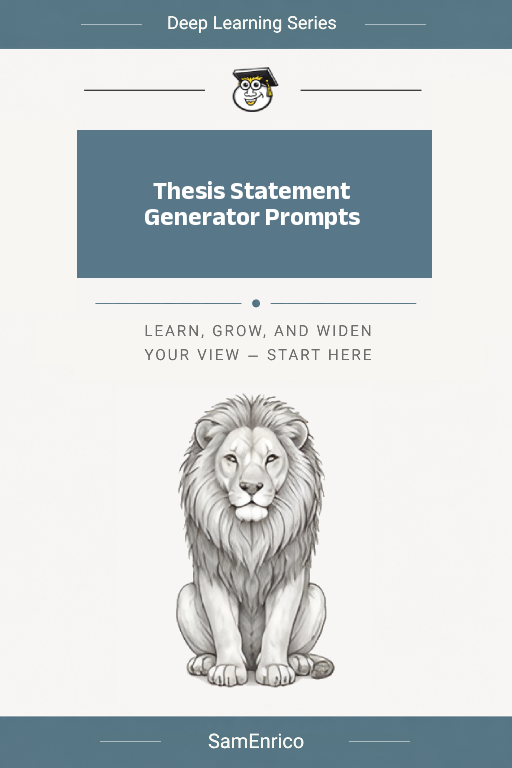
Thesis Statement Generator Prompts eBook
Formulate arguable thesis statements using GPT pro
Formulate arguable thesis statements using GPT prompts that test different claims, refining your main argument before outlining the essay.
Formats
Free sample
Chapter 1: The Empty Page--The cursor blinks on a white screen. It has been blinking for forty-seven minutes.You have a deadline. You have sources. You have opinions, vaguely formed, floating somewhere between your coffee mug and the stack of highlighted articles you printed but haven't fully read. What you do not have is a thesis.
Not a real one. Not one that could survive a conversation with a skeptical professor, let alone a room full of peers who might disagree with you.So you do what millions of students and professionals have done since 2022. You open a new tab. You navigate to Chat GPT. You type the words that feel like a lifeline: "Give me a thesis statement about [your topic]."And the AI obliges.
Within seconds, sentences appear. They are grammatically perfect. They are logically structured. They are, to your exhausted eyes, beautiful."Climate change is a critical issue that requires immediate action from governments, corporations, and individuals to mitigate its devastating effects on the planet."You copy it. You paste it into your document.
The cursor stops blinking because you have filled the space. The empty page is no longer empty. You exhale.You have just made a mistake that will cost you weeks of unnecessary work, a lower grade than you deserve, and the opportunity to actually learn something. You have asked an averaging engine for an opinion. You have received a consensus.
And you have mistaken the absence of error for the presence of insight.This chapter is about why that mistake is so seductive, why it is so destructive, and what you need to understand about the nature of arguable claims before you write another word.The Seduction of the Safe Statement Let us look closely at the thesis statement the AI produced. "Climate change is a critical issue that requires immediate action from governments, corporations, and individuals to mitigate its devastating effects on the planet."Who disagrees with this sentence? Not a single person in any academic or professional context you will ever encounter. Climate change deniers exist, but they are not your audience. Your professor is not a climate change denier.
Your classmates are not climate change deniers. The journals you hope to publish in do not publish climate change denial. You have written a sentence that everyone already accepts.This is not a thesis. It is a public service announcement. It belongs on a bumper sticker, not at the top of a research paper.
An essay built around this sentence has nowhere to go. Every paragraph will simply repeat the claim in different words: *"Climate change is bad." *"We should do something about it." *"Here is another reason why it matters." * There is no tension. No conflict. No reason to read past the first page.And yet, the AI gave you this sentence because you asked for it. The AI is not malicious.
It is not lazy. It is doing exactly what you requested: generating a thesis statement about your topic. The problem is not the AI's output. The problem is your request. You asked for a statement.
You should have asked for an argument.The Fundamental Confusion: Statement vs. Argument This distinction is the single most important concept in this book. If you remember nothing else, remember this: a statement reports. An argument disputes.A statement can be true or false. "The sky is blue" is a statement.
It is true on a clear day. It requires no defense because no reasonable person would fight it. An argument takes a position that someone could reasonably oppose. "The sky appears blue due to Rayleigh scattering, but this optical effect should not be used as evidence of atmospheric stability in climate models" is an argument. It is specific.
It is contestable. It connects a phenomenon to a larger claim.Here is the confusion that traps most writers: they believe that a strong thesis is simply a true thesis. So they write statements that are undeniably correct. And then they wonder why their papers receive comments like *"So what?" * and "This is obvious" and "Where is your argument?"A true thesis is not necessarily a strong thesis. In fact, the truer your thesis, the weaker it may be as an argument.
If everyone agrees with you before you open your mouth, you have nothing to say. The purpose of academic and professional writing is not to confirm what we already know. It is to question, to complicate, to reframe, to discover. A thesis that begins with consensus ends with boredom.The AI gave you a consensus statement because consensus is what you asked for. You did not ask it to find something worth arguing about.
You asked it to find something that looked like a thesis. And the most common pattern in its training data is the safe, uncontroversial, committee-approved sentence that nobody will challenge because nobody can.The Three Signs of a Counterfeit Thesis How do you know if your thesis is counterfeit — a statement disguised as an argument? Look for these three signs.Sign One: Universal Quantifiers. Words like *"all," *"every," *"always," *"never," * "no one." * These words are the fingerprints of a statement that cannot be defended because it cannot be true. "Social media always harms teen mental health" is not arguable.
It is false. A single study showing any benefit disproves it. A strong thesis uses qualifiers like *"often," *"in some contexts," *"under certain conditions." * But be careful. Adding qualifiers does not automatically create an argument. It only makes your statement more honest.Sign Two: Value Judgments Without Criteria.
Words like *"good," *"bad," *"important," * "significant," *"effective." * These words are empty until you define the measure. "Exercise is good for you" is a statement about biology, but it is not an argument because no one disputes it. "Exercise is more effective than medication for treating mild depression in adolescents under the specific condition of parental involvement" is moving toward an argument because it names a comparison, a population, and a condition.Sign Three: The Polite Consensus. This is the most dangerous sign because it looks responsible. The polite consensus thesis acknowledges multiple perspectives before settling on a harmless middle ground.
*"While there are valid concerns about screen time, social media also offers benefits for teen socialization, and a balanced approach is best." * This sentence has successfully avoided saying anything at all. It is the written equivalent of a shrug. It is not arguable because it takes no position. It simply observes that the world is complicated, which everyone already knows.If your thesis exhibits any of these three signs, you do not have a thesis. You have a placeholder.
And you have just saved yourself weeks of wasted effort by catching it now, before you wrote forty pages around it.The Cost of a Counterfeit Thesis Let us calculate the real cost of writing an essay around a counterfeit thesis. We will use conservative estimates.The average college research paper requires twenty to thirty sources. Finding, reading, and taking notes on those sources takes about thirty hours. Outlining takes five hours. Drafting takes twenty hours.
Revising takes ten hours. Total: sixty-five hours.Now imagine you complete all sixty-five hours of work on a counterfeit thesis —…
This is the end of the free sample. Get the eBook to keep going. Buy now
About this book
Details
- Author
- Cabrera Nella
- Publisher
- SamEnrico
- Language
- English
- Genre
- Non-Fiction, Student's Shortcut
- Released
- 2026-06-01
- Pages (approx.)
- 147
- Available as
- eBook, Audiobook

Read better in the ZLOADR app
Your eBooks on your phone or tablet. Sign in with your SamEnrico account and start reading.
More by Cabrera Nella
 Sleep Memory For ProfessionalsCabrera Nella$11.99
 Name Memory for Religious LeadersCabrera Nella$11.99
 Martina McBride Independence DayCabrera Nella$11.99
 Elvis Presley Memphis FlashCabrera Nella$11.99
 The Check-In HabitCabrera Nella$11.99
 B2B Software Renewal TriggersCabrera Nella$11.99
 Detox And DiabetesCabrera Nella$11.99
 Grief Counseling In Poor CountriesCabrera Nella$11.99
 The War of the Two Rivers: Iran-Iraq's Mechanical Inferno (1980-1988)Cabrera Nella$11.99
 The Golden Quill of Timbuktu: Pirates of the Saharan MindCabrera Nella$11.99
 UAE B2B Sales HandbookCabrera Nella$12.99
 A Collector's Handbook to the Bsa 10 HPCabrera Nella$11.99
You may also like
 LSE Online Program LengthAgee Letisha$11.99
 Harvard Extension School for Working AdultsRoush Yer$11.99
 LSE Online Reading ListAshford Ludivina$11.99
 LSE Online Language RequirementsWhitten Daphine$11.99
 LSE Online Class SizeHughey Garret$11.99
 LSE Online Alumni MentorshipWild Lyla$11.99
 London School of Economics Alumni NetworkDutton Chantal$11.99
 Harvard Extension School Student SupportCantrell Christene$11.99
 Harvard Extension School Library AccessSantana Adah$11.99
 Harvard Extension School Degree CompletionBray Wyatt$11.99
 Harvard Extension School Course AuditingAbbott Craig$11.99
 Harvard Extension School Extension DiplomaNew Joane$11.99