
Non-FictionSelf-HelpTherapyDBT
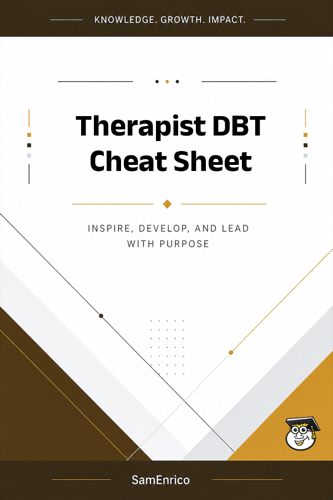
Therapist DBT Cheat Sheet
Quick reference for clinicians teaching emotion re
Quick reference for clinicians teaching emotion regulation skills.
Formats
About this book
Free sample
Chapter 1: The Biosocial Key--–- Every therapist has a moment when they realize that understanding a client’s pain is not the same as knowing what to do about it. Mine came in a supervision group during my second year of practice. A colleague presented a case: a sixteen-year-old girl who had been hospitalized four times in eight months for suicidal ideation and self-harm. The treatment team had tried CBT, motivational interviewing, family therapy, and a partial hospitalization program. Nothing worked.
The supervisor, an older psychologist who had been practicing since before DBT existed outside of Seattle, asked a simple question: “What does she say when you ask her why she cuts?”The colleague sighed. “She says she doesn’t know. Or she says she feels empty. Or she says she hates herself. It’s different every time.”The supervisor nodded and said something I have never forgotten: “Stop asking why.
Start asking what happened right before. You are looking for the sequence, not the reason.”That was my first exposure to the biosocial theory, even though I did not know the name for it yet. The shift from “why” to “what happened before” is the shift from moral judgment to behavioral analysis. It is the shift from asking a client to explain their pain (which they cannot do, because pain is not rational) to asking them to describe it (which they can do, because description is a skill). And that shift is the entire foundation of emotion regulation.This chapter is not a dry rehearsal of academic theory.
It is a practical guide to the single most important concept in DBT: the biosocial model. Understand this, and everything else in this book will make sense. Miss this, and you will spend years teaching skills to clients who secretly believe you think they are broken. The biosocial model is the key that unlocks the shame. Without it, you are just handing out worksheets.
With it, you are offering a new story about who your client is and what they are capable of becoming.The Two-Legged Stool of Dysregulation The biosocial model…
This is the end of the free sample. Get the eBook to keep going. Buy now
Contents
- Chapter 1
- Chapter 2
- Chapter 3
- Chapter 4
- Chapter 5
- Chapter 6
- Chapter 7
- Chapter 8
- Chapter 9
- Chapter 10
- Chapter 11
- Chapter 12
Details
- Author
- Larsen Marissa
- Publisher
- SamEnrico
- Language
- English
- Genre
- Non-Fiction, Self-Help, Therapy, DBT
- Released
- 2026-06-07
- Pages (approx.)
- 158
- Available as
- eBook, Audiobook

Read better in the ZLOADR app
Your eBooks on your phone or tablet. Sign in with your SamEnrico account and start reading.
More by Larsen Marissa
 The IBS Bloating GuideLarsen Marissa$11.99
 The Listening In Love GuideLarsen Marissa$11.99
 Anger as Alarm System CourseLarsen Marissa$11.99
 The James Watson DNA HelixLarsen Marissa$11.99
 The Battle for Benin Bronzes: Africa's Fight to Reclaim Its Stolen HeritageLarsen Marissa$11.99
 Pro Paint SpecialistLarsen Marissa$11.99
 Payment Delay Busters GuideLarsen Marissa$12.99
 OAPI vs ARIPO GuideLarsen Marissa$12.99
 Understanding Thies–reis SyndromeLarsen Marissa$17.99
 How to Become a Plate FinisherLarsen Marissa$11.99
You may also like
 Hong Kong Handover 1997Dunn Johnnie$11.99
 Zumba For Postnatal Recovery CourseNeal Christian$11.99
 Zumba for BeginnersLadner Nikia$11.99
 YouTube Comment Mining GuideHumes Pandora$12.99
 Worry Box MeditationCarlin Rudy$11.99
 Workplace Stress MeditationNguyen Lynn$11.99
 Workplace Stress and Sleep RepairHawley Ivory$11.99
 Workplace Perfectionism CureDelaney Jeffry$11.99
 Workplace Injustice Anger GuideWallen Isabelle$11.99
 Work Addiction and Burnout LinkGreenwood Ester$11.99
 Women in Yoga and WellnessBeattie Galina$11.99
 Women in Stand Up ComedyChun Evangeline$11.99