
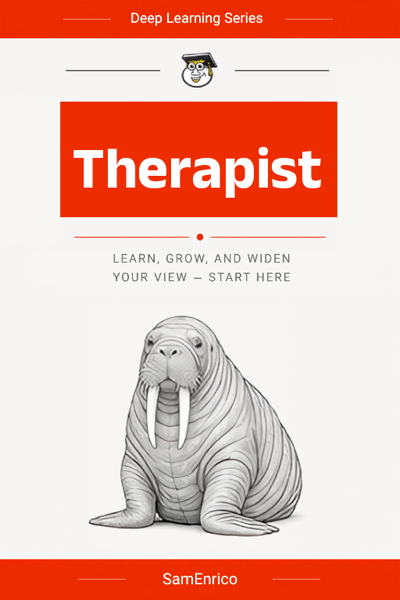
Therapist
A Coursebook on Therapist
by Mahon Liza
A Coursebook on Therapist
Formats
About this book
Free sample
Chapter 1: The Unspoken Ingredient--I still remember the knot in my stomach during my first week of practicum. I had memorized the DSM criteria for major depressive disorder, practiced the cognitive triangle until I could recite it in my sleep, and rehearsed open-ended questions like a script. I was technically prepared. And then my first client sat down, looked at me with exhausted eyes, and said, "I don't know why I'm here. Nothing helps." Every textbook answer I had rehearsed evaporated.
I sat there, terrified, and did the only thing that made sense: I stayed. I didn't intervene. I didn't diagnose. I just nodded and said, "That sounds unbearably heavy." She cried for twenty minutes. At the end, she said, "Thank you for not trying to fix me." That session taught me what three years of graduate school had not: the relationship is not a soft skill.
It is the entire medicine.The Myth That Keeps Therapists Stuck For decades, the mental health field has operated under a seductive illusion. The illusion says that therapeutic success comes from mastering the right technique, applying the correct intervention, and following the evidence-based protocol with fidelity. If a client does not improve, the reasoning goes, the therapist must have applied the technique incorrectly or chosen the wrong manual. This illusion has produced generations of highly trained clinicians who can recite cognitive distortions, name attachment styles, and administer standardized assessments—yet still feel secretly inadequate when a client does not get better.The problem is not the techniques. The problem is the belief that techniques work in isolation.Here is the truth that the most effective therapists learn, often through painful experience: the therapeutic alliance predicts treatment outcomes more powerfully than any specific modality.
Not more than some modalities. More than any modality. A client's sense of being understood, accepted, and genuinely accompanied predicts whether they will improve—regardless of whether the therapist is using CBT, psychodynamic therapy, EMDR, or person-centered approaches. This finding has been replicated across hundreds of studies, thousands of clients, and dozens of diagnoses. It is one of the most robust findings…
This is the end of the free sample. Get the eBook to keep going. Buy now
Contents
- Chapter 1
- Chapter 2
- Chapter 3
- Chapter 4
- Chapter 5
- Chapter 6
- Chapter 7
- Chapter 8
- Chapter 9
- Chapter 10
- Chapter 11
- Chapter 12
Details
- Author
- Mahon Liza
- Publisher
- SamEnrico
- Language
- English
- Genre
- Non-Fiction, Informative, Educational
- Released
- 2026-05-04
- Pages (approx.)
- 158
- Available as
- eBook, Audiobook

Read better in the ZLOADR app
Your eBooks on your phone or tablet. Sign in with your SamEnrico account and start reading.
More by Mahon Liza
 Forgiving Yourself For Poor ChoicesMahon Liza$11.99
 Loving Kindness For InfertilityMahon Liza$11.99
 The Gambler Financial Recovery PlanMahon Liza$11.99
 The Empathetic Listening HandbookMahon Liza$11.99
 The Apalachin Summit: How a Small-Town Raid Exposed the Global MafiaMahon Liza$11.99
 Understanding Southwestern Athabaskan Genetic DiseasesMahon Liza$17.99
 Price Increase ImplementationMahon Liza$12.99
 HARO vs Other PR PlatformsMahon Liza$12.99
 How to Start a Acoustical Engineering Business (Beginners Guide)Mahon Liza$11.99