
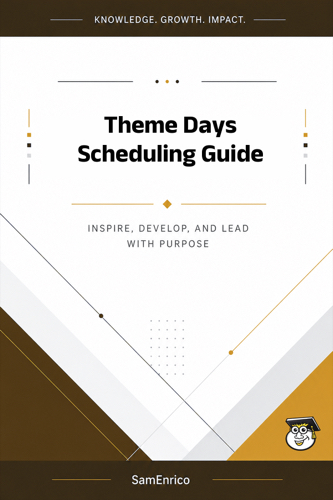
Non-FictionSelf-HelpTheme Days
Theme Days Scheduling Guide eBook
Assign entire days to specific types of work using
Assign entire days to specific types of work using this strategic time blocking approach.
Formats
Free sample
Chapter 1: The Biology of Batched Work...--–- Your email chimes. You glance at it, answer quickly, then return to your report. Three minutes later, your Slack pings. You respond, then jump back to the report. A colleague stops by your desk with a “quick question.” You answer, then stare at the report, trying to remember where you left off.
This cycle repeats forty, fifty, sixty times a day. And you feel exhausted, yet somehow unproductive.You are not lazy. You are not undisciplined. You are fighting a biological losing battle.The modern workplace has trained you to believe that multitasking is a skill to be cultivated, that the ability to juggle multiple projects simultaneously is a mark of high performance. This belief is not just wrong—it is neurologically destructive.
The human brain was never designed to do what we ask of it every single day. Understanding why this is true is the first step toward fixing your week.This chapter lays the biological foundation for everything that follows. By the time you finish reading, you will understand why context switching is so expensive, why your brain craves batching, and why Theme Days are not merely a productivity hack but a structural intervention that aligns with how your brain actually functions. You will also complete a simple diagnostic exercise that will shock you with its honesty.The Myth of the Multitasking Brain Let us begin with a fundamental truth: The human brain cannot multitask. Not really.What people call multitasking is actually rapid sequential task-switching.
When you believe you are writing an email and listening to a colleague simultaneously, your brain is not processing both inputs at once. Instead, it is rapidly toggling attention between the two streams—email, colleague, email, colleague—at a speed that creates the illusion of simultaneity. But the illusion has a cost.Cognitive neuroscientists have studied this phenomenon extensively using functional magnetic resonance imaging (f MRI). When you focus on a single task, your brain activates a specific network of regions: the prefrontal cortex (for decision-making), the parietal lobe (for attention), and the anterior cingulate cortex (for error monitoring). This network works smoothly and efficiently when uninterrupted.When you switch tasks, however, your brain must perform a two-step process.
First, it must disengage from Task A—a process called “goal shifting.” Second, it must activate the neural rules and context for Task B—a process called “rule activation.” Each switch takes a fraction of a second. But fractions add up. Over the course of a day, task-switching can consume 40 percent of your productive time.The most striking finding comes from a study conducted at the University of California, Irvine. Researchers observed knowledge workers in their natural environments and found that the average employee switches tasks every three minutes and five seconds. After each switch, it takes an average of twenty-three minutes and fifteen seconds to fully return to the original task.
Think about that number. Every time you check your email—just a quick glance—you lose nearly half an hour of focused attention.This is not a willpower problem. You cannot “try harder” to make your brain multitask because your brain is physically incapable of doing so. The architecture of working memory, the brain’s temporary storage system, limits you to holding between three and five discrete items at any given moment. When you switch tasks, you dump one set of items and load another.
Information is lost in the transfer. Mistakes multiply. Exhaustion accumulates.Attention Residue: The Hidden Tax The economist and productivity researcher Sophie Leroy introduced a concept that fundamentally changed how we understand task-switching: attention residue.Leroy’s experiments revealed that when you stop working on Task A to begin Task B, a portion of your attention remains stuck on Task A. You cannot fully commit to Task B because your brain is still processing the incomplete work of Task A. This residual attention lingers even when you believe you have moved on completely.In one study, Leroy asked participants to work on a complex task, interrupted them before completion, and then measured their performance on a second task.
The results were stark: participants who were interrupted performed significantly worse on the second task than those who completed the first task before moving on. Moreover, the participants themselves were unaware of their diminished performance. They felt just as focused—but the data showed otherwise.Attention residue explains why you can feel busy all day yet accomplish nothing of substance. You are present, you are working, but your cognitive resources are split. You are doing many things poorly instead of one thing well.The size of the residue depends on two factors.
First, how engaged you were with the original task. Deeply engaging work leaves a larger residue than shallow work. This is paradoxical: the more important and immersive your original task, the more it sabotages your subsequent tasks if interrupted. Second, how close you were to completion when interrupted. The Zeigarnik effect—named after Russian psychologist Bluma Zeigarnik—shows that the brain remembers incomplete tasks better than completed ones.
An unfinished task sits in your mental periphery, demanding attention until it is resolved.Taken together, these findings reveal a brutal arithmetic. If you switch tasks ten times in a day—a conservative estimate for most knowledge workers—and each switch costs twenty-three minutes of recovery time, you have lost nearly four hours. Not to the tasks themselves, but to the transitions between them. That is not productivity. That is thrashing.The 40 Percent Rule The cumulative cost of context switching has been quantified repeatedly across industries.
The most widely cited figure comes from a synthesis of research conducted for the book The Art of Getting Things Done, which analyzed dozens of workplace studies and concluded that context switching wastes up to 40 percent of a knowledge worker’s productive time.Let that number land. Forty percent. Nearly two full days out of every five-day work week are lost not to meetings, not to interruptions, not to procrastination—but to the mental friction of switching between tasks. You are already working those hours. You are sitting at your desk.
But your brain is paying a tax on every transition.This is not a theory. It is a measurable phenomenon.Software developers, whose work requires deep, sustained concentration, experience the 40 percent rule acutely. A study of programmers found that after an interruption—even a two-minute interruption—it takes an average of fifteen minutes to re-enter a state of productive flow. If a developer is interrupted four times in an afternoon, they effectively lose an entire hour of coding time. Yet their calendar shows they were “working” the whole time.The same pattern appears in creative professions.
Writers, designers, architects, and strategists all report that interruptions are more costly than the interruption itself. The pain is not the five-minute conversation or the quick email check. The pain is the twenty minutes afterward spent staring at the screen, trying to remember what you were thinking before the interruption.Even administrative and managerial roles are not immune. While these roles involve more natural task-switching, the cost remains high. A manager who switches between budget review, employee feedback, and…
This is the end of the free sample. Get the eBook to keep going. Buy now
About this book
Details
- Author
- Stanton Deidra
- Publisher
- SamEnrico
- Language
- English
- Genre
- Non-Fiction, Self-Help, Theme Days
- Released
- 2026-06-06
- Pages (approx.)
- 141
- Available as
- eBook, Audiobook

Read better in the ZLOADR app
Your eBooks on your phone or tablet. Sign in with your SamEnrico account and start reading.
More by Stanton Deidra
 James Brown Godfather SoulStanton Deidra$11.99
 Success Ownership WorkbookStanton Deidra$11.99
 Deep Work For AccountantsStanton Deidra$11.99
 Retiree Talent Migration PatternsStanton Deidra$11.99
 Writer Time Blocking GuideStanton Deidra$11.99
 The Startup Audit Prep GuideStanton Deidra$11.99
 The Great Spruce Heist: How One Tree Changed a NationStanton Deidra$11.99
 PT Master GuideStanton Deidra$11.99
 The Golden Road of Axum: Africa's Forgotten Maritime EmpireStanton Deidra$11.99
 How to Produce Pool and SPA Chlorine GeneratorsStanton Deidra$11.99
 Exploring Photography: Composition, Light & EditingStanton Deidra$11.99
 Brown Mustard: Seed HarvestingStanton Deidra$11.99
You may also like
 Hong Kong Handover 1997Dunn Johnnie$11.99
 Zumba For Postnatal Recovery CourseNeal Christian$11.99
 Zumba for BeginnersLadner Nikia$11.99
 YouTube Comment Mining GuideHumes Pandora$12.99
 Worry Box MeditationCarlin Rudy$11.99
 Workplace Stress MeditationNguyen Lynn$11.99
 Workplace Stress and Sleep RepairHawley Ivory$11.99
 Workplace Perfectionism CureDelaney Jeffry$11.99
 Workplace Injustice Anger GuideWallen Isabelle$11.99
 Work Addiction and Burnout LinkGreenwood Ester$11.99
 Women in Yoga and WellnessBeattie Galina$11.99
 Women in Stand Up ComedyChun Evangeline$11.99