
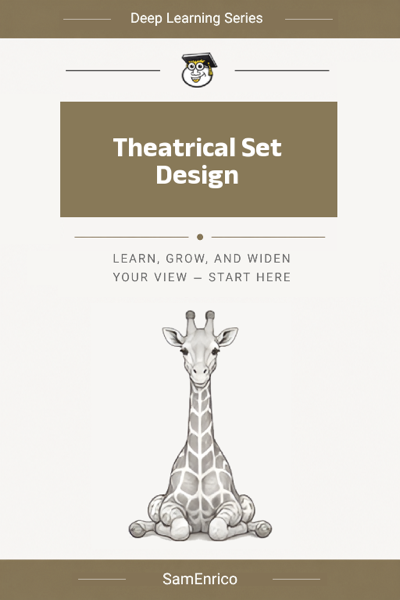
Non-FictionInformativeEducational
Theatrical Set Design eBook
A Coursebook on Theatrical Set Design
A Coursebook on Theatrical Set Design
Formats
Free sample
Chapter 1: The Great Lie--–- You have been told a lie about what set designers actually do.Not a small lie. Not a harmless misunderstanding. A career-wrecking, soul-crushing, production-derailing lie that has caused more talented artists to fail than lack of skill, bad grades, or even poverty.The lie is this: Set design is about making things look beautiful.Walk into any high school theater program. Flip through the portfolio of a well-meaning undergraduate. Scroll through Pinterest boards labeled “set design inspiration.” What do you see?
Pretty rooms. Elegant furniture. Stunning color palettes. Victorian parlors that look like they belong in a magazine. Forest scenes that could be postcards.And every single one of them is dead on arrival.Because a beautiful set that doesn't tell a story isn't set design.
It's interior decoration. And interior decoration has never made an audience gasp, weep, or leap to their feet.This chapter is going to dismantle that lie, brick by brick, and replace it with something far more useful: a functional definition of what set designers actually do, the seven jobs your set performs before an actor says a single word, and the concept that will separate your work from every amateur who ever picked up a scale ruler.You are not a decorator. You are a visual dramaturg.Let me tell you what that means.The Funeral That Changed Everything In 1983, a young designer named Ming Cho Lee was asked to design a production of The Tempest at the Public Theater in New York. The director wanted a beautiful island. Palm trees.
Sandy beaches. A paradise.Lee said no.Instead, he built a set that looked like a shipwreck—broken timbers, rusted chains, torn sails hanging at unnatural angles. It was ugly. It was uncomfortable. It looked like something had gone terribly wrong.On opening night, an audience member came backstage after the show.
She wasn't crying because the play was sad. She was crying because the set had made her feel something she couldn't name. She said, “I didn't know an island could feel like grief.”That is the difference between a decorator and a designer.A decorator asks: Does this look good?A designer asks: What does this feel like? What does this mean? What story does this tell before anyone speaks?Lee's set wasn't beautiful in any conventional sense.
It was broken, dangerous, and haunted. It was also one of the most celebrated designs in American theater history.Because he understood the great truth: The set is not the background. The set is a character.The Seven Jobs Your Set Performs (Every Single Night)Before an actor takes a breath, before the lights come up, before the audience has even settled into their seats, your set is already working. Here are the seven jobs it performs, whether you intended them or not.Job One: Establish Time and Place This is the most obvious job, and the one that beginners obsess over. Where are we?
When are we? Is this 1880s London or 3020 on a spaceship?But here's what beginners get wrong: they think “establishing time and place” means historical accuracy. It does not. It means immediate comprehensibility. The audience needs to know, within three seconds of the lights coming up, what world they've entered.A single object can do this faster than a room full of period-accurate furniture.
A smartphone on a table says “contemporary.” A gas lamp says “nineteenth century.” A viewscreen on the wall says “future.”The best time-and-place designs are economical. They give the audience three clues, maximum, and let their brains fill in the rest.Job Two: Reveal Character Psychology This is where design separates from decoration. Your set must tell the audience who lives here, what they want, and what's wrong with them.Consider two kitchens. Both are technically “contemporary middle-class.” But one has dirty dishes piled in the sink, a half-empty wine bottle on the counter, and a calendar that hasn't been turned in six months. The other has everything in its place, throw pillows aligned at precise angles, and a note on the refrigerator that says “TAKE OUT THE TRASH” in aggressive capital letters.The first kitchen belongs to someone depressed, or overwhelmed, or grieving.
The second belongs to someone controlling, or anxious, or angry.Same time. Same place. Radically different characters.The set reveals psychology through accumulated choices. Every object, every texture, every color is a vote for who this person is.Job Three: Create Mood and Atmosphere Mood is not the same as psychology. Mood is what the audience feels.
Psychology is what the character feels. Sometimes they align. Often, they clash brilliantly.A character who feels nothing while standing in a room that feels haunted is a character we immediately distrust. A character who feels terrified in a room that feels safe is a character we immediately pity.Mood is created through the elements of design—line, shape, color, texture—organized by the principles of design—focus, balance, proportion, rhythm, unity. (We will spend all of Chapter 2 and Chapter 3 on these, so don't worry if those terms feel abstract right now.)For now, understand this: mood is not “happy” or “sad.” Mood is specific.
A room can feel abandoned. Or threatening. Or hopeful. Or nostalgic. Or lonely.
Or expectant.Your job is to choose the specific mood the scene requires and build it into every surface.Job Four: Facilitate Actor Movement This is the job that beginners forget, and professional designers never stop thinking about.Your set is not a painting. It is not a photograph. It is a gymnasium where actors will run, fall, dance, fight, embrace, and die.Every platform you build, every staircase you design, every piece of furniture you place is a surface an actor will use. If a platform wobbles, an actor gets hurt. If a staircase is too steep, an actor trips.
If a hallway is too narrow, an actor cannot turn around.(This is not hyperbole. I have seen an actor fall off a poorly designed platform and break her wrist. I have seen a staircase so steep that the actor playing Hamlet had to descend backward, destroying the tension of his “To be or not to be” soliloquy. I have seen a hallway so narrow that two actors could not pass each other, forcing the director to re-block an entire scene.)Facilitating movement means knowing circulation paths—the routes actors will take across the stage. It means understanding that a romantic embrace requires three feet of clear space, a sword fight requires eight feet, and a death fall requires a six-foot radius with no furniture.(We will spend significant time on circulation paths in Chapter 7, when we learn to draft ground plans.
For now, just remember: every inch of your set is a stage. Treat it like one.)Job Five: Provide a Visual Metaphor This is the secret weapon of great design. The set should not just show the audience where the play takes place. It should show them what the play is about.A visual metaphor is a concrete image that represents an abstract idea. The slanted floor that represents moral instability.
The shrinking room that represents psychological entrapment. The door that never opens, representing missed opportunities.Here is the test for whether…
This is the end of the free sample. Get the eBook to keep going. Buy now
About this book
Details
- Author
- Strunk Fransisca
- Publisher
- SamEnrico
- Language
- English
- Genre
- Non-Fiction, Informative, Educational
- Released
- 2026-06-02
- Pages (approx.)
- 138
- Available as
- eBook, Audiobook

Read better in the ZLOADR app
Your eBooks on your phone or tablet. Sign in with your SamEnrico account and start reading.
More by Strunk Fransisca
 The Overland AstronomerStrunk Fransisca$11.99
 Franklin Paris Training WorkbookStrunk Fransisca$11.99
 Carson Pesticide Industry Backlash GuideStrunk Fransisca$11.99
 The Caregiver Mobility Loss GuideStrunk Fransisca$11.99
 Cognitive Reserve Building HandbookStrunk Fransisca$11.99
 The Riddle of the Fenris Wolf: How Loki's Progeny Nearly Ended the GodsStrunk Fransisca$11.99
 The Great Google Glass Gamble: Innovation's Short-Sighted VisionStrunk Fransisca$11.99
 Understanding Floating-harbor SyndromeStrunk Fransisca$17.99
 A Beginners Guide to Button Men (Volume 1)Strunk Fransisca$11.99
 Customer Impact MetricsStrunk Fransisca$12.99
 Three City Fundraising HandbookStrunk Fransisca$12.99
You may also like
 Hong Kong Handover 1997Dunn Johnnie$11.99
 Zumba For Postnatal Recovery CourseNeal Christian$11.99
 Zumba for BeginnersLadner Nikia$11.99
 YouTube Comment Mining GuideHumes Pandora$12.99
 Worry Box MeditationCarlin Rudy$11.99
 Workplace Stress MeditationNguyen Lynn$11.99
 Workplace Stress and Sleep RepairHawley Ivory$11.99
 Workplace Perfectionism CureDelaney Jeffry$11.99
 Workplace Injustice Anger GuideWallen Isabelle$11.99
 Work Addiction and Burnout LinkGreenwood Ester$11.99
 Women in Yoga and WellnessBeattie Galina$11.99
 Women in Stand Up ComedyChun Evangeline$11.99