
Non-FictionSelf-HelpEricksonian
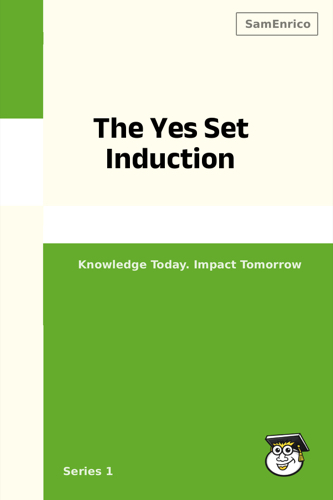
The Yes Set Induction eBook
Uses a series of undeniable truths to build agreem
Uses a series of undeniable truths to build agreement momentum before trance suggestion.
Formats
Free sample
Chapter 1: The Unseen Lever...--Every morning, before you speak your first word to another human being, you make a silent choice. You can push against the world, or you can learn to move with it. Most people spend their entire lives pushing. They argue, they explain, they persuade, they convince, they raise their voices, they repeat themselves, they wonder why smart people make dumb decisions, they blame the other person for being stubborn, unreasonable, or blind to the obvious truth. And then they push harder.
And nothing changes.This book exists because there is another way.There is a lever hidden beneath every conversation, every negotiation, every sales pitch, every request, every attempt to lead, teach, heal, or influence. Most people never see it. They push against the door when the lever would have opened it effortlessly. The lever is not manipulation. It is not trickery.
It is not hypnosis in the way you have seen it on television, with swinging watches and stage performers making people bark like dogs. The lever is simpler, more elegant, and far more useful in real life. It is the mechanical advantage of agreement.Before you learn how to use this lever, you must understand why it works. And before you understand why it works, you must face an uncomfortable truth about the human brain.The Illusion of Rationality You like to believe that you make decisions based on logic, evidence, and careful reasoning. You like to believe that when someone presents you with a good argument, you say yes because the argument is good, and when someone presents you with a bad argument, you say no because the argument is bad.
This belief is comforting. It is also largely false.The human brain is not a supercomputer processing data toward optimal outcomes. It is a pattern-matching organ designed for survival on the African savanna. It is fast, efficient, and deeply irrational in ways that are predictable, systematic, and exploitable. Not exploitable in the sense of manipulation, but exploitable in the sense of understanding.
Once you understand how the brain actually works, you can structure your communication to work with the brain's natural processes rather than against them.One of the most reliable and powerful patterns in the human brain is called the consistency principle.The Consistency Principle Psychologists have known for decades that human beings have a deep, almost desperate need to appear consistent to themselves and to others. Once you take a position, state a belief, or make a commitment, your brain will work tirelessly to justify that position, defend that belief, and honor that commitment. This is not a sign of weakness or stupidity. It is a feature of a brain that needs to navigate a complex world without recalculating every decision from scratch.Consider this experiment from the research of Robert Cialdini, one of the most cited social psychologists in the world. Researchers went door to door in a neighborhood and asked residents if they would allow a large, unsightly billboard with the words "DRIVE CAREFULLY" to be placed on their front lawns.
Only 17 percent agreed. That is not surprising. Most people do not want ugly billboards on their lawns.But in a nearby neighborhood, the researchers tried a different approach. First, they asked residents if they would display a small, three-inch square sticker that said "BE A SAFE DRIVER" in their front windows. Nearly everyone agreed.
It was a tiny request, trivial really, and it made the residents feel good about themselves as safe, responsible drivers. Two weeks later, the researchers returned and asked the same residents if they would allow the large, ugly billboard on their lawns. This time, 76 percent agreed.What happened? The residents had taken a small action that committed them to an identity: I am the kind of person who supports safe driving. When the larger request came, saying yes was consistent with that identity.
Saying no would have required admitting that the first action was meaningless or that the identity was false. The brain chose consistency.This is the consistency principle in action. Once a person agrees to something small, their brain creates an internal pressure to continue agreeing to larger things that align with the same direction.The Yes Set Defined This book introduces a specific application of the consistency principle called the Yes Set. A Yes Set is a sequence of statements or questions structured so that the listener can only respond affirmatively. Each yes, no matter how small, builds momentum.
After three yes responses in a row, the listener's brain has entered a state of what we call agreement momentum. In this state, saying yes feels natural, easy, and even inevitable. Saying no feels jarring, inconsistent, and uncomfortable.The Yes Set does not require formal hypnosis. It does not require a trance state, a swinging watch, or any of the theatrical elements you might associate with stage hypnosis. The Yes Set works on fully conscious, alert, skeptical human beings.
In fact, it works best on analytical people who pride themselves on their rationality. They are the ones most trapped by their own need for consistency.The Yes Set Induction, the title of this book, means using Yes Sets to induce a state of heightened suggestibility. That is a clinical way of saying: you build agreement momentum, and then you make your real request. The request feels like a natural continuation of everything that came before. The listener says yes not because you pushed them, but because they have already been saying yes all along.Micro, Standard, and Extended Yes Sets Throughout this book, we will refer to three types of Yes Sets, each suited to different situations.
Understanding this taxonomy now will prevent confusion later.The Micro Yes Set uses two steps. It is designed for low-stakes situations where you need quick agreement. Example: "You are reading this book. You want to communicate better, don't you?" That is two statements, both undeniable, ending with a tag question that asks for a yes. Micro Yes Sets are useful for opening conversations, transitioning between topics, or testing the listener's receptivity.The Standard Yes Set uses three steps.
This is the core pattern of the entire book, and Chapter 3 is dedicated entirely to mastering it. The structure is simple: first pace, second pace, bridge and lead. Example: "You are holding this book. You have read this far. And you might be wondering how the rest of this chapter could change the way you communicate, isn't that true?" Three agreements, building momentum toward the lead.The Extended Yes Set uses four to seven steps.
These are for high-stakes situations like complex sales, therapeutic interventions, or negotiations where you need deep agreement before making your final request. Extended Yes Sets are covered in detail in Chapters 7 and 11.For now, you only need to remember this: a Yes Set is a sequence of statements or questions that generate agreement momentum. The longer the sequence, the stronger the momentum. But even two or three yes responses are enough to change the trajectory of a conversation.The Three End States of a Yes Set Before you build your first Yes Set, you must know what success looks like. Every…
This is the end of the free sample. Get the eBook to keep going. Buy now
About this book
Details
- Author
- Fairbanks Beatriz
- Publisher
- SamEnrico
- Language
- English
- Genre
- Non-Fiction, Self-Help, Ericksonian
- Released
- 2026-06-09
- Pages (approx.)
- 136
- Available as
- eBook, Audiobook

Read better in the ZLOADR app
Your eBooks on your phone or tablet. Sign in with your SamEnrico account and start reading.
More by Fairbanks Beatriz
 GAD Depression Comorbidity GuideFairbanks Beatriz$11.99
 Brand Health MapFairbanks Beatriz$11.99
 Khomeini Death in 1989Fairbanks Beatriz$11.99
 Eisenhower for Work Life BalanceFairbanks Beatriz$11.99
 The Blackout Prophecies: The 1977 New York City Power Grid ParanormalFairbanks Beatriz$11.99
 Crom Dubh's Iron Spire: The Forgotten Tower of the Tuatha Dé DanannFairbanks Beatriz$11.99
 How to Become a Claims ClerkFairbanks Beatriz$11.99
 Open Source Artificial Intelligence OutlookFairbanks Beatriz$12.99
 African Applicant Scholarship ManualFairbanks Beatriz$12.99
 Video Game TesterFairbanks Beatriz$11.99
 Understanding Hairy Palms and SolesFairbanks Beatriz$17.99
You may also like
 Hong Kong Handover 1997Dunn Johnnie$11.99
 Zumba For Postnatal Recovery CourseNeal Christian$11.99
 Zumba for BeginnersLadner Nikia$11.99
 YouTube Comment Mining GuideHumes Pandora$12.99
 Worry Box MeditationCarlin Rudy$11.99
 Workplace Stress MeditationNguyen Lynn$11.99
 Workplace Stress and Sleep RepairHawley Ivory$11.99
 Workplace Perfectionism CureDelaney Jeffry$11.99
 Workplace Injustice Anger GuideWallen Isabelle$11.99
 Work Addiction and Burnout LinkGreenwood Ester$11.99
 Women in Yoga and WellnessBeattie Galina$11.99
 Women in Stand Up ComedyChun Evangeline$11.99