
Non-FictionHealth & WellnessAnxiety
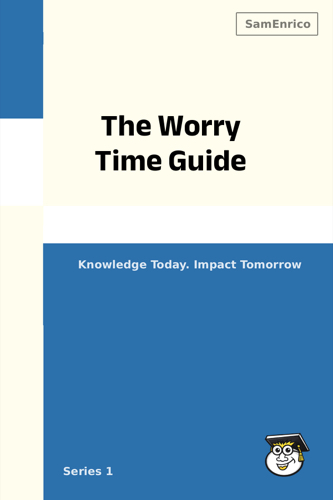
The Worry Time Guide eBook
Schedules anxiety earlier in day to reduce bedtime
by Chen Ilda
Schedules anxiety earlier in day to reduce bedtime rumination.
Formats
Free sample
Chapter 1: The Midnight Prosecutor--–- You are not a bad person for worrying at 3 a.m. You are a person whose brain is doing exactly what evolution designed it to do—at exactly the wrong time.The bedroom is dark. The house is silent. Your partner is breathing softly beside you, or perhaps you are alone with nothing but the ceiling and the spinning reel of your thoughts. You have been here before.
Last Tuesday. Last week. Last month. The details change—a tense email you sent, a health symptom you noticed, a bill you forgot to pay, a conversation that felt off—but the architecture of the experience never changes. Your mind takes one small concern and begins to circle it like a shark.
Then it adds another concern. Then another. Soon you are not thinking about any single problem. You are thinking about all of them, simultaneously, in a rising tide of wordless dread.This is the 3 a.m. courtroom, and it is always in session.The metaphor is not accidental.
When you lie awake in the dark, your brain does something remarkable and terrible: it appoints a prosecutor, a jury, and a judge. The prosecutor works for free. It gathers every mistake you have ever made, every ambiguous text message you sent, every deadline you nearly missed, and presents them as evidence of your fundamental inadequacy. The jury—made of the same anxious neural tissue—never deliberates. It simply convicts.
And the judge, who is also you, sentences you to another hour of wakefulness, another cycle of cortisol, another morning of exhaustion.But here is what no one tells you about the 3 a.m. courtroom: it has no defense attorney. Not because you are incapable of defending yourself, but because the part of your brain that builds rational arguments—the prefrontal cortex—is half-asleep. Its blood flow is reduced. Its glucose consumption has dropped.
By midnight, your executive function is running on fumes. By 3 a.m., it has clocked out entirely.What remains is your amygdala, the brain's ancient smoke detector, and your default mode network, the system that activates whenever your mind is not focused on the outside world. The DMN is responsible for self-referential thought—thinking about yourself, your past, your future, your relationships. In anxious individuals, the DMN becomes hyperconnected at night, linking unrelated worries into a continuous, looping narrative. You worry about work, which reminds you of your health, which reminds you of your aging parents, which reminds you of your finances, which circles back to work.
The loop has no off-ramp because the off-ramp—deliberate, effortful cognitive shifting—requires the prefrontal cortex to intervene. And the prefrontal cortex is asleep.This chapter is not a pep talk. It will not tell you to "just stop worrying" or "think positive thoughts" or "trust the universe." Those strategies fail because they misunderstand the problem. The problem is not that you have worries. Everyone has worries.
The problem is that you are trying to solve those worries at a time when your brain is neurologically incapable of solving anything.The problem is that you have mistaken 3 a.m. for a reasonable hour to do cognitive work.It is not.The Evolutionary Mismatch: Why Darkness Equals Danger To understand why nighttime amplifies anxiety, you have to go back approximately 300,000 years. Your brain was not designed for email, mortgages, performance reviews, or social media. It was designed for the African savanna, where darkness meant one thing above all others: predators. Lions, leopards, hyenas, and other humans with sharp sticks.
In that environment, a brain that became more alert in the dark was a brain that survived. Hypervigilance at night was not a disorder. It was a competitive advantage.Your modern bedroom is not the savanna. There are no lions under your bed. There are no leopards in your closet.
But your amygdala—the brain's threat-detection system—does not know this. It cannot know this. Evolution moves slowly, measured in hundreds of thousands of years. Your amygdala is still running software version 1.0, designed for a world that no longer exists.Here is what happens when you lie awake at night: sensory input drops to near zero. No screens, no conversations, no ambient noise (or very little).
Your brain, starved of external stimulation, turns inward. The default mode network activates. And because the amygdala is primed for threat detection in darkness, it tags your internal thoughts as potentially dangerous. That ambiguous email from your boss is not just an email. It becomes a saber-toothed tiger.
That skipped workout is not just a missed habit. It becomes evidence that you are losing control.This is the evolutionary mismatch at its cruelest. The very mechanism that kept your ancestors alive is now keeping you awake.The research on this is robust. A 2019 study published in Nature Human Behaviour used functional MRI to scan the brains of participants who were asked to ruminate on personal worries while lying in a dark, quiet room—a direct simulation of nighttime rumination. The results showed increased connectivity between the amygdala and the default mode network, along with decreased connectivity between the prefrontal cortex and both regions.
In plain English: the fear center and the self-referential network were having a loud, unmodulated conversation while the rational brain sat silently in the corner, unable to intervene.You are not weak for worrying at night. You are not broken. You are experiencing a predictable neurological response to an evolutionary mismatch. The only surprising thing is that more people do not struggle with this.But understanding the mismatch is not enough. You also need to understand what happens after the mismatch—the cascade of physiological events that turns a single worry into a sleepless night.The Cortisol Cascade: How Rumination Becomes Biology Worry is not just a thought.
It is a biological event.When your amygdala detects a threat—even a purely cognitive threat like a worrying thought—it sends an emergency signal to your hypothalamus. Your hypothalamus activates your sympathetic nervous system (the "fight or flight" response). Your adrenal glands release cortisol and adrenaline. Your heart rate increases. Your breathing quickens.
Blood flows away from your digestive system and toward your large muscles, preparing you to run or fight.This is the cortisol cascade, and it takes approximately three seconds from trigger to full activation.Here is the problem: cortisol is the enemy of sleep. Specifically, cortisol interferes with two critical phases of the sleep cycle: REM sleep and deep slow-wave sleep.REM sleep (rapid eye movement sleep) is when your brain processes emotions. During REM, your amygdala is active, but it is now connected to your prefrontal cortex, allowing you to "reprocess" emotional memories in a safer, more integrated way. REM is essentially overnight therapy. But cortisol suppresses REM.
High cortisol levels at night mean less REM sleep, which means unprocessed emotions accumulate like unpaid bills. One bad night is manageable. Thirty bad nights create an emotional debt that affects your mood, your relationships, and your resilience.Deep slow-wave sleep is when your body physically restores itself. Growth hormone is released. Tissues repair.
Immune function strengthens. Deep sleep is measured in delta waves—slow, high-amplitude oscillations that sweep across your brain like a gentle…
This is the end of the free sample. Get the eBook to keep going. Buy now
About this book
Details
- Author
- Chen Ilda
- Publisher
- SamEnrico
- Language
- English
- Genre
- Non-Fiction, Health & Wellness, Anxiety
- Released
- 2026-06-06
- Pages (approx.)
- 158
- Available as
- eBook, Audiobook

Read better in the ZLOADR app
Your eBooks on your phone or tablet. Sign in with your SamEnrico account and start reading.
More by Chen Ilda
 Natural Sleep Sounds MeditationChen Ilda$11.99
 Young Conductor Audition SecretsChen Ilda$11.99
 Outdoor HIIT Park WorkoutChen Ilda$11.99
 Assertiveness Salary NegotiationChen Ilda$11.99
 The Timbuktu Calculators: Africa's Forgotten Mathematicians of the Golden AgeChen Ilda$11.99
 The Breeder's Guide to Gulf Coast SheepChen Ilda$11.99
 Marketplace Free to PaidChen Ilda$12.99
 Automotive Retention GuideChen Ilda$12.99
 How to Become a Package CrimperChen Ilda$11.99
 Glamour PhotographyChen Ilda$11.99
You may also like
 Hong Kong Handover 1997Dunn Johnnie$11.99
 Zumba For Postnatal Recovery CourseNeal Christian$11.99
 Zumba for BeginnersLadner Nikia$11.99
 YouTube Comment Mining GuideHumes Pandora$12.99
 Worry Box MeditationCarlin Rudy$11.99
 Workplace Stress MeditationNguyen Lynn$11.99
 Workplace Stress and Sleep RepairHawley Ivory$11.99
 Workplace Perfectionism CureDelaney Jeffry$11.99
 Workplace Injustice Anger GuideWallen Isabelle$11.99
 Work Addiction and Burnout LinkGreenwood Ester$11.99
 Women in Yoga and WellnessBeattie Galina$11.99
 Women in Stand Up ComedyChun Evangeline$11.99