
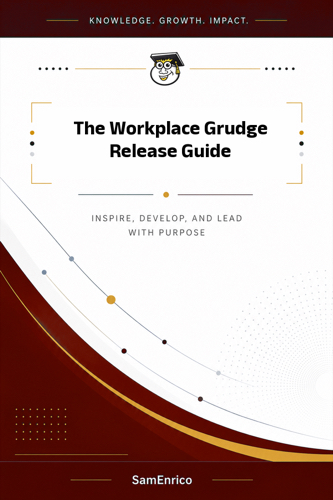
The Workplace Grudge Release Guide eBook
Forgives colleagues, bosses, or workplace injustic
Forgives colleagues, bosses, or workplace injustices.
Formats
Free sample
Chapter 1: The Weight You Carry--The alarm goes off at 6:45 AM. You’ve been awake since 4:30. Not because of coffee or a noisy neighbor, but because your brain has been running the same reel for the third straight hour. The moment in the meeting. The email that wasn’t sent to you.
The comment that landed like a dart. The promotion that went to someone else. The boss who looked through you like you were furniture. You’ve replayed it. Re-litigated it.
Re-heard every word. Re-felt every humiliation. And now it’s 6:45 AM, your jaw is clenched, your shoulders are somewhere up near your ears, and you haven’t even brushed your teeth yet.This is not a bad day. This is a pattern. And the pattern has a name.You are carrying a workplace grudge.Not the Hollywood kind where someone schemes in a dark office and dramatically quits.
Not the kind that makes for good television. The real kind. The quiet kind. The kind that lives in your chest during Monday morning stand-ups. The kind that makes you breathe differently when a certain person walks into the room.
The kind that has you rehearsing conversations in the shower that will never happen, with apologies you will never receive, from people who have probably already forgotten what they did.If you picked up this book, you already know the feeling. You might not have called it a grudge. You might have called it “being right.” You might have called it “waiting for justice.” You might have called it “professional caution” or “healthy skepticism” or “I just haven’t forgotten what kind of person they are.” But underneath all of those polite labels is the same heavy truth: you are carrying something that does not belong to you, and it is crushing you one sleepless night at a time.The problem is not that you were wronged. The problem is what you have been doing with that wrong since it happened.Most people believe a grudge is simply “being angry.” They think it’s a feeling, like sadness or excitement—something that comes and goes. That is dangerously incorrect.
Anger is an emotion. A grudge is a structure. Anger is a wave. A grudge is a dam you built to hold the wave in place. And the water behind that dam?
It’s rising. It’s seeping into the cracks. And eventually, it will either flood everything or rot the foundation from the inside.This chapter is not about forgiveness. We will get to that later, and we will do so with far more nuance than most books offer. This chapter is about something more fundamental: measurement.
You cannot release what you refuse to measure. You cannot heal a wound you will not examine. And you cannot move on from a weight you have convinced yourself you aren’t carrying.So let us begin by looking directly at the weight.The Physics of Resentment Let’s get one thing straight immediately. You did not choose to be resentful because you are weak, small, petty, or broken. You are not a bad person for holding a grudge.
You are not morally defective. You are not “less than” the person who seems to have let things go. In fact, the very opposite may be true.You are holding onto this grudge because something happened that should not have happened. Your brain, which is designed to keep you safe, has flagged that event as a threat. And because the threat has not been resolved—because there has been no apology, no accountability, no change in behavior—your brain keeps the alarm system on.
It is doing exactly what it evolved to do. The problem is that the alarm was designed for predators in the savanna, not for passive-aggressive emails in an open-plan office.This is what neuroscientists call the negativity bias. Your brain processes negative events more thoroughly than positive ones. It remembers criticism longer than praise. It catalogs threats with far more detail than it catalogs safety.
This is not a bug. It is a feature. Your ancestors who remembered exactly which berry made them sick, exactly which trail held a predator, and exactly which tribe member had betrayed them—those ancestors survived. The ones who shrugged and said “I’m sure it’s fine” did not pass on their genes.So when your boss takes credit for your work, and your brain replays that moment two hundred times, your brain is not trying to torture you. It is trying to protect you from that boss.
It is building a file labeled “Do Not Trust This Person.” The problem is that the file does not close. It stays open. It stays on your desktop, blinking, demanding attention, consuming processing power that you need for other things. The file grows. It collects new evidence.
It connects to other files. Before long, you have an entire operating system running in the background, and you have no idea how much energy it is consuming.Here is what the research actually shows about what that background process costs you.A 2017 study published in the journal Emotion found that people who reported higher levels of workplace resentment also reported significantly higher levels of cortisol, the stress hormone, even on weekends and vacations. Their bodies were still in fight-or-flight mode when they were supposed to be resting. Their sleep was lighter. Their recovery from illness was slower.
Their blood pressure was higher. And here is the cruelest part: they reported feeling the physical symptoms of stress even when they were not actively thinking about the offense. The body had learned the pattern. The body was keeping score even when the mind tried to take a break.The cognitive costs are even more striking. A study from Stanford’s Center for Compassion and Altruism Research found that rumination—the repeated replaying of a negative event—consumes roughly twenty to forty percent of working memory capacity while it is happening.
That means while you are sitting in a meeting, nodding along, a significant portion of your brain is actually back in last week’s meeting, replaying the moment you were dismissed. You are not fully present. You are not fully listening. You are not fully problem-solving. You are splitting your attention between the actual meeting and the ghost meeting that lives in your head.That is why you feel exhausted at the end of the day even when you did not do anything physically demanding.
That is why you forget small things—where you put your keys, what someone just asked you, whether you replied to that email. Your brain is running two operating systems simultaneously, and one of them is dedicated entirely to replaying something you cannot change.And then there is the career cost. This one is harder to measure but easier to feel.People who carry workplace grudges become less collaborative. Not because they are difficult people, but because collaboration requires trust, and trust requires vulnerability, and vulnerability feels dangerous when your brain is still flashing the threat warning from last time. You hold back in meetings.
You do not share ideas freely. You do not volunteer for cross-functional projects that would require working closely with the…
This is the end of the free sample. Get the eBook to keep going. Buy now
About this book
Details
- Author
- Shifflett Cleo
- Publisher
- SamEnrico
- Language
- English
- Genre
- Non-Fiction, Self-Help, Workplace
- Released
- 2026-06-07
- Pages (approx.)
- 138
- Available as
- eBook, Audiobook

Read better in the ZLOADR app
Your eBooks on your phone or tablet. Sign in with your SamEnrico account and start reading.
More by Shifflett Cleo
 Partner Grief Pregnancy Loss CourseShifflett Cleo$11.99
 The Stress Endurance AthleteShifflett Cleo$11.99
 Dual Diagnosis Urban ResourcesShifflett Cleo$11.99
 Anger Management for Agile CoachesShifflett Cleo$11.99
 The Silent Code: How a 19th-Century Gymnastics Scandal Reshaped Women's SportsShifflett Cleo$11.99
 Understanding Santavuori DiseaseShifflett Cleo$17.99
 How to Start a Circular Saws for All Materials Business (Beginners Guide)Shifflett Cleo$11.99
 Invoice Factoring US CreditShifflett Cleo$12.99
 Week Two LLC Operations SetupShifflett Cleo$12.99
 Performance Test EngineerShifflett Cleo$11.99
You may also like
 Hong Kong Handover 1997Dunn Johnnie$11.99
 Zumba For Postnatal Recovery CourseNeal Christian$11.99
 Zumba for BeginnersLadner Nikia$11.99
 YouTube Comment Mining GuideHumes Pandora$12.99
 Worry Box MeditationCarlin Rudy$11.99
 Workplace Stress MeditationNguyen Lynn$11.99
 Workplace Stress and Sleep RepairHawley Ivory$11.99
 Workplace Perfectionism CureDelaney Jeffry$11.99
 Workplace Injustice Anger GuideWallen Isabelle$11.99
 Work Addiction and Burnout LinkGreenwood Ester$11.99
 Women in Yoga and WellnessBeattie Galina$11.99
 Women in Stand Up ComedyChun Evangeline$11.99